



 Chat with AI
Exam 33: Geometric Optics

Exam 1: Units, Physical Quantities, and Vectors107 Questions
Exam 2: Motion Along a Straight Line59 Questions
Exam 3: Motion in Two or Three Dimensions50 Questions
Exam 4: Newtons Laws of Motion44 Questions
Exam 5: Applying Newtons Laws95 Questions
Exam 6: Work and Kinetic Energy54 Questions
Exam 7: Potential Energy and Energy Conservation55 Questions
Exam 8: Momentum, Impulse, and Collisions50 Questions
Exam 9: Rotation of Rigid Bodies26 Questions
Exam 10: Equilibrium and Elasticity50 Questions
Exam 11: Fluid Mechanics50 Questions
Exam 12: Gravitation50 Questions
Exam 13: Periodic Motion50 Questions
Exam 14: Mechanical Waves44 Questions
Exam 15: Sound and Hearing66 Questions
Exam 16: Temperature and Heat63 Questions
Exam 17: Thermal Properties of Matter58 Questions
Exam 18: The First Law of Thermodynamics52 Questions
Exam 19: The Second Law of Thermodynamics50 Questions
Exam 20: Electric Charge and Electric Field58 Questions
Exam 21: Gausss Law41 Questions
Exam 22: Electric Potential55 Questions
Exam 23: Capacitance and Dielectrics52 Questions
Exam 24: Current, Resistance, and Electromotive Force50 Questions
Exam 25: Direct-Current Circuits53 Questions
Exam 26: Magnetic Field and Magnetic Forces36 Questions
Exam 27: Sources of Magnetic Field51 Questions
Exam 28: Electromagnetic Induction39 Questions
Exam 29: Inductance26 Questions
Exam 30: Alternating Current49 Questions
Exam 31: Electromagnetic Waves47 Questions
Exam 32: The Nature and Propagation of Light28 Questions
Exam 33: Geometric Optics81 Questions
Exam 34: Interference33 Questions
Exam 35: Diffraction49 Questions
Exam 36: Relativity51 Questions
Exam 37: Photons: Light Waves Behaving As Particles38 Questions
Exam 38: Particles Behaving As Waves52 Questions
Exam 39: Quantum Mechanics40 Questions
Exam 40: Atomic Structure41 Questions
Exam 41: Molecules and Condensed Matter31 Questions
Exam 42: Nuclear Physics89 Questions
Exam 43: Particle Physics and Cosmology44 Questions
Select questions type


You have available lenses of focal lengths 2.0 cm, 4.0 cm, 8.0 cm, and 16.0 cm.
(a) If you were to use any two of these lenses to build a telescope, what is the maximum magnification you could achieve?
(b) If you were to use any two of these lenses to build a telescope, what is the lens separation for the maximum magnification telescope?
(Short Answer)
4.8/5  (66)
(66) In a 35.0-mm single lens reflex camera (SLR), the distance from the lens to the film is varied in order to focus on objects at varying distances. Over what distance range must a lens of 55-mm focal length vary if the camera is to be able to focus on objects ranging in distance from infinity down to 0.60 m from the camera?
(Multiple Choice)
4.9/5 (85)
(85) A person can read the newspaper when it is held at 60 cm from his eyes. What should the focal length of his contact lenses be to allow him to read the newspaper comfortably at a distance of 30 cm?
(Multiple Choice)
4.8/5 (68)
(68) How far are you from your image when you stand 0.750 m in front of a vertical plane mirror?
(Multiple Choice)
4.8/5 (84)
(84) A swimming pool is filled to a depth of 2.0 m. How deep does the pool appear to be from above the water, which has an index of refraction of 1.33?
(Multiple Choice)
4.9/5 (72)
(72) A 4.0-cm tall object is placed 50.0 cm from a diverging lens having a focal length of magnitude 25.0 cm. What are the nature and location of the image? The image is
(Multiple Choice)
4.8/5 (78)
(78) The near point of a farsighted person's uncorrected eyes is 80 cm. What power contact lens should be used to move the near point to 25 cm from this person's eyes?
(Multiple Choice)
4.9/5 (78)
(78) The focal lengths of the objective and eyepiece in a compound microscope are 0.80 cm and 2.5 cm, respectively. The image formed by the objective is 16 cm from it and the final image is 25 cm from the eye. What is the total overall magnification of the microscope?
(Multiple Choice)
4.8/5 (90)
(90) A convex spherical mirror with a radius of 50 cm has a 4.0 cm tall object placed 100 cm in front of it. What is the position of the image relative to the mirror?
(Multiple Choice)
4.7/5 (89)
(89) A 35-mm camera equipped with a 95 mm focal length lens is used to photograph a tree that is 8.0 m tall. A 32 mm high image of the tree on the film is needed. The required distance, between the tree and the camera lens, to take the photograph is closest to
(Multiple Choice)
4.9/5 (83)
(83) In the figure, the thin lens forms a real image of the object 94.0 cm from the object. What is the focal length of the lens? 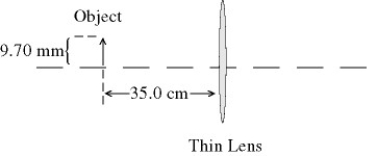
(Multiple Choice)
5.0/5 (66)
(66) A nearsighted person has her distant vision corrected using a -2.0-diopter contact lens. Her uncorrected near point is 15 cm. What is her near point using this lens if the lens is 2.0 cm from the eye?
(Multiple Choice)
5.0/5 (66)
(66) Which one of the following is a characteristic of a compound microscope?
(Multiple Choice)
4.8/5 (67)
(67) The angular magnification of a refracting telescope is 40 x. When the object and final image are both at infinity, the distance between the eyepiece and the objective is 143.5 cm. The telescope is used to view a distant radio tower. The real image of the tower, formed by the objective, is 6.0 mm in height. The focal point of the eyepiece is positioned at the real image. What is the focal length of the objective lens?
(Multiple Choice)
4.9/5 (68)
(68) An astronomical telescope has an objective of diameter 20 cm with a focal length of 180 cm. The telescope is used with an eyepiece of focal length 30 mm. What is the angular magnification of this telescope?
(Multiple Choice)
4.8/5 (93)
(93) A myopic (nearsighted) dancer wears eyeglasses that allow him to have clear distant vision. The power of the lenses of his eyeglasses is -3.00 diopters. Without eyeglasses, what is the far point of the dancer?
(Multiple Choice)
4.9/5 (82)
(82) A magnifying lens has a focal length of 10 cm. A person has a near point of 25 cm and a far point at infinity. What is the angular magnification of the lens for that person when their eyes are focused at infinity?
(Short Answer)
4.9/5 (76)
(76) A fish appears to be 2.00 m below the surface of a pond when viewed almost directly above by a fisherman. What is the actual depth of the fish? (nwater = 1.33)
(Multiple Choice)
4.8/5 (70)
(70) What is the uncorrected near point of a person who has a near point that is 25 cm from his eyes when he is wearing 3.33-diopter contact lenses?
(Multiple Choice)
4.9/5 (78)
(78) A convex lens has focal length f. If an object is located extremely far from the lens (at infinity), the image formed is located what distance from the lens?
(Multiple Choice)
4.8/5 (81)
(81) 
Filters
- Essay(0)
- Multiple Choice(0)
- Short Answer(0)
- True False(0)
- Matching(0)