



 Chat with AI
Exam 27: Sources of Magnetic Field

Exam 1: Units, Physical Quantities, and Vectors107 Questions
Exam 2: Motion Along a Straight Line59 Questions
Exam 3: Motion in Two or Three Dimensions50 Questions
Exam 4: Newtons Laws of Motion44 Questions
Exam 5: Applying Newtons Laws95 Questions
Exam 6: Work and Kinetic Energy54 Questions
Exam 7: Potential Energy and Energy Conservation55 Questions
Exam 8: Momentum, Impulse, and Collisions50 Questions
Exam 9: Rotation of Rigid Bodies26 Questions
Exam 10: Equilibrium and Elasticity50 Questions
Exam 11: Fluid Mechanics50 Questions
Exam 12: Gravitation50 Questions
Exam 13: Periodic Motion50 Questions
Exam 14: Mechanical Waves44 Questions
Exam 15: Sound and Hearing66 Questions
Exam 16: Temperature and Heat63 Questions
Exam 17: Thermal Properties of Matter58 Questions
Exam 18: The First Law of Thermodynamics52 Questions
Exam 19: The Second Law of Thermodynamics50 Questions
Exam 20: Electric Charge and Electric Field58 Questions
Exam 21: Gausss Law41 Questions
Exam 22: Electric Potential55 Questions
Exam 23: Capacitance and Dielectrics52 Questions
Exam 24: Current, Resistance, and Electromotive Force50 Questions
Exam 25: Direct-Current Circuits53 Questions
Exam 26: Magnetic Field and Magnetic Forces36 Questions
Exam 27: Sources of Magnetic Field51 Questions
Exam 28: Electromagnetic Induction39 Questions
Exam 29: Inductance26 Questions
Exam 30: Alternating Current49 Questions
Exam 31: Electromagnetic Waves47 Questions
Exam 32: The Nature and Propagation of Light28 Questions
Exam 33: Geometric Optics81 Questions
Exam 34: Interference33 Questions
Exam 35: Diffraction49 Questions
Exam 36: Relativity51 Questions
Exam 37: Photons: Light Waves Behaving As Particles38 Questions
Exam 38: Particles Behaving As Waves52 Questions
Exam 39: Quantum Mechanics40 Questions
Exam 40: Atomic Structure41 Questions
Exam 41: Molecules and Condensed Matter31 Questions
Exam 42: Nuclear Physics89 Questions
Exam 43: Particle Physics and Cosmology44 Questions
Select questions type


At what distance from the central axis of a long straight thin wire carrying a current of 5.0 A is the magnitude of the magnetic field due to the wire equal to the strength of the Earth's magnetic field of about 5.0 × 10⁻⁵ T? (μ0 = 4π × 10-7 T ∙ m/A)
(Multiple Choice)
4.9/5  (76)
(76) A very long thin wire produces a magnetic field of 0.0050 × 10⁻⁴ T at a distance of 3.0 mm. from the central axis of the wire. What is the magnitude of the current in the wire? (μ0 = 4π × 10-7 T ∙ m/A)
(Multiple Choice)
4.9/5 (69)
(69) Consider a solenoid of length L, N windings, and radius b (L is much longer than b). A current I is flowing through the wire. If the length of the solenoid became twice as long (2L), and all other quantities remained the same, the magnetic field inside the solenoid would
(Multiple Choice)
4.8/5 (78)
(78) A long, straight wire with 3.0 A current flowing through it produces magnetic field strength 1.0 T at its surface. If the wire has a radius R, where within the wire is the field strength equal to 36% of the field strength at the surface of the wire? Assume that the current density is uniform throughout the wire. (μ0 = 4π × 10-7 T ∙ m/A)
(Multiple Choice)
4.8/5 (79)
(79) As shown in the figure, an insulated wire is bent into a circular loop of radius 6.0 cm and has two long straight sections. The loop is in the xy-plane, with the center at the origin. The straight sections are parallel to the z-axis. The wire carries a current of 8.0 A. What is the magnitude of the magnetic field at the origin? (μ0 = 4π × 10-7 T ∙ m/A) 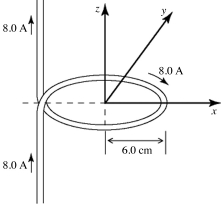
(Multiple Choice)
4.7/5 (55)
(55) A coaxial cable consists of an inner cylindrical conductor of radius R1 = 0.040 m on the axis of an outer hollow cylindrical conductor of inner radius R2 = 0.080 m and outer radius R2 = 0.090 m. The inner conductor carries current I1 = 4.40 A in one direction, and the outer conductor carries current I2 = 7.70 A in the opposite direction. What is the magnitude of the magnetic field at the following distances from the central axis of the cable? (μ0 = 4π × 10-7 T ∙ m/A)
(a) At r = 0.060 m (in the gap midway between the two conductors)
(b) At r = 0.150 m (outside the cable)
(Short Answer)
4.9/5 (80)
(80) The figure shows three long, parallel current-carrying wires. The magnitudes of the currents are equal and their directions are indicated in the figure. Which of the arrows drawn near the wire carrying current 1 correctly indicates the direction of the magnetic force acting on that wire? 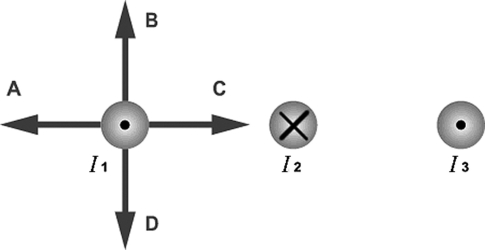
(Multiple Choice)
4.8/5 (89)
(89) Two very long parallel wires are a distance d apart and carry equal currents in opposite directions. The locations where the net magnetic field due to these currents is equal to zero are
(Multiple Choice)
4.8/5 (75)
(75) Three very long, straight, parallel wires each carry currents of 4.00 A, directed out of the page as shown in the figure. The wires pass through the vertices of a right isosceles triangle of side 2.00 cm. What is the magnitude of the magnetic field at point P at the midpoint of the hypotenuse of the triangle? 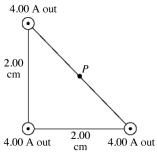
(Multiple Choice)
4.7/5 (63)
(63) A type of transmission line for electromagnetic waves consists of two parallel conducting plates (assumed infinite in width) separated by a distance a. Each plate carries the same uniform surface current density of 16.0 A/m, but the currents run in opposite directions. What is the magnitude of the magnetic field between the plates at a point 1.00 mm from one of the plates if a = 0.800 cm? (μ0 = 4π × 10-7 T ∙ m/A)
(Multiple Choice)
4.7/5 (76)
(76) A horizontal wire carries a current straight toward you. From your point of view, the magnetic field at a point directly below the wire points
(Multiple Choice)
4.9/5 (86)
(86) 
Filters
- Essay(0)
- Multiple Choice(0)
- Short Answer(0)
- True False(0)
- Matching(0)