



 Chat with AI
Exam 27: Sources of Magnetic Field

Exam 1: Units, Physical Quantities, and Vectors107 Questions
Exam 2: Motion Along a Straight Line59 Questions
Exam 3: Motion in Two or Three Dimensions50 Questions
Exam 4: Newtons Laws of Motion44 Questions
Exam 5: Applying Newtons Laws95 Questions
Exam 6: Work and Kinetic Energy54 Questions
Exam 7: Potential Energy and Energy Conservation55 Questions
Exam 8: Momentum, Impulse, and Collisions50 Questions
Exam 9: Rotation of Rigid Bodies26 Questions
Exam 10: Equilibrium and Elasticity50 Questions
Exam 11: Fluid Mechanics50 Questions
Exam 12: Gravitation50 Questions
Exam 13: Periodic Motion50 Questions
Exam 14: Mechanical Waves44 Questions
Exam 15: Sound and Hearing66 Questions
Exam 16: Temperature and Heat63 Questions
Exam 17: Thermal Properties of Matter58 Questions
Exam 18: The First Law of Thermodynamics52 Questions
Exam 19: The Second Law of Thermodynamics50 Questions
Exam 20: Electric Charge and Electric Field58 Questions
Exam 21: Gausss Law41 Questions
Exam 22: Electric Potential55 Questions
Exam 23: Capacitance and Dielectrics52 Questions
Exam 24: Current, Resistance, and Electromotive Force50 Questions
Exam 25: Direct-Current Circuits53 Questions
Exam 26: Magnetic Field and Magnetic Forces36 Questions
Exam 27: Sources of Magnetic Field51 Questions
Exam 28: Electromagnetic Induction39 Questions
Exam 29: Inductance26 Questions
Exam 30: Alternating Current49 Questions
Exam 31: Electromagnetic Waves47 Questions
Exam 32: The Nature and Propagation of Light28 Questions
Exam 33: Geometric Optics81 Questions
Exam 34: Interference33 Questions
Exam 35: Diffraction49 Questions
Exam 36: Relativity51 Questions
Exam 37: Photons: Light Waves Behaving As Particles38 Questions
Exam 38: Particles Behaving As Waves52 Questions
Exam 39: Quantum Mechanics40 Questions
Exam 40: Atomic Structure41 Questions
Exam 41: Molecules and Condensed Matter31 Questions
Exam 42: Nuclear Physics89 Questions
Exam 43: Particle Physics and Cosmology44 Questions
Select questions type


The figure shows four different sets of insulated wires that cross each other at right angles without actually making electrical contact. The magnitude of the current is the same in all the wires, and the directions of current flow are as indicated. For which (if any) configuration will the magnetic field at the center of the square formed by the wires be equal to zero? 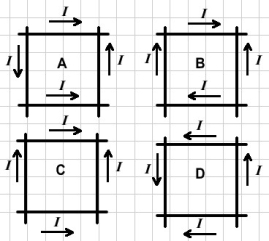
(Multiple Choice)
4.8/5  (73)
(73) As shown in the figure, a rectangular current loop is carrying current I1 = 3.0 A, in the direction shown, and is located near a long wire carrying a current Iw. The long wire is parallel to the sides of the rectangle. The rectangle loop has length 0.80 m and its sides are 0.10 m and 0.70 m from the wire, as shown. We measure that the net force on the rectangular loop is 4.9 × 10⁻⁶ N and is directed towards the wire. (μ0 = 4π × 10-7 T ∙ m/A) 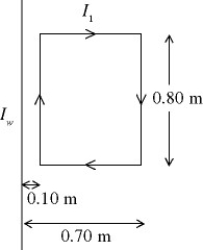 (a) What is the magnitude of the current Iw?
(b) In which direction does Iw flow: from top to bottom or from bottom to top in the sketch?
(a) What is the magnitude of the current Iw?
(b) In which direction does Iw flow: from top to bottom or from bottom to top in the sketch? (Short Answer)
4.8/5 (91)
(91) The magnetic field at a distance of 2 cm from a current carrying wire is 4 μT. What is the magnetic field at a distance of 4 cm from the wire?
(Multiple Choice)
4.9/5 (91)
(91) A cylindrical insulated wire of diameter 5.0 mm is tightly wound 200 times around a cylindrical core to form a solenoid with adjacent coils touching each other. When a 0.10 A current is sent through the wire, what is the magnitude of the magnetic field on the axis of the solenoid near its center? (μ0 = 4π × 10-7 T ∙ m/A)
(Multiple Choice)
4.9/5 (82)
(82) A solenoid having N turns and carrying a current of 2.000 A has a length of 34.00 cm. If the magnitude of the magnetic field generated at the center of the solenoid is 9.000 mT, what is the value of N? (μ0 = 4π × 10-7 T ∙ m/A)
(Multiple Choice)
4.7/5 (79)
(79) A wire carrying a current is shaped in the form of a circular loop of radius 3.0 mm. If the magnetic field strength that this current produces at the center of the loop is 1.1 mT, what is the magnitude of the current that flows through the wire? (μ0 = 4π × 10-7 T ∙ m/A)
(Multiple Choice)
4.8/5 (84)
(84) A toroidal solenoid has a central radius of 0.50 m and a cross-sectional diameter of 10 cm. When a current passes through the coil of the solenoid, the magnetic field inside the solenoid at its CENTER has a magnitude of 2.0 μT. What is the largest value of the magnetic field inside the solenoid when this current is flowing? (μ0 = 4π × 10-7 T ∙ m/A)
(Multiple Choice)
4.9/5 (85)
(85) A solenoid of length 18 cm consists of closely spaced coils of wire wrapped tightly around a wooden core. The magnetic field strength is 2.0 mT inside the solenoid near its center when a certain current flows through the coils. If the coils of the solenoid are now pulled apart slightly, stretching it to 21 cm without appreciably changing the size of the coils, what does the magnetic field become near the center of the solenoid when the same current flows through the coils? (μ0 = 4π × 10-7 T ∙ m/A)
(Multiple Choice)
4.9/5 (88)
(88) A vertical wire carries a current straight down. To the east of this wire, the magnetic field points
(Multiple Choice)
4.8/5 (93)
(93) A point charge Q moves on the x-axis in the positive direction with a speed of 280 m/s. A point P is on the y-axis at y = +70 mm. The magnetic field produced at the point P, as the charge moves through the origin, is equal to -0.30 μT  . What is the charge Q? (μ0 = 4π × 10-7 T ∙ m/A)
 (Multiple Choice)
4.8/5 (84)
(84) The figure shows the cross-section of a hollow cylinder of inner radius a = 5.0 cm and outer radius b = 7.0 cm. A uniform current density of 1.0 A/ cm2 flows through the cylinder parallel to its axis. Calculate the magnitude of the magnetic field at a distance of d = 10 cm from the axis of the cylinder. (μ0 = 4π × 10-7 T ∙ m/A) 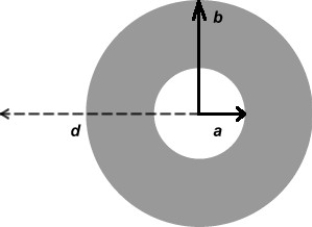
(Multiple Choice)
4.8/5 (85)
(85) Two long parallel wires carry currents of 20 A and 5.0 A in opposite directions. The wires are separated by 0.20 m. What is the magnitude of the magnetic field midway between the two wires? (μ0 = 4π × 10-7 T ∙ m/A)
(Multiple Choice)
4.8/5 (76)
(76) Two very long parallel wires in the xy-plane, a distance 2a apart, are parallel to the y-axis and carry equal currents I as shown in the figure. The +z direction points perpendicular to the xy-plane in a right-handed coordinate system. If the left current flows in the +y direction and the right current flows in the -y direction, which one of the graphs shown in the figure below best represents the z component of the net magnetic field, in the xy-plane, as a function of x? (Caution: These graphs are not magnetic field lines.) 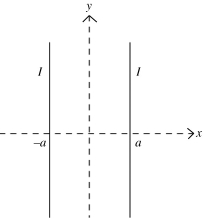
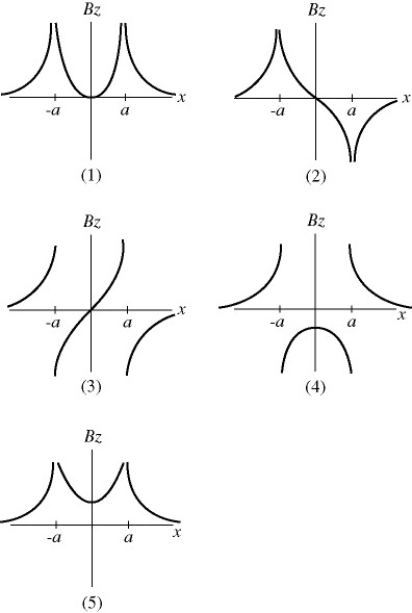
(Multiple Choice)
4.8/5 (68)
(68) A rectangular loop of wire measures 1.0 m by 1.0 cm. If a 7.0-A current flows through the wire, what is the magnitude of the magnetic force on the centermost 1.0-cm segment of the 1.0-m side of the loop? (μ0 = 4π × 10-7 T ∙ m/A)
(Multiple Choice)
4.9/5 (74)
(74) Two circular coils of diameter 30.0 cm are parallel to each other and have their centers along the same line L but separated by 22.0 cm. When an experimenter views the coils along L, the coil closer to her carries a clockwise current of 2.50 A. Find the magnitude and sense (clockwise or counterclockwise) of the current needed in the other coil so that the net magnetic field on L midway between the two coils will have a magnitude of 4.10 µT and point away from the experimenter who is viewing the coils along L. (μ0 = 4π × 10-7 T ∙ m/A)
(Short Answer)
4.9/5 (79)
(79) The figure shows two long wires carrying equal currents I1 and I2 flowing in opposite directions. Which of the arrows labeled A through D correctly represents the direction of the magnetic field due to the wires at a point located at an equal distance d from each wire? 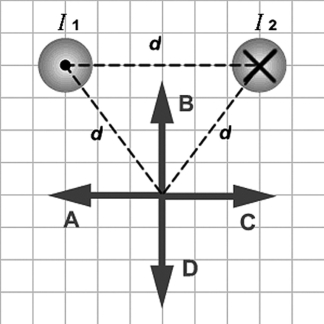
(Multiple Choice)
4.7/5 (84)
(84) Two long parallel wires placed side-by-side on a horizontal table carry identical size currents in opposite directions. The wire on your right carries current toward you, and the wire on your left carries current away from you. From your point of view, the magnetic field at the point exactly midway between the two wires
(Multiple Choice)
4.7/5 (79)
(79) As shown in the figure, two long straight wires are separated by a distance of d = 0.80 m. The currents are I1 = 2.0 A to the right in the upper wire and I2 = 7.0 A to the left in the lower wire. What are the magnitude and direction of the magnetic field at point P, which is a distance d/2 = 0.40 m below the lower wire? (μ0 = 4π × 10-7 T ∙ m/A) 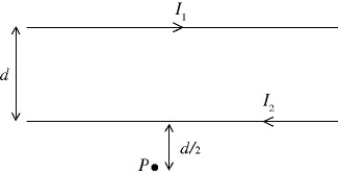
(Short Answer)
4.9/5 (84)
(84) A very long, hollow, thin-walled conducting cylindrical shell (like a pipe) of radius R carries a current along its length uniformly distributed throughout the thin shell. Which one of the graphs shown in the figure most accurately describes the magnitude B of the magnetic field produced by this current as a function of the distance r from the central axis? 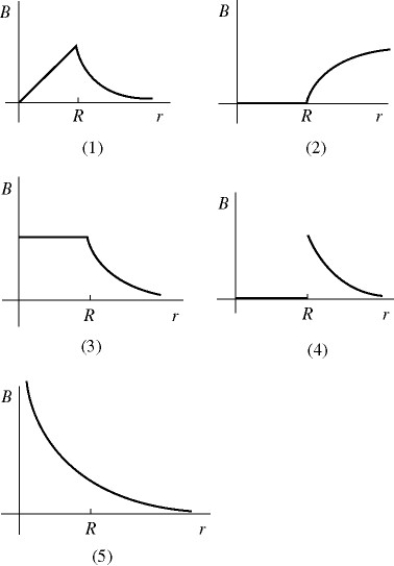
(Multiple Choice)
4.8/5 (83)
(83) Two long parallel wires carry currents of 10 A in opposite directions. They are separated by 40 cm. What is the magnitude of the magnetic field in the plane of the wires at a point that is 20 cm from one wire and 60 cm from the other? (μ0 = 4π × 10-7 T ∙ m/A)
(Multiple Choice)
4.8/5 (86)
(86) 
Filters
- Essay(0)
- Multiple Choice(0)
- Short Answer(0)
- True False(0)
- Matching(0)