



 Chat with AI
Exam 24: Current, Resistance, and Electromotive Force

Exam 1: Units, Physical Quantities, and Vectors107 Questions
Exam 2: Motion Along a Straight Line59 Questions
Exam 3: Motion in Two or Three Dimensions50 Questions
Exam 4: Newtons Laws of Motion44 Questions
Exam 5: Applying Newtons Laws95 Questions
Exam 6: Work and Kinetic Energy54 Questions
Exam 7: Potential Energy and Energy Conservation55 Questions
Exam 8: Momentum, Impulse, and Collisions50 Questions
Exam 9: Rotation of Rigid Bodies26 Questions
Exam 10: Equilibrium and Elasticity50 Questions
Exam 11: Fluid Mechanics50 Questions
Exam 12: Gravitation50 Questions
Exam 13: Periodic Motion50 Questions
Exam 14: Mechanical Waves44 Questions
Exam 15: Sound and Hearing66 Questions
Exam 16: Temperature and Heat63 Questions
Exam 17: Thermal Properties of Matter58 Questions
Exam 18: The First Law of Thermodynamics52 Questions
Exam 19: The Second Law of Thermodynamics50 Questions
Exam 20: Electric Charge and Electric Field58 Questions
Exam 21: Gausss Law41 Questions
Exam 22: Electric Potential55 Questions
Exam 23: Capacitance and Dielectrics52 Questions
Exam 24: Current, Resistance, and Electromotive Force50 Questions
Exam 25: Direct-Current Circuits53 Questions
Exam 26: Magnetic Field and Magnetic Forces36 Questions
Exam 27: Sources of Magnetic Field51 Questions
Exam 28: Electromagnetic Induction39 Questions
Exam 29: Inductance26 Questions
Exam 30: Alternating Current49 Questions
Exam 31: Electromagnetic Waves47 Questions
Exam 32: The Nature and Propagation of Light28 Questions
Exam 33: Geometric Optics81 Questions
Exam 34: Interference33 Questions
Exam 35: Diffraction49 Questions
Exam 36: Relativity51 Questions
Exam 37: Photons: Light Waves Behaving As Particles38 Questions
Exam 38: Particles Behaving As Waves52 Questions
Exam 39: Quantum Mechanics40 Questions
Exam 40: Atomic Structure41 Questions
Exam 41: Molecules and Condensed Matter31 Questions
Exam 42: Nuclear Physics89 Questions
Exam 43: Particle Physics and Cosmology44 Questions
Select questions type


The heater element of a particular 120-V toaster is a 8.9-m length of nichrome wire, whose diameter is 0.86 mm. The resistivity of nichrome at the operating temperature of the toaster is 1.3 × 10⁻⁶ Ω ∙ m. If the toaster is operated at a voltage of 120 V, how much power does it draw?
(Multiple Choice)
4.8/5  (81)
(81) If a current of 2.4 A is flowing in a cylindrical wire of diameter 2.0 mm, what is the average current density in this wire?
(Multiple Choice)
4.9/5 (77)
(77) A cylindrical wire of radius 2.0 mm carries a current of 2.5 A. The potential difference between points on the wire that are 46 m apart is 3.7 V.
(a) What is the electric field in the wire?
(b) What is the resistivity of the material of which the wire is made?
(Short Answer)
4.9/5 (86)
(86) Two cables of the same length are made of the same material, except that one cable has twice the diameter of the other cable. When the same potential difference is maintained across both cables, which of the following statements are true? (There may be more than one correct choice.)
(Multiple Choice)
4.9/5 (87)
(87) A 110-V hair dryer is rated at 1200 W. What current will it draw when operating from a 110-V electrical outlet?
(Multiple Choice)
4.7/5 (66)
(66) A platinum wire is used to determine the melting point of indium. The resistance of the platinum wire is 2.000 Ω at 20°C and increases to 3.072 Ω as the indium starts to melt. What is the melting point of indium? The temperature coefficient of resistivity for platinum is 3.9 × 10⁻³(C°)-1.
(Multiple Choice)
4.8/5 (72)
(72) A narrow copper wire of length L and radius b is attached to a wide copper wire of length L and radius 2b, forming one long wire of length 2L. This long wire is attached to a battery, and a current is flowing through it. If the electric field in the narrow wire is E, the electric field in the wide wire is
(Multiple Choice)
4.8/5 (79)
(79) A 2.0 mm diameter wire of length 20 m has a resistance of 0.25 Ω. What is the resistivity of the wire?
(Multiple Choice)
4.8/5 (79)
(79) A wire has a cross-sectional area of 0.10 mm2. If there are 4.0 × 1028 atoms per cubic meter in this wire, and if each atom contributes 2 free electrons, what is the drift velocity of the electrons when the current in the wire is 6.0 A? (e = 1.60 × 10⁻¹⁹ C)
(Multiple Choice)
4.7/5 (84)
(84) A proton beam that carries a total current of 1.3 mA has 10.0 mm diameter. The current density in the proton beam increases linearly with distance from the center. This is expressed mathematically as J(r) = J0 (r/R), where R is the radius of the beam and J0 is the current density at the edge. Determine the value of J0.
(Multiple Choice)
4.8/5 (77)
(77) What must be the diameter of a cylindrical 120-m long metal wire if its resistance is to be 6.0 Ω? The resistivity of this metal is 1.68 × 10⁻⁸ Ω ∙ m.
(Multiple Choice)
4.8/5 (85)
(85) How much current will be flowing through a 40.0 m length of cylindrical metal wire with radius 0.0 mm if it is connected to a source supplying 16.0 V? The resistivity of this metal is
1)68 × 10-8 Ω ∙ m.
(Multiple Choice)
5.0/5 (78)
(78) A silver wire with resistivity 1.59 × 10⁻⁸ Ω ∙ m carries a current density of 4.0 A/mm2. What is the magnitude of the electric field inside the wire?
(Multiple Choice)
4.8/5 (63)
(63) The current in a wire varies with time according to the equation I(t) = 6.00 A + (4.80 A/s)t, where t is in seconds. How many coulombs of charge pass a cross section of the wire in the time period between t = 0.00 s and t = 3.00 s?
(Short Answer)
4.9/5 (77)
(77) A wire of resistivity ρ must be replaced in a circuit by a wire of the same material but 4 times as long. If, however, the resistance of the new wire is to be the same as the resistance of the original wire, the diameter of the new wire must be
(Multiple Choice)
4.8/5 (84)
(84) The emf and the internal resistance of a battery are as shown in the figure. If a current of 8.3 A is drawn from the battery when a resistor R is connected across the terminals ab of the battery, what is the power dissipated by the resistor R? 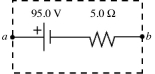
(Multiple Choice)
4.9/5 (84)
(84) The temperature coefficient of resistivity for copper is 0.0068 (C°)-1. If a copper wire has a resistance of 104 Ω at 20°C, what is its resistance 80°C?
(Multiple Choice)
4.8/5 (91)
(91) A silver wire has a cross sectional area A = 2.0 mm2. A total of 9.4 × 10¹⁸ electrons pass through the wire in 3.0 s. The conduction electron density in silver is 5.8 × 1028 electrons/m3 and e = 1.60 × 10⁻¹⁹ C. What is the drift velocity of these electrons?
(Multiple Choice)
4.8/5 (81)
(81) When a voltage difference is applied to a piece of metal wire, a 5.0-mA current flows through it. If this metal wire is now replaced with a silver wire having twice the diameter of the original wire, how much current will flow through the silver wire? The lengths of both wires are the same, and the voltage difference remains unchanged. (The resistivity of the original metal is 1.68 × 10⁻⁸ Ω ∙ m, and the resistivity of silver is 1.59 × 10⁻⁸ Ω ∙ m.)
(Multiple Choice)
4.8/5 (81)
(81) A 1500-W heater is connected to a 120-V line. How much heat energy does it produce in 2.0 hours?
(Multiple Choice)
4.9/5 (79)
(79) 
Filters
- Essay(0)
- Multiple Choice(0)
- Short Answer(0)
- True False(0)
- Matching(0)