



 Chat with AI
Exam 18: The First Law of Thermodynamics

Exam 1: Units, Physical Quantities, and Vectors107 Questions
Exam 2: Motion Along a Straight Line59 Questions
Exam 3: Motion in Two or Three Dimensions50 Questions
Exam 4: Newtons Laws of Motion44 Questions
Exam 5: Applying Newtons Laws95 Questions
Exam 6: Work and Kinetic Energy54 Questions
Exam 7: Potential Energy and Energy Conservation55 Questions
Exam 8: Momentum, Impulse, and Collisions50 Questions
Exam 9: Rotation of Rigid Bodies26 Questions
Exam 10: Equilibrium and Elasticity50 Questions
Exam 11: Fluid Mechanics50 Questions
Exam 12: Gravitation50 Questions
Exam 13: Periodic Motion50 Questions
Exam 14: Mechanical Waves44 Questions
Exam 15: Sound and Hearing66 Questions
Exam 16: Temperature and Heat63 Questions
Exam 17: Thermal Properties of Matter58 Questions
Exam 18: The First Law of Thermodynamics52 Questions
Exam 19: The Second Law of Thermodynamics50 Questions
Exam 20: Electric Charge and Electric Field58 Questions
Exam 21: Gausss Law41 Questions
Exam 22: Electric Potential55 Questions
Exam 23: Capacitance and Dielectrics52 Questions
Exam 24: Current, Resistance, and Electromotive Force50 Questions
Exam 25: Direct-Current Circuits53 Questions
Exam 26: Magnetic Field and Magnetic Forces36 Questions
Exam 27: Sources of Magnetic Field51 Questions
Exam 28: Electromagnetic Induction39 Questions
Exam 29: Inductance26 Questions
Exam 30: Alternating Current49 Questions
Exam 31: Electromagnetic Waves47 Questions
Exam 32: The Nature and Propagation of Light28 Questions
Exam 33: Geometric Optics81 Questions
Exam 34: Interference33 Questions
Exam 35: Diffraction49 Questions
Exam 36: Relativity51 Questions
Exam 37: Photons: Light Waves Behaving As Particles38 Questions
Exam 38: Particles Behaving As Waves52 Questions
Exam 39: Quantum Mechanics40 Questions
Exam 40: Atomic Structure41 Questions
Exam 41: Molecules and Condensed Matter31 Questions
Exam 42: Nuclear Physics89 Questions
Exam 43: Particle Physics and Cosmology44 Questions
Select questions type


In an isochoric process, the internal (thermal) energy of an ideal gas decreases by 50 J. How much work does the gas do during this process?
(Multiple Choice)
4.9/5  (75)
(75) An ideal gas increases in temperature from 22°C to 42°C by two different processes. In one process, the temperature increases at constant volume, and in the other process the temperature increases at constant pressure. Which of the following statements about this gas are correct? (There may be more than one correct choice.)
(Multiple Choice)
5.0/5 (90)
(90) When a fixed amount of ideal gas goes through an isothermal expansion
(Multiple Choice)
4.9/5 (87)
(87) A monatomic ideal gas undergoes an isothermal expansion at 300 K, as the volume increased from 0.03 m3 to 0.21 m3. The final pressure of the gas is 60 kPA. The ideal gas constant is R = 8.314 J/mol ∙ K. The change in the internal (thermal) energy of the gas is closest to
(Multiple Choice)
4.8/5 (69)
(69) 3.0 moles of an ideal gas with a molar heat capacity at constant volume of 4.9 cal/(mol∙K) and a molar heat capacity at constant pressure of 6.9 cal/(mol∙K) starts at 300 K and is heated at constant pressure to 320 K, then cooled at constant volume to its original temperature. How much heat flows into the gas during this two-step process?
(Multiple Choice)
5.0/5 (78)
(78) An expansion process on an ideal diatomic gas has a linear path between the initial and final states on a pV diagram. The initial pressure is 300 kPa, the initial volume is 0.020 m3, and the initial temperature is 390 K. The final pressure is 160 kPa and the final temperature is 310K. The change in the internal (thermal) energy of the gas is closest to
(Multiple Choice)
4.8/5 (82)
(82) How much work is done by 3.00 mol of ideal gas when it triples its volume at a constant temperature of 127°C? The ideal gas constant is R = 8.314 J/mol ∙ K.
(Multiple Choice)
5.0/5 (87)
(87) The gas in a perfectly insulated system does work at a rate of 13 W. At what rate is the internal (thermal) energy of the gas changing?
(Multiple Choice)
4.8/5 (93)
(93) The figure shows a pV diagram for 8.3 g of nitrogen gas (N2) in a sealed container. The temperature T1 of the gas in state 1 is 79°C. What are (a) the pressure p1 of the gas in state 1 and (b) the temperature T2 of the gas in state 2? The ideal gas constant is R = 8.314 J/mol ∙ K = 0.0821 L ∙ atm/mol ∙ K, and the ATOMIC weight of nitrogen is 14 g/mol. 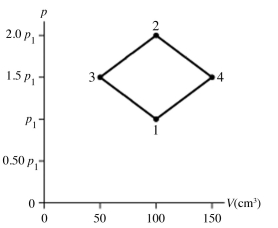
(Multiple Choice)
4.8/5 (73)
(73) An ideal gas is allowed to expand slowly at constant temperature to twice its original volume. During the expansion, the gas absorbs 200 kJ of heat.
(a) What is the change in the internal (thermal) energy of the gas during the expansion?
(b) How much work does the gas do during the expansion?
(Short Answer)
4.7/5 (73)
(73) An expansion process on an ideal diatomic gas has a linear path between the initial and final states on a pV diagram. The initial pressure is 300 kPa, the initial volume is 0.060 m3, and the initial temperature is 390 K. The ideal gas constant is R = 8.314 J/mol ∙ K. The final pressure is 150 kPa and the final temperature is 260K. The work done by the gas is closest to
(Multiple Choice)
4.7/5 (80)
(80) 
Filters
- Essay(0)
- Multiple Choice(0)
- Short Answer(0)
- True False(0)
- Matching(0)