



 Chat with AI
Exam 18: The First Law of Thermodynamics

Exam 1: Units, Physical Quantities, and Vectors107 Questions
Exam 2: Motion Along a Straight Line59 Questions
Exam 3: Motion in Two or Three Dimensions50 Questions
Exam 4: Newtons Laws of Motion44 Questions
Exam 5: Applying Newtons Laws95 Questions
Exam 6: Work and Kinetic Energy54 Questions
Exam 7: Potential Energy and Energy Conservation55 Questions
Exam 8: Momentum, Impulse, and Collisions50 Questions
Exam 9: Rotation of Rigid Bodies26 Questions
Exam 10: Equilibrium and Elasticity50 Questions
Exam 11: Fluid Mechanics50 Questions
Exam 12: Gravitation50 Questions
Exam 13: Periodic Motion50 Questions
Exam 14: Mechanical Waves44 Questions
Exam 15: Sound and Hearing66 Questions
Exam 16: Temperature and Heat63 Questions
Exam 17: Thermal Properties of Matter58 Questions
Exam 18: The First Law of Thermodynamics52 Questions
Exam 19: The Second Law of Thermodynamics50 Questions
Exam 20: Electric Charge and Electric Field58 Questions
Exam 21: Gausss Law41 Questions
Exam 22: Electric Potential55 Questions
Exam 23: Capacitance and Dielectrics52 Questions
Exam 24: Current, Resistance, and Electromotive Force50 Questions
Exam 25: Direct-Current Circuits53 Questions
Exam 26: Magnetic Field and Magnetic Forces36 Questions
Exam 27: Sources of Magnetic Field51 Questions
Exam 28: Electromagnetic Induction39 Questions
Exam 29: Inductance26 Questions
Exam 30: Alternating Current49 Questions
Exam 31: Electromagnetic Waves47 Questions
Exam 32: The Nature and Propagation of Light28 Questions
Exam 33: Geometric Optics81 Questions
Exam 34: Interference33 Questions
Exam 35: Diffraction49 Questions
Exam 36: Relativity51 Questions
Exam 37: Photons: Light Waves Behaving As Particles38 Questions
Exam 38: Particles Behaving As Waves52 Questions
Exam 39: Quantum Mechanics40 Questions
Exam 40: Atomic Structure41 Questions
Exam 41: Molecules and Condensed Matter31 Questions
Exam 42: Nuclear Physics89 Questions
Exam 43: Particle Physics and Cosmology44 Questions
Select questions type


The temperature of an ideal gas in a sealed 0.40-m3 rigid container is reduced from 350 K to 270k The final pressure of the gas is 60 kPA. The molar heat capacity at constant volume of the gas is 28.0 J/mol · K. The heat absorbed by the gas is closest to
(Multiple Choice)
4.9/5  (80)
(80) The temperature of an ideal gas in a sealed 0.40 m3 container is reduced from 400 K to 270 K. The final pressure of the gas is 30 kPA. The molar heat capacity at constant volume of the gas is 28.0 J/mol · K. The work done by the gas is closest to
(Multiple Choice)
4.9/5 (84)
(84) During an isothermal process, 5.0 J of heat is removed from an ideal gas. How much work does the gas do during this process?
(Multiple Choice)
4.8/5 (84)
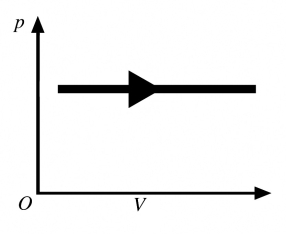
(84) 
A monatomic ideal gas undergoes an isothermal expansion at 300 K, as the volume increased from 0.020 m3 to 0.040 m3. The final pressure is 120 kPA. The ideal gas constant is R = 8.314 J/mol ∙ K. The heat transfer to the gas is closest to
(Multiple Choice)
4.7/5 (87)
(87) A steel container, equipped with a piston, contains 21 mol of an ideal gas at 465 K. The container is compressed isothermally to 90% of its original volume. How much work is done on the gas? The ideal gas constant is R = 8.314 J/mol ∙ K.
(Multiple Choice)
4.7/5 (82)
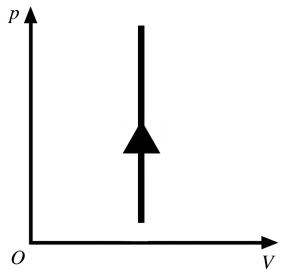
(82) When a fixed amount of ideal gas goes through an isochoric process
(Multiple Choice)
4.9/5 (81)
(81) In an isochoric process, the internal (thermal) energy of an ideal gas decreases by 50 J. How much heat is exchanged with the gas during this process?
(Multiple Choice)
4.9/5 (76)
(76) A compression, at a constant pressure of 190 kPa, is performed on 5.0 moles of an ideal monatomic gas. The compression reduces the volume of the gas from 0.19 m3 to 0.12 m3. The ideal gas constant is R = 8.314 J/mol ∙ K. The work done by the gas is closest to
(Multiple Choice)
4.8/5 (74)
(74) An ideal gas in a balloon is kept in thermal equilibrium with its constant-temperature surroundings. How much work is done by the gas if the outside pressure is slowly reduced, allowing the balloon to expand to 6.0 times its original size? The balloon initially has a pressure of 645.0 Pa and a volume of 0.10 m3. The ideal gas constant is R = 8.314 J/mol ∙ K.
(Multiple Choice)
4.9/5 (78)
(78) 
The figure shows a pV diagram for 0.95 mol of gas that undergoes the process 1 → 2. The gas then undergoes an isochoric heating from point 2 until the pressure is restored to the value it had at point 1. What is the final temperature of the gas? The ideal gas constant is R = 8.314 J/mol ∙ K = 0.0821 L ∙ atm/mol ∙ K. 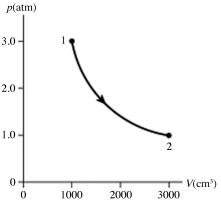
(Multiple Choice)
4.7/5 (73)
(73) During an isothermal process, 5.0 J of heat is removed from an ideal gas. What is the change in internal (thermal) energy of the gas?
(Multiple Choice)
4.8/5 (84)
(84) The pV diagram shown is for 7.50 moles of an ideal diatomic gas taken through a cycle from a to b to c. The ideal gas constant is R = 8.314 J/mol ∙ K. 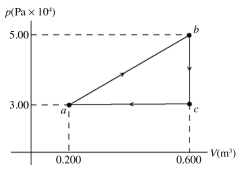 (a) What is the highest temperature reached by the gas during the cycle?
(b) What net work does the gas do during the cycle?
(c) How much heat is exchanged with the gas during part bc of the cycle? Does it enter or leave the gas?
(d) What is the change in the internal (thermal) energy of the gas during part bc of the cycle?
(e) What is the change in the internal (thermal) energy of the gas during the entire cycle?
(a) What is the highest temperature reached by the gas during the cycle?
(b) What net work does the gas do during the cycle?
(c) How much heat is exchanged with the gas during part bc of the cycle? Does it enter or leave the gas?
(d) What is the change in the internal (thermal) energy of the gas during part bc of the cycle?
(e) What is the change in the internal (thermal) energy of the gas during the entire cycle? (Short Answer)
4.9/5 (74)
(74) 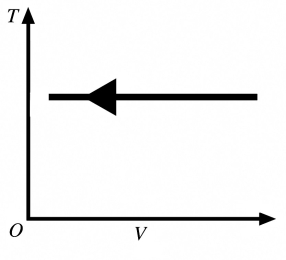
When a fixed amount of ideal gas goes through an isobaric expansion
(Multiple Choice)
4.8/5 (78)
(78) A cylinder contains 1.2 moles of ideal gas, initially at a temperature of 116°C. The cylinder is provided with a frictionless piston, which maintains a constant pressure of 6.4 × 10⁵ Pa on the gas. The gas is cooled until its temperature has decreased to 27°C. For the gas CV = 11.65 J/mol ∙ K, and the ideal gas constant R = 8.314 J/mol ∙ K.
(a) Find the work done by (or on) the gas during this process. Is the work done by or on the gas?
(b) What is the change in the internal (thermal) energy of the gas during this process?
(c) How much heat is transferred to (or from) the gas during this process? Does this heat flow into or out of the gas?
(Short Answer)
4.9/5 (91)
(91) An ideal gas with γ = 1.30 occupies 7.0 L at 300 K and 200 kPa pressure. It is compressed adiabatically to 1/7 of its original volume, then cooled at constant volume to 300 K, and finally allowed to expand isothermally to 7.0 L. How much work does the gas do during this process? The ideal gas constant is R = 8.314 J/mol ∙ K = 0.0821 L ∙ atm/mol ∙ K.
(Multiple Choice)
4.9/5 (84)
(84) A container of ideal gas has a movable frictionless piston. This container is placed in a very large water bath and slowly compressed so that the temperature of the gas remains constant and equal to the temperature of the water. Which of the following statements about this gas are true for this process? (There may be more than one correct choice.)
(Multiple Choice)
5.0/5 (90)
(90) An ideal monatomic gas cools from 455.0 K to 405.0 K at constant volume as 831 J of energy is removed from it. How many moles of gas are in the sample? The ideal gas constant is R = 8.314 J/mol ∙ K.
(Multiple Choice)
5.0/5 (89)
(89) 
Filters
- Essay(0)
- Multiple Choice(0)
- Short Answer(0)
- True False(0)
- Matching(0)