



 Chat with AI
Exam 11: Fluid Mechanics

Exam 1: Units, Physical Quantities, and Vectors107 Questions
Exam 2: Motion Along a Straight Line59 Questions
Exam 3: Motion in Two or Three Dimensions50 Questions
Exam 4: Newtons Laws of Motion44 Questions
Exam 5: Applying Newtons Laws95 Questions
Exam 6: Work and Kinetic Energy54 Questions
Exam 7: Potential Energy and Energy Conservation55 Questions
Exam 8: Momentum, Impulse, and Collisions50 Questions
Exam 9: Rotation of Rigid Bodies26 Questions
Exam 10: Equilibrium and Elasticity50 Questions
Exam 11: Fluid Mechanics50 Questions
Exam 12: Gravitation50 Questions
Exam 13: Periodic Motion50 Questions
Exam 14: Mechanical Waves44 Questions
Exam 15: Sound and Hearing66 Questions
Exam 16: Temperature and Heat63 Questions
Exam 17: Thermal Properties of Matter58 Questions
Exam 18: The First Law of Thermodynamics52 Questions
Exam 19: The Second Law of Thermodynamics50 Questions
Exam 20: Electric Charge and Electric Field58 Questions
Exam 21: Gausss Law41 Questions
Exam 22: Electric Potential55 Questions
Exam 23: Capacitance and Dielectrics52 Questions
Exam 24: Current, Resistance, and Electromotive Force50 Questions
Exam 25: Direct-Current Circuits53 Questions
Exam 26: Magnetic Field and Magnetic Forces36 Questions
Exam 27: Sources of Magnetic Field51 Questions
Exam 28: Electromagnetic Induction39 Questions
Exam 29: Inductance26 Questions
Exam 30: Alternating Current49 Questions
Exam 31: Electromagnetic Waves47 Questions
Exam 32: The Nature and Propagation of Light28 Questions
Exam 33: Geometric Optics81 Questions
Exam 34: Interference33 Questions
Exam 35: Diffraction49 Questions
Exam 36: Relativity51 Questions
Exam 37: Photons: Light Waves Behaving As Particles38 Questions
Exam 38: Particles Behaving As Waves52 Questions
Exam 39: Quantum Mechanics40 Questions
Exam 40: Atomic Structure41 Questions
Exam 41: Molecules and Condensed Matter31 Questions
Exam 42: Nuclear Physics89 Questions
Exam 43: Particle Physics and Cosmology44 Questions
Select questions type


Consider a very small hole in the bottom of a tank 20.0 cm in diameter filled with water to a height of 50.0 cm. Find the speed at which the water exits the tank through the hole.
(Multiple Choice)
4.8/5  (80)
(80) Fluid fills the container shown in the figure. At which of the indicated points is the pressure greatest? 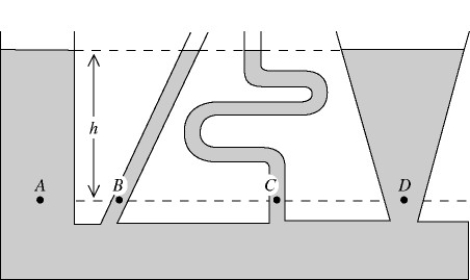
(Multiple Choice)
4.8/5 (89)
(89) A 12,000-N car is raised using a hydraulic lift, which consists of a U-tube with arms of unequal areas, filled with incompressible oil and capped at both ends with tight-fitting pistons. The wider arm of the U-tube has a radius of 18.0 cm and the narrower arm has a radius of 5.00 cm. The car rests on the piston on the wider arm of the U-tube. The pistons are initially at the same level. What is the initial force that must be applied to the smaller piston in order to start lifting the car? (For purposes of this problem, you can neglect the weight of the pistons.)
(Multiple Choice)
5.0/5 (87)
(87) A rock is under water in a shallow lake. As the rock sinks deeper and deeper into water, the buoyant force on it
(Multiple Choice)
4.8/5 (81)
(81) A horizontal tube consists of a 7.0-cm-diameter pipe that narrows to a 2.0-cm-diameter throat. In the pipe, the water pressure is twice atmospheric pressure and the water flows with a speed of 0.40 m/s. What is the pressure in the throat, assuming that the water behaves like an ideal fluid? The density of water is 1000 kg/m3, and atmospheric pressure is 1.01 × 10⁵ Pa.
(Multiple Choice)
4.8/5 (74)
(74) Incompressible water flows out of a large reservoir through a pipe that opens to the atmosphere 5.70 m below the level of the water in the reservoir. What is the speed of the water as it comes out of the pipe?
(Multiple Choice)
4.8/5 (76)
(76) A large cylindrical water tank is mounted on a platform with its central axis vertical. The water level is 3.75 m above the base of the tank, and base is 6.50 m above the ground. A small hole 2.22 mm in diameter has formed in the base of the tank. Both the hole and the top of the tank are open to the air. We can ignore air resistance and treat water as an ideal fluid with a density of 1000 kg/m3.
(a) How many cubic meters of water per second is this tank losing?
(b) How fast is the water from the hole moving just as it reaches the ground?
(Short Answer)
5.0/5 (76)
(76) A certain coin has a diameter of 21.21 mm, a thickness of 1.95 mm, and weighs 0.04905 N. What is its density?
(Multiple Choice)
4.9/5 (80)
(80) A sphere is constructed of two concentric parts. The inner part is a solid sphere of radius 10.0 cm made of a material with density 4000 kg/m3. The outer part is a spherical shell with inner radius 10.0 cm and outer radius 20.0 cm. The material in the outer shell has a density 9000 kg/m3.
(a) What is the mass of the sphere?
(b) What is the average density of this sphere?
(Short Answer)
5.0/5 (91)
(91) A 12,000-N car is raised using a hydraulic lift, which consists of a U-tube with arms of unequal areas, filled with incompressible oil with a density of 800 kg/m3 and capped at both ends with tight-fitting pistons. The wider arm of the U-tube has a radius of 18.0 cm and the narrower arm has a radius of 5.00 cm. The car rests on the piston on the wider arm of the U-tube. The pistons are initially at the same level. What is the force that must be applied to the smaller piston in order to lift the car after it has been raised 1.20 m? (For purposes of this problem, you can neglect the weight of the pistons.)
(Multiple Choice)
4.9/5 (81)
(81) 
Filters
- Essay(0)
- Multiple Choice(0)
- Short Answer(0)
- True False(0)
- Matching(0)