



 Chat with AI
Exam 11: Fluid Mechanics

Exam 1: Units, Physical Quantities, and Vectors107 Questions
Exam 2: Motion Along a Straight Line59 Questions
Exam 3: Motion in Two or Three Dimensions50 Questions
Exam 4: Newtons Laws of Motion44 Questions
Exam 5: Applying Newtons Laws95 Questions
Exam 6: Work and Kinetic Energy54 Questions
Exam 7: Potential Energy and Energy Conservation55 Questions
Exam 8: Momentum, Impulse, and Collisions50 Questions
Exam 9: Rotation of Rigid Bodies26 Questions
Exam 10: Equilibrium and Elasticity50 Questions
Exam 11: Fluid Mechanics50 Questions
Exam 12: Gravitation50 Questions
Exam 13: Periodic Motion50 Questions
Exam 14: Mechanical Waves44 Questions
Exam 15: Sound and Hearing66 Questions
Exam 16: Temperature and Heat63 Questions
Exam 17: Thermal Properties of Matter58 Questions
Exam 18: The First Law of Thermodynamics52 Questions
Exam 19: The Second Law of Thermodynamics50 Questions
Exam 20: Electric Charge and Electric Field58 Questions
Exam 21: Gausss Law41 Questions
Exam 22: Electric Potential55 Questions
Exam 23: Capacitance and Dielectrics52 Questions
Exam 24: Current, Resistance, and Electromotive Force50 Questions
Exam 25: Direct-Current Circuits53 Questions
Exam 26: Magnetic Field and Magnetic Forces36 Questions
Exam 27: Sources of Magnetic Field51 Questions
Exam 28: Electromagnetic Induction39 Questions
Exam 29: Inductance26 Questions
Exam 30: Alternating Current49 Questions
Exam 31: Electromagnetic Waves47 Questions
Exam 32: The Nature and Propagation of Light28 Questions
Exam 33: Geometric Optics81 Questions
Exam 34: Interference33 Questions
Exam 35: Diffraction49 Questions
Exam 36: Relativity51 Questions
Exam 37: Photons: Light Waves Behaving As Particles38 Questions
Exam 38: Particles Behaving As Waves52 Questions
Exam 39: Quantum Mechanics40 Questions
Exam 40: Atomic Structure41 Questions
Exam 41: Molecules and Condensed Matter31 Questions
Exam 42: Nuclear Physics89 Questions
Exam 43: Particle Physics and Cosmology44 Questions
Select questions type


The two water reservoirs shown in the figure are open to the atmosphere, and the water has density 1000 kg/m3. The manometer contains incompressible oil with a density of 820 kg/m3. What is the difference in elevation h if the manometer reading m is 25.0 cm? 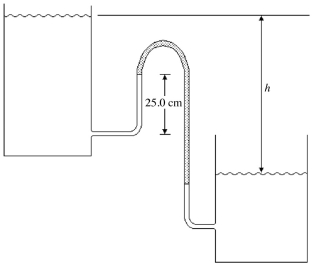
(Multiple Choice)
4.9/5  (74)
(74) Air is flowing through a rocket nozzle. Inside the rocket the air has a density of 5.25 kg/m3 and a speed of 1.20 m/s. The interior diameter of the rocket is 15.0 cm. At the nozzle exit, the diameter is 2.50 cm and the density is 1.29 kg/m3. What is the speed of the air when it leaves the nozzle?
(Multiple Choice)
4.8/5 (80)
(80) One of the dangers of tornados and hurricanes is the rapid drop in air pressure that is associated with such storms. Assume that the air pressure inside of a sealed house is 1.02 atm when a hurricane hits. The hurricane rapidly decreases the external air pressure to 0.910 atm. A square window in an outside wall of the house measures 2.02 m on each side. What net force (directed outwards) is exerted on this window? (1 atm = 1.01 × 10⁵ Pa.)
(Multiple Choice)
4.8/5 (88)
(88) A wooden raft has a mass of 50 kg. When empty it floats in water (density 1000 kg/m3) with 69% of its volume submerged. What mass of sand can be put on the raft without it sinking?
(Short Answer)
4.8/5 (79)
(79) At a certain depth in the ocean, the absolute pressure is p. If you go to twice that depth (treating the water as incompressible)
(Multiple Choice)
4.8/5 (62)
(62) On planet X, the absolute pressure at a depth of 2.00 m below the surface of a liquid nitrogen lake is 5.00 × 10⁵ N/m2. At a depth 5.00 m below the surface, the absolute pressure is 8.00 × 10⁵ N/m2. The density of liquid nitrogen is 808 kg/m3.
(a) What is the atmospheric pressure on planet X?
(b) What is the acceleration due to gravity on planet X?
(Short Answer)
4.8/5 (73)
(73) You are driving a late model convertible car at the 65 mph speed limit with its soft flexible roof closed up and the windows closed. You observe that the roof
(Multiple Choice)
4.9/5 (80)
(80) A barge is 15.0 m wide and 75.0 m long and has vertical sides. The bottom of the hull is 1.20 m below the water surface. What is the weight of the barge and its cargo, if it is floating in fresh water of density 1000 kg/m3?
(Multiple Choice)
4.8/5 (82)
(82) If you double the pressure on the surface of a can of water, the buoyant force on a stone placed in that water will
(Multiple Choice)
4.9/5 (86)
(86) When you blow some air above the upper face of a paper strip, the paper rises. This occurs because
(Multiple Choice)
4.9/5 (81)
(81) A cubical box, 5.00 cm on each side, is immersed in a fluid. The gauge pressure at the top surface of the box is 594 Pa and the gauge pressure on the bottom surface is 1133 Pa. What is the density of the fluid?
(Multiple Choice)
4.8/5 (71)
(71) Water flows through a pipe having a varying width. More water flows per second through the wide section than through the narrow section because there is more room for it to flow.
(True/False)
4.7/5 (75)
(75) A circular cylinder of height 1.20 m having faces of diameter 0.620 m is immersed in water of density 1.00 × 10³ kg/m3 with its axis vertical so that its faces are parallel to the surface of the water. The upper face is 2.50 m below the surface of the water. The net force on this cylinder is observed to be 1120 N downward. Atmospheric pressure is 1.01 × 10⁵ Pa. What net force does the water exert on the lower face of the cylinder?
(Multiple Choice)
4.8/5 (80)
(80) The weight of a car of mass 1.20 × 10³ kg is supported equally by the four tires, which are inflated to the same gauge pressure. What gauge pressure in the tires is required so the area of contact of each tire with the road is 1.00 × 102 cm2? (1 atm = 1.01 × 10⁵ Pa.)
(Multiple Choice)
4.9/5 (78)
(78) As shown in the figure, a container has a vertical tube, whose inner radius is 32.00 mm, connected to it at its side. An unknown liquid reaches level A in the container and level B in the tube level A being 5.0 cm higher than level B. The liquid supports a 20.0-cm high column of oil, between levels B and C, whose density is 460 kg/m3. What is the density of the unknown liquid? 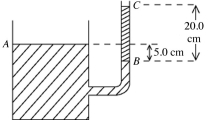
(Multiple Choice)
4.9/5 (70)
(70) A person who weighs 550 N empties her lungs as much as possible and is then completely immersed in water (of density 1000 kg/m3) while suspended from a harness. Her apparent weight is now 21.2 N. What is her density?
(Multiple Choice)
4.9/5 (85)
(85) A piece of wood is floating in a bathtub. A second piece of wood sits on top of the first piece, and does not touch the water. If the top piece is taken off and placed in the water, what happens to the water level in the tub?
(Multiple Choice)
4.9/5 (85)
(85) Water flows in the horizontal pipe shown in the figure. At point A the area is 25.0 cm2 and the speed of the water is 2.00 m/s. At B the area is 16.0 cm2. The fluid in the manometer is mercury, which has a density of 13,600 kg/m3. We can treat water as an ideal fluid having a density of 1000 kg/m3. What is the manometer reading h? 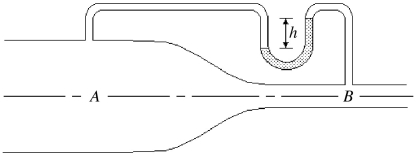
(Multiple Choice)
4.8/5 (76)
(76) An incompressible fluid flows steadily through a pipe that has a change in diameter. The fluid speed at a location where the pipe diameter is 8.0 cm is 1.28 m/s. What is the fluid speed at a location where the diameter has narrowed to 4.0 cm?
(Multiple Choice)
4.9/5 (67)
(67) A cup of water containing an ice cube at 0°C is filled to the brim. The tip of the ice cube sticks out of the surface. As the ice melts, you observe that
(Multiple Choice)
4.7/5 (85)
(85) 
Filters
- Essay(0)
- Multiple Choice(0)
- Short Answer(0)
- True False(0)
- Matching(0)