



 Chat with AI
Exam 7: Potential Energy and Energy Conservation

Exam 1: Units, Physical Quantities, and Vectors107 Questions
Exam 2: Motion Along a Straight Line59 Questions
Exam 3: Motion in Two or Three Dimensions50 Questions
Exam 4: Newtons Laws of Motion44 Questions
Exam 5: Applying Newtons Laws95 Questions
Exam 6: Work and Kinetic Energy54 Questions
Exam 7: Potential Energy and Energy Conservation55 Questions
Exam 8: Momentum, Impulse, and Collisions50 Questions
Exam 9: Rotation of Rigid Bodies26 Questions
Exam 10: Equilibrium and Elasticity50 Questions
Exam 11: Fluid Mechanics50 Questions
Exam 12: Gravitation50 Questions
Exam 13: Periodic Motion50 Questions
Exam 14: Mechanical Waves44 Questions
Exam 15: Sound and Hearing66 Questions
Exam 16: Temperature and Heat63 Questions
Exam 17: Thermal Properties of Matter58 Questions
Exam 18: The First Law of Thermodynamics52 Questions
Exam 19: The Second Law of Thermodynamics50 Questions
Exam 20: Electric Charge and Electric Field58 Questions
Exam 21: Gausss Law41 Questions
Exam 22: Electric Potential55 Questions
Exam 23: Capacitance and Dielectrics52 Questions
Exam 24: Current, Resistance, and Electromotive Force50 Questions
Exam 25: Direct-Current Circuits53 Questions
Exam 26: Magnetic Field and Magnetic Forces36 Questions
Exam 27: Sources of Magnetic Field51 Questions
Exam 28: Electromagnetic Induction39 Questions
Exam 29: Inductance26 Questions
Exam 30: Alternating Current49 Questions
Exam 31: Electromagnetic Waves47 Questions
Exam 32: The Nature and Propagation of Light28 Questions
Exam 33: Geometric Optics81 Questions
Exam 34: Interference33 Questions
Exam 35: Diffraction49 Questions
Exam 36: Relativity51 Questions
Exam 37: Photons: Light Waves Behaving As Particles38 Questions
Exam 38: Particles Behaving As Waves52 Questions
Exam 39: Quantum Mechanics40 Questions
Exam 40: Atomic Structure41 Questions
Exam 41: Molecules and Condensed Matter31 Questions
Exam 42: Nuclear Physics89 Questions
Exam 43: Particle Physics and Cosmology44 Questions
Select questions type


A block slides down a frictionless inclined ramp. If the ramp angle is 17.0° and its length is 30.0 m, find the speed of the block as it reaches the bottom of the ramp, assuming it started sliding from rest at the top.
(Multiple Choice)
4.8/5  (83)
(83) Which, if any, of the following statements concerning the work done by a conservative force is NOT true?
(Multiple Choice)
4.9/5 (95)
(95) A car on a roller coaster starts at zero speed at an elevation above the ground of 26 m. It coasts down a slope, and then climbs a hill. The top of the hill is at an elevation of 16 m. What is the speed of the car at the top of the hill? Neglect any frictional effects.
(Multiple Choice)
4.9/5 (74)
(74) A 60.0-kg person drops from rest a distance of 1.20 m to a platform of negligible mass supported by an ideal stiff spring of negligible mass. The platform drops 6.00 cm before the person comes to rest. What is the spring constant of the spring?
(Multiple Choice)
4.8/5 (77)
(77) A force on an object is given by F(x) = (2.00 N/m)x - (3.00 N/m3)x3. What is a potential energy function U(x) for this conservative force?
(Short Answer)
4.9/5 (77)
(77) A ball drops some distance and loses 30 J of gravitational potential energy. Do NOT ignore air resistance. How much kinetic energy did the ball gain?
(Multiple Choice)
4.8/5 (84)
(84) Is it possible for a system to have negative potential energy?
(Multiple Choice)
4.8/5 (81)
(81) When an object is solely under the influence of conservative forces, the sum of its kinetic and potential energies does not change.
(True/False)
4.8/5 (77)
(77) It requires 6.0 J of work is needed to push a 2.0-kg object from point A to point B of the frictionless ramp as shown in the figure. What is the length s of the ramp from A to B? 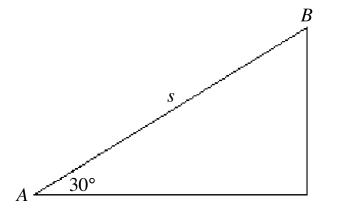
(Short Answer)
4.9/5 (75)
(75) A roller coaster of mass 80.0 kg is moving with a speed of 20.0 m/s at position A as shown in the figure. The vertical height above ground level at position A is 200 m. Neglect friction. 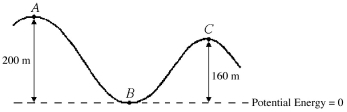 (a) What is the total mechanical energy of the roller coaster at point A?
(b) What is the total mechanical energy of the roller coaster at point B?
(c) What is the speed of the roller coaster at point B?
(d) What is the speed of the roller coaster at point C?
(a) What is the total mechanical energy of the roller coaster at point A?
(b) What is the total mechanical energy of the roller coaster at point B?
(c) What is the speed of the roller coaster at point B?
(d) What is the speed of the roller coaster at point C? (Short Answer)
4.9/5 (86)
(86) Two identical balls are thrown directly upward, ball A at speed v and ball B at speed 2v, and they feel no air resistance. Which statement about these balls is correct?
(Multiple Choice)
4.8/5 (80)
(80) An 8.0-kg block is released from rest, with v1 = 0.00 m/s, on a rough incline, as shown in the figure. The block moves a distance of 1.6-m down the incline, in a time interval of 0.80 s, and acquires a velocity of v2 = 4.0 m/s. How much work does gravity do on the block during this process? 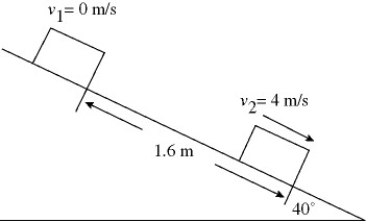
(Multiple Choice)
4.8/5 (69)
(69) A potential energy function is given by U(x) = ( 3.00 N/m)x - ( 1.00 N/m3)x3. At what position or positions is the force equal to zero?
(Multiple Choice)
4.8/5 (76)
(76) A small hockey puck slides without friction over the icy hill shown in the figure and lands 6.20 m from the foot of the cliff with no air resistance. What was its speed v0 at the bottom of the hill? 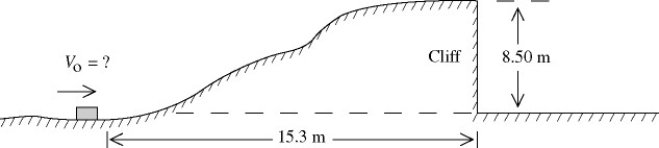
(Multiple Choice)
4.8/5 (80)
(80) The potential energy for a certain mass moving in one dimension is given by U(x) = (2.0 J/m3)x3 - (15 J/m2)x2 + (36 J/m)x - 23 J. Find the location(s) where the force on the mass is zero.
(Multiple Choice)
4.9/5 (77)
(77) 
Filters
- Essay(0)
- Multiple Choice(0)
- Short Answer(0)
- True False(0)
- Matching(0)