



 Chat with AI
Exam 7: Potential Energy and Energy Conservation

Exam 1: Units, Physical Quantities, and Vectors107 Questions
Exam 2: Motion Along a Straight Line59 Questions
Exam 3: Motion in Two or Three Dimensions50 Questions
Exam 4: Newtons Laws of Motion44 Questions
Exam 5: Applying Newtons Laws95 Questions
Exam 6: Work and Kinetic Energy54 Questions
Exam 7: Potential Energy and Energy Conservation55 Questions
Exam 8: Momentum, Impulse, and Collisions50 Questions
Exam 9: Rotation of Rigid Bodies26 Questions
Exam 10: Equilibrium and Elasticity50 Questions
Exam 11: Fluid Mechanics50 Questions
Exam 12: Gravitation50 Questions
Exam 13: Periodic Motion50 Questions
Exam 14: Mechanical Waves44 Questions
Exam 15: Sound and Hearing66 Questions
Exam 16: Temperature and Heat63 Questions
Exam 17: Thermal Properties of Matter58 Questions
Exam 18: The First Law of Thermodynamics52 Questions
Exam 19: The Second Law of Thermodynamics50 Questions
Exam 20: Electric Charge and Electric Field58 Questions
Exam 21: Gausss Law41 Questions
Exam 22: Electric Potential55 Questions
Exam 23: Capacitance and Dielectrics52 Questions
Exam 24: Current, Resistance, and Electromotive Force50 Questions
Exam 25: Direct-Current Circuits53 Questions
Exam 26: Magnetic Field and Magnetic Forces36 Questions
Exam 27: Sources of Magnetic Field51 Questions
Exam 28: Electromagnetic Induction39 Questions
Exam 29: Inductance26 Questions
Exam 30: Alternating Current49 Questions
Exam 31: Electromagnetic Waves47 Questions
Exam 32: The Nature and Propagation of Light28 Questions
Exam 33: Geometric Optics81 Questions
Exam 34: Interference33 Questions
Exam 35: Diffraction49 Questions
Exam 36: Relativity51 Questions
Exam 37: Photons: Light Waves Behaving As Particles38 Questions
Exam 38: Particles Behaving As Waves52 Questions
Exam 39: Quantum Mechanics40 Questions
Exam 40: Atomic Structure41 Questions
Exam 41: Molecules and Condensed Matter31 Questions
Exam 42: Nuclear Physics89 Questions
Exam 43: Particle Physics and Cosmology44 Questions
Select questions type


When a particle is a distance r from the origin, its potential energy function is given by the equation U(r) = kr, where k is a constant and r = 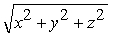 (a) What are the SI units of k?
(b) Find a mathematical expression in terms of x, y, and z for the y component of the force on the particle.
(c) If U = 3.00 J when the particle is 2.00 m from the origin, find the numerical value of the y component of the force on this particle when it is at the point (-1.00 m, 2.00 m, 3.00 m).
(a) What are the SI units of k?
(b) Find a mathematical expression in terms of x, y, and z for the y component of the force on the particle.
(c) If U = 3.00 J when the particle is 2.00 m from the origin, find the numerical value of the y component of the force on this particle when it is at the point (-1.00 m, 2.00 m, 3.00 m). (Short Answer)
4.8/5  (73)
(73) A potential energy function is given by U(x) = (3.00 J)x + (1.00 J/m2)x3. What is the force function F(x) that is associated with this potential energy function?
(Short Answer)
4.8/5 (79)
(79) A mass is pressed against (but is not attached to) an ideal horizontal spring on a frictionless horizontal surface. After being released from rest, the mass acquires a maximum speed v and a maximum kinetic energy K. If instead the mass initially compresses the spring twice as far:
(Multiple Choice)
4.8/5 (76)
(76) A ball drops some distance and gains 30 J of kinetic energy. Do NOT ignore air resistance. How much gravitational potential energy did the ball lose?
(Multiple Choice)
4.8/5 (77)
(77) The only force acting on an object moving along the x-axis is the conservative force given by F(x) = (2.00 N/m)x + (1.00 N/m3)x3.
(a) What is the change in potential energy when the object moves from x = 1.00 m to x = 2.00 m?
(b) What is the change in kinetic energy when the object moves from x = 1.00 m to x = 2.00 m?
(Short Answer)
4.9/5 (93)
(93) Two stones, one of mass m and the other of mass 2m, are thrown directly upward with the same velocity at the same time from ground level and feel no air resistance. Which statement about these stones is true?
(Multiple Choice)
4.8/5 (83)
(83) A 2.0 g bead slides along a frictionless wire, as shown in the figure. At point A, the bead is moving to the right but with negligible speed. 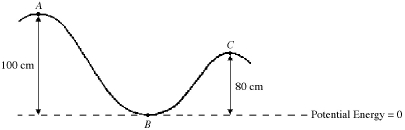 (a) What is the potential energy of the bead at point A?
(b) What is the kinetic energy of the bead at point B?
(c) What is the speed of the bead at point B?
(d) What is the speed of the bead at point C?
(a) What is the potential energy of the bead at point A?
(b) What is the kinetic energy of the bead at point B?
(c) What is the speed of the bead at point B?
(d) What is the speed of the bead at point C? (Short Answer)
4.9/5 (82)
(82) In the figure, a very small toy race car of mass m is released from rest on the loop-the-loop track. If it is released at a height 2R above the floor, how high is it above the floor when it leaves the track, neglecting friction? 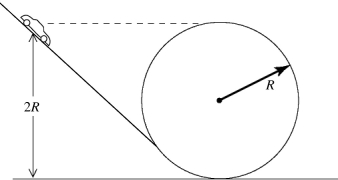
(Multiple Choice)
5.0/5 (62)
(62) In the figure, a 5.00-kg block is moving at 5.00 m/s along a horizontal frictionless surface toward an ideal massless spring that is attached to a wall. After the block collides with the spring, the spring is compressed a maximum distance of 0.68 m. What is the speed of the block when it has moved so that the spring is compressed to only one-half of the maximum distance? 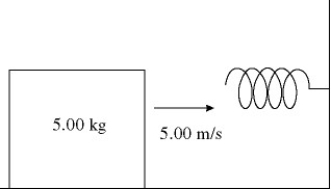
(Short Answer)
4.9/5 (91)
(91) An object is attached to a hanging unstretched ideal and massless spring and slowly lowered to its equilibrium position, a distance of 6.4 cm below the starting point. If instead of having been lowered slowly the object was dropped from rest, how far then would it then stretch the spring at maximum elongation?
(Multiple Choice)
4.8/5 (91)
(91) A 5.00-kg object moves clockwise around a 50.0 cm radius circular path. At one location, the speed of the object is 4.00 m/s. When the object next returns to this same location, the speed is 3.00 m/s.
(a) How much work was done by nonconservative (dissipative) forces as the object moved once around the circle?
(b) If the magnitude of the above nonconservative (dissipative) forces acting on the object is constant, what is the value of this magnitude?
(Short Answer)
4.8/5 (78)
(78) A 2.0 kg mass is moving along the x-axis. The potential energy curve as a function of position is shown in the figure. The kinetic energy of the object at the origin is 12 J. The system is conservative, and there is no friction. 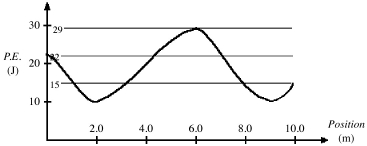 (a) What will be the kinetic energy at 2.0 m along the +x-axis?
(b) What will be the speed of the object at 6.0 m along the +x-axis?
(a) What will be the kinetic energy at 2.0 m along the +x-axis?
(b) What will be the speed of the object at 6.0 m along the +x-axis? (Short Answer)
4.9/5 (80)
(80) A force on an object is given by F(x) = ( -4.00 N/m)x + ( 2.00 N/m3)x3. What is the change in potential energy in moving from x = 1.00 m to x = 2.00 m?
(Multiple Choice)
4.8/5 (76)
(76) A 1.37-kg block is held in place against the spring by a 74-N horizontal external force (see the figure). The external force is removed, and the block is projected with a velocity v1 = 1.2 m/s upon separation from the spring. The block descends a ramp and has a velocity v2 = 1.4 m/s at the bottom. The track is frictionless between points A and B. The block enters a rough section at B, extending to E. The coefficient of kinetic friction over this section is 0.24. The velocity of the block is v3 = 1.4 m/s at C. The block moves on to D, where it stops. The initial compression of the spring is closest to: 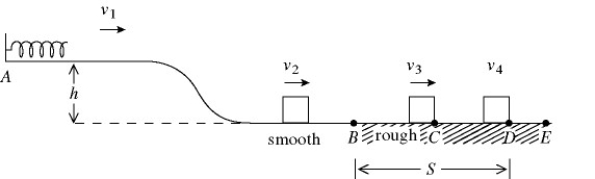
(Multiple Choice)
4.8/5 (63)
(63) A girl throws a stone from a bridge. Consider the following ways she might throw the stone. The speed of the stone as it leaves her hand is the same in each case, and air resistance is negligible.
Case A: Thrown straight up.
Case B: Thrown straight down.
Case C: Thrown out at an angle of 45° above horizontal.
Case D: Thrown straight out horizontally.
In which case will the speed of the stone be greatest when it hits the water below?
(Multiple Choice)
4.8/5 (95)
(95) In the figure, a stunt car driver negotiates the frictionless track shown in such a way that the car is barely in contact with the track at the top of the loop. The radius of the track is 9.9 m and the mass of the car is 1800 kg. Find the magnitude of the force of the car on the track when the car is at point A. You can treat the car as a point mass. 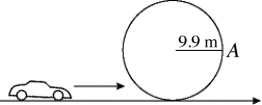
(Short Answer)
4.7/5 (94)
(94) The plot in the figure shows the potential energy of a particle, due to the force exerted on it by another particle, as a function of distance. At which of the three points labeled in the figure is the magnitude of the force on the particle greatest? 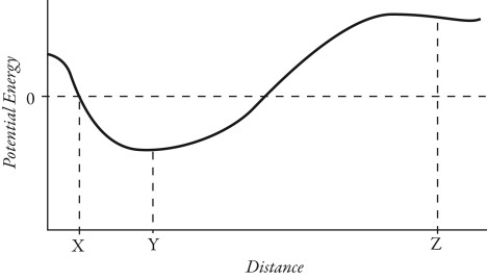
(Multiple Choice)
4.9/5 (82)
(82) A box of mass m is pressed against (but is not attached to) an ideal spring of force constant k and negligible mass, compressing the spring a distance x. After it is released, the box slides up a frictionless incline as shown in the figure and eventually stops. If we repeat this experiment but instead use a spring having force constant 2k 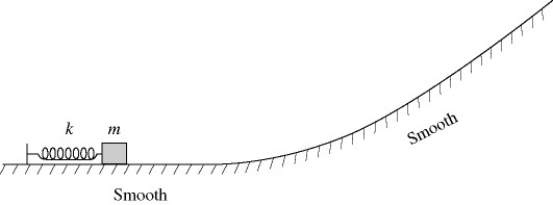
(Multiple Choice)
4.9/5 (65)
(65) A projectile is fired from ground level at an angle of 40.0° above horizontal at a speed of 30.0 m/s. What is the speed of the projectile when it has reached a height equal to 50.0% of its maximum height?
(Multiple Choice)
4.9/5 (87)
(87) A box of mass m is pressed against (but is not attached to) an ideal spring of force constant k and negligible mass, compressing the spring a distance x. After it is released, the box slides up a frictionless incline as shown in the figure and eventually stops. If we repeat this experiment with a box of mass 2m 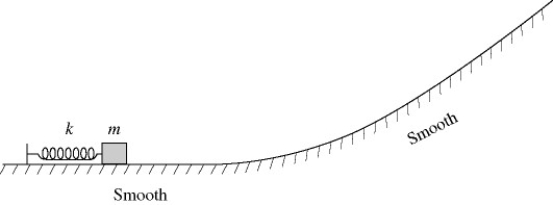
(Multiple Choice)
4.8/5 (81)
(81) 
Filters
- Essay(0)
- Multiple Choice(0)
- Short Answer(0)
- True False(0)
- Matching(0)