



 Chat with AI
Exam 2: Motion Along a Straight Line

Exam 1: Units, Physical Quantities, and Vectors107 Questions
Exam 2: Motion Along a Straight Line59 Questions
Exam 3: Motion in Two or Three Dimensions50 Questions
Exam 4: Newtons Laws of Motion44 Questions
Exam 5: Applying Newtons Laws95 Questions
Exam 6: Work and Kinetic Energy54 Questions
Exam 7: Potential Energy and Energy Conservation55 Questions
Exam 8: Momentum, Impulse, and Collisions50 Questions
Exam 9: Rotation of Rigid Bodies26 Questions
Exam 10: Equilibrium and Elasticity50 Questions
Exam 11: Fluid Mechanics50 Questions
Exam 12: Gravitation50 Questions
Exam 13: Periodic Motion50 Questions
Exam 14: Mechanical Waves44 Questions
Exam 15: Sound and Hearing66 Questions
Exam 16: Temperature and Heat63 Questions
Exam 17: Thermal Properties of Matter58 Questions
Exam 18: The First Law of Thermodynamics52 Questions
Exam 19: The Second Law of Thermodynamics50 Questions
Exam 20: Electric Charge and Electric Field58 Questions
Exam 21: Gausss Law41 Questions
Exam 22: Electric Potential55 Questions
Exam 23: Capacitance and Dielectrics52 Questions
Exam 24: Current, Resistance, and Electromotive Force50 Questions
Exam 25: Direct-Current Circuits53 Questions
Exam 26: Magnetic Field and Magnetic Forces36 Questions
Exam 27: Sources of Magnetic Field51 Questions
Exam 28: Electromagnetic Induction39 Questions
Exam 29: Inductance26 Questions
Exam 30: Alternating Current49 Questions
Exam 31: Electromagnetic Waves47 Questions
Exam 32: The Nature and Propagation of Light28 Questions
Exam 33: Geometric Optics81 Questions
Exam 34: Interference33 Questions
Exam 35: Diffraction49 Questions
Exam 36: Relativity51 Questions
Exam 37: Photons: Light Waves Behaving As Particles38 Questions
Exam 38: Particles Behaving As Waves52 Questions
Exam 39: Quantum Mechanics40 Questions
Exam 40: Atomic Structure41 Questions
Exam 41: Molecules and Condensed Matter31 Questions
Exam 42: Nuclear Physics89 Questions
Exam 43: Particle Physics and Cosmology44 Questions
Select questions type


A car starts from rest and accelerates with a constant acceleration of 1.00 m/s2 for 3.00 s. The car continues for 5.00 s at constant velocity. How far has the car traveled from its starting point?
(Multiple Choice)
4.9/5  (82)
(82) The position of an object as a function of time is given by x(t) = at3 - bt2 + ct - d, where
a = 3.6 m/s3, b = 4.0 m/s2, c = 60 m/s and d = 7.0 m.
(a) Find the instantaneous acceleration at t =2.4 s.
(b) Find the average acceleration over the first 2.4 seconds.
(Short Answer)
4.8/5 (74)
(74) A foul ball is hit straight up into the air with a speed of 30.0 m/s.
(a) Calculate the time required for the ball to rise to its maximum height.
(b) Calculate the maximum height reached by the ball.
(c) Determine the time at which the ball pass a point 25.0 m above the point of contact between the bat and ball.
(d) Explain why there are two answers to part (c).
(Short Answer)
4.9/5 (74)
(74) When can we be certain that the average velocity of an object is always equal to its instantaneous velocity?
(Multiple Choice)
4.9/5 (82)
(82) The motion of a particle is described in the velocity versus time graph shown in the figure. We can say that its speed 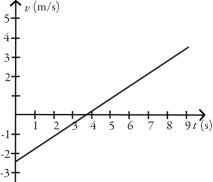
(Multiple Choice)
4.8/5 (83)
(83) The position of an object is given by x = at3 - bt2 + ct where a = 4.1 m/s3, b = 2.2 m/s2,
C = 1.7 m/s and x and t are in SI units. What is the instantaneous acceleration of the object when
T = 0.7 s?
(Multiple Choice)
4.8/5 (91)
(91) A rock is thrown directly upward from the edge of the roof of a building that is 66.2 meters tall. The rock misses the building on its way down, and is observed to strike the ground 4.00 seconds after being thrown. Neglect any effects of air resistance. With what speed was the rock thrown?
(Short Answer)
4.9/5 (54)
(54) A cat runs along a straight line (the x-axis) from point A to point B to point C, as shown in the figure. The distance between points A and C is 5.00 m, the distance between points B and C is 10.0 m, and the positive direction of the x-axis points to the right. The time to run from A to B is 20.0 s, and the time from B to C is 8.00 s. As the cat runs along the x-axis between points A and C
(a) what is the magnitude of its average velocity?
(b) what is its average speed? 
(Short Answer)
5.0/5 (68)
(68) A ball is projected upward at time t = 0.0 s, from a point on a roof 90 m above the ground. The ball rises, then falls and strikes the ground. The initial velocity of the ball is 36.2 m/s if air resistance is negligible. The time when the ball strikes the ground is closest to
(Multiple Choice)
4.8/5 (81)
(81) A runner maintains constant acceleration after starting from rest as she runs a distance of 60.0 m. The runner's speed at the end of the 60.0 m is 9.00 m/s. How much time did it take the runner to complete the 60.0 m distance?
(Multiple Choice)
4.9/5 (86)
(86) A dragster starts from rest and travels 1/4 mi in 6.70 s with constant acceleration. What is its velocity when it crosses the finish line?
(Multiple Choice)
4.9/5 (71)
(71) On the earth, when an astronaut throws a 0.250-kg stone vertically upward, it returns to his hand a time T later. On planet X he finds that, under the same circumstances, the stone returns to his hand in 2T. In both cases, he throws the stone with the same initial velocity and it feels negligible air resistance. The acceleration due to gravity on planet X (in terms of g) is
(Multiple Choice)
4.8/5 (86)
(86) A test rocket is fired straight up from rest with a net acceleration of 20.0 m/s2. After 4.00 seconds the motor turns off, but the rocket continues to coast upward with no appreciable air resistance. What maximum elevation does the rocket reach?
(Multiple Choice)
4.8/5 (90)
(90) A speeding car is traveling at a constant 30.0 m/s when it passes a stationary police car. If the police car delays for 1.00 s before starting, what must be the magnitude of the constant acceleration of the police car to catch the speeding car after the police car travels a distance of 300 m?
(Multiple Choice)
4.9/5 (82)
(82) A racing car accelerates uniformly from rest along a straight track. This track has markers spaced at equal distances along it from the start, as shown in the figure. The car reaches a speed of 140 km/h as it passes marker 2. Where on the track was the car when it was traveling at 70 km/h? 
(Multiple Choice)
4.8/5 (91)
(91) The figure shows the velocity of a particle as it travels along the x-axis. What is the direction of the acceleration at t = 0.5 s? 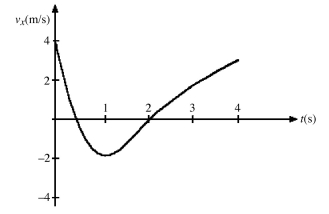
(Multiple Choice)
4.7/5 (79)
(79) Two objects are dropped from a bridge, an interval of 1.0 s apart, and experience no appreciable air resistance. As time progresses, the DIFFERENCE in their speeds
(Multiple Choice)
4.7/5 (80)
(80) A ball rolls across a floor with an acceleration of 0.100 m/s2 in a direction opposite to its velocity. The ball has a velocity of 4.00 m/s after rolling a distance 6.00 m across the floor. What was the initial speed of the ball?
(Multiple Choice)
4.9/5 (75)
(75) The velocity of an object is given by the expression v(t) = 3.00 m/s + (4.00 m/s3)t2, where t is in seconds. Determine the position of the object as a function of time if it is located at x = 1.00 m at time t = 0.000 s.
(Multiple Choice)
5.0/5 (87)
(87) 
Filters
- Essay(0)
- Multiple Choice(0)
- Short Answer(0)
- True False(0)
- Matching(0)