



 Chat with AI
Exam 11: Taylor Polynomials and Infinite Series

Exam 1: The Derivative189 Questions
Exam 2: Applications of the Derivative93 Questions
Exam 3: Techniques of Differentiation69 Questions
Exam 4: Logarithm Functions135 Questions
Exam 5: Applications of the Exponential and Natural Logarithm Functions73 Questions
Exam 6: The Definite Integral135 Questions
Exam 7: Functions of Several Variables119 Questions
Exam 8: The Trigonometric Functions128 Questions
Exam 9: Techniques of Integration178 Questions
Exam 10: Differential Equations126 Questions
Exam 11: Taylor Polynomials and Infinite Series132 Questions
Exam 12: Probability and Calculus92 Questions
Select questions type


Use the second Taylor polynomial at x = 1 to estimate .
Enter just a reduced fraction.
(Short Answer)
5.0/5  (88)
(88) Find the Taylor series of f(x) = for < 1 then multiply the series by x to obtain a series expansion of , and then use these two series to obtain a series expansion of for < 1.
Is the correct expansion?
(True/False)
4.8/5 (80)
(80) Find the first four non-zero terms of the Taylor series at x = 0 of .
Is correct?
(True/False)
4.8/5 (82)
(82) Suppose is an initial approximation of a zero of the function f(x). Using the Newton-Raphson algorithm, a second approximation, is obtained. Which of the following must be true?
(Multiple Choice)
4.8/5 (71)
(71) Suppose f(x) = - 7 + 2. The fifth Taylor polynomial of f(x) at x = 1 is .
(True/False)
4.7/5 (75)
(75) Find the first four non-zero terms of the Taylor series at x = 0 of .
Is the correct answer?
(True/False)
4.8/5 (83)
(83) Suppose converges. What can you say about the value of m?
Enter your answer in standard interval notation (no variables).
(Short Answer)
4.8/5 (80)
(80) Consider the following geometric series: - + - + ... . Which of the following statements is true?
(Multiple Choice)
4.8/5 (68)
(68) The function f(x) = sin is approximated by its second Taylor polynomial (x) at x = 0. Which of the following statements is NOT true?
(Multiple Choice)
4.9/5 (69)
(69) Find the first four non-zero terms of the Taylor series at x = 0 for f(x) = 1 + .
Is the correct answer?
(True/False)
4.8/5 (95)
(95) Find the second Taylor polynomial for f(x) = at x = 0 and use it to approximate .
Enter just a real number rounded off to two decimal places.
(Short Answer)
4.7/5 (94)
(94) Suppose f(x) = - 7 + 2. The third Taylor polynomial of f(x) at x = 1 is .
(True/False)
4.9/5 (82)
(82) If the following is a graph of f(x), which of the following could be the first Taylor polynomial of f at ? 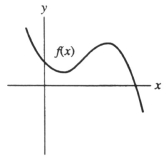
(Multiple Choice)
4.7/5 (74)
(74) Use the comparison test to determine whether the infinite series is convergent or divergent.
Enter just "convergent" or "divergent".
(Short Answer)
4.9/5 (76)
(76) Suppose f(0) = 1, f'(0) = 1, and f''(0) = -1. Use a Taylor polynomial of degree two to approximate f . Is the solution?
(True/False)
4.8/5 (91)
(91) Use the Newton-Raphson algorithm with three repetitions to approximate the solution to = 2 - x near x = 2.
Enter just a real number rounded off to two decimal places.
(Short Answer)
4.8/5 (75)
(75) Find the first four non-zero terms of the Taylor series at x = 0 of .
Is correct?
(True/False)
4.9/5 (61)
(61) 
Filters
- Essay(0)
- Multiple Choice(0)
- Short Answer(0)
- True False(0)
- Matching(0)