



 Chat with AI
Exam 18: Fiscal Policy

Exam 1: The Big Ideas253 Questions
Exam 2: The Power of Trade150 Questions
Exam 3: Supply and Demand135 Questions
Exam 4: Equilibrium- How Supply and Demand241 Questions
Exam 5: Price Ceilings and Floors309 Questions
Exam 6: GDP and the Measurement of Progress205 Questions
Exam 7: The Wealth of Nations and Economic Growth269 Questions
Exam 8: Growth,capital Accumulation155 Questions
Exam 9: Saving,investment,and the Financial System285 Questions
Exam 10: Stock Markets and Personal Finance241 Questions
Exam 11: Unemployment and Labor Force Participation186 Questions
Exam 12: Inflation and the Quantity Theory of Money155 Questions
Exam 13: Business Fluctuations231 Questions
Exam 14: Transmission and Amplification Mechanisms219 Questions
Exam 15: The Federal Reserve System271 Questions
Exam 16: Monetary Policy242 Questions
Exam 17: The Federal Budget- Taxes and Spending167 Questions
Exam 18: Fiscal Policy270 Questions
Exam 19: International Trade192 Questions
Exam 20: International Finance289 Questions
Exam 21: Political Economy and Public Choice304 Questions
Select questions type


In a recession,some aspects of fiscal policy can stimulate aggregate demand without deliberate actions of policymakers.This occurs as a result of:
(Multiple Choice)
4.8/5  (73)
(73) Lags associated with monetary policy are generally longer than lags associated with fiscal policy.
(True/False)
4.7/5 (92)
(92) Which statement does NOT limit the effectiveness of fiscal policy?
(Multiple Choice)
4.9/5 (59)
(59) When the government conducts fiscal policy,it makes up for a decrease in with:
(Multiple Choice)
4.8/5 (87)
(87) If Ricardian equivalence holds,then an expansionary fiscal policy will:
(Multiple Choice)
4.8/5 (72)
(72) Which statement is TRUE about the difference between monetary and fiscal policy?
(Multiple Choice)
4.8/5 (69)
(69) In the short run,an increase in government spending growth will cause the inflation rate to:
(Multiple Choice)
4.8/5 (82)
(82) Many economists believe that the most harmful consequence of continuing to finance high budget deficits through borrowing is the upward pressure placed on interest rates.Explain this argument.(That is,explain why higher budget deficits may lead to higher interest rates and why this may be detrimental to the economy in the long run. )
(Essay)
4.7/5 (77)
(77) Use the following to answer questions
Figure: Aggregate Demand and Fiscal Policy 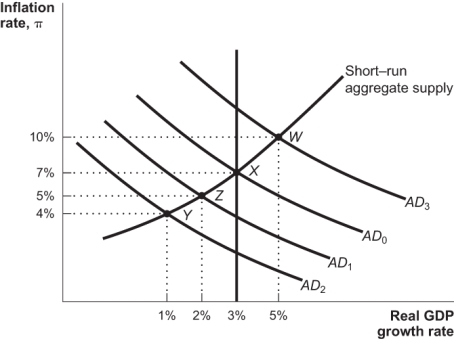 -(Figure: Aggregate Demand and Fiscal Policy)Refer to the figure.In the best case scenario,effective fiscal policy would take which action to correct an economy in recession at point Z?
 (Multiple Choice)
4.8/5 (80)
(80) Use the following to answer questions
Figure: Aggregate Demand and Fiscal Policy
-(Figure: Aggregate Demand and Fiscal Policy)Refer to the figure.In the best case scenario,an economy in a recession at point Y would use fiscal policy to increase spending growth to:
-(Figure: Aggregate Demand and Fiscal Policy)Refer to the figure.In the best case scenario,an economy in a recession at point Y would use fiscal policy to increase spending growth to: (Multiple Choice)
5.0/5 (77)
(77) A decrease in consumption growth will cause inflation to fall in:
(Multiple Choice)
4.7/5 (69)
(69) Bond-financed expansionary fiscal policy is least likely to be effective when the private sector is reluctant to spend or invest.
(True/False)
4.8/5 (82)
(82) A decrease in consumption growth will cause the LRAS curve to:
(Multiple Choice)
4.8/5 (66)
(66) What can happen when a government continues to use expansionary fiscal policy even as government debt becomes a problem?
(Multiple Choice)
4.9/5 (72)
(72) Which fiscal stimulus policy will provide a greater incentive to work?
(Multiple Choice)
4.8/5 (72)
(72) Fiscal policy is most desirable if the economy returns to its long-run equilibrium immediately after a shock occurs.
(True/False)
4.8/5 (67)
(67) When consumers are very reluctant to spend in a recessionary environment,the government's MOST effective strategy is to:
(Multiple Choice)
4.8/5 (73)
(73) 
Filters
- Essay(0)
- Multiple Choice(0)
- Short Answer(0)
- True False(0)
- Matching(0)