



 Chat with AI
Exam 13: Business Fluctuations

Exam 1: The Big Ideas253 Questions
Exam 2: The Power of Trade150 Questions
Exam 3: Supply and Demand135 Questions
Exam 4: Equilibrium- How Supply and Demand241 Questions
Exam 5: Price Ceilings and Floors309 Questions
Exam 6: GDP and the Measurement of Progress205 Questions
Exam 7: The Wealth of Nations and Economic Growth269 Questions
Exam 8: Growth,capital Accumulation155 Questions
Exam 9: Saving,investment,and the Financial System285 Questions
Exam 10: Stock Markets and Personal Finance241 Questions
Exam 11: Unemployment and Labor Force Participation186 Questions
Exam 12: Inflation and the Quantity Theory of Money155 Questions
Exam 13: Business Fluctuations231 Questions
Exam 14: Transmission and Amplification Mechanisms219 Questions
Exam 15: The Federal Reserve System271 Questions
Exam 16: Monetary Policy242 Questions
Exam 17: The Federal Budget- Taxes and Spending167 Questions
Exam 18: Fiscal Policy270 Questions
Exam 19: International Trade192 Questions
Exam 20: International Finance289 Questions
Exam 21: Political Economy and Public Choice304 Questions
Select questions type


A significant,widespread decline in real income and employment is called:
(Multiple Choice)
4.9/5  (78)
(78) Expected increases in the price of oil are the most costly to deal with.
(True/False)
5.0/5 (84)
(84) The aggregate demand curve is a straight line with a slope of _____.
(Multiple Choice)
4.8/5 (71)
(71) Which of the following would NOT shift the long-run aggregate supply curve?
(Multiple Choice)
4.8/5 (74)
(74) Each aggregate demand curve contains only one combination of inflation and real growth that leads to a distinct level of spending.
(True/False)
4.7/5 (75)
(75) During periods of real shocks,the long-run aggregate supply curve will remain the same in the short term and the long run.
(True/False)
4.9/5 (77)
(77) Variations in real GDP growth around its trend growth rate are called:
(Multiple Choice)
4.9/5 (81)
(81) The aggregate demand curve shows all the combinations of _____ and _____ that are consistent with a specified rate of _____.
(Multiple Choice)
4.7/5 (76)
(76) For an aggregate demand curve with = 10% and = 0%,if inflation is 6%,then real growth is:
(Multiple Choice)
4.8/5 (72)
(72) Use the following to answer questions
Figure: Aggregate Demand 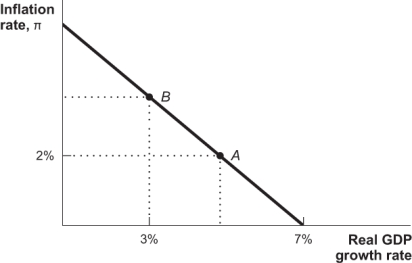 -(Figure: Aggregate Demand)Point A on this aggregate demand curve represents a real GDP growth rate of:
 (Multiple Choice)
4.7/5 (86)
(86) The short-run aggregate supply curve shows that higher-than-expected-inflation will increase output and lower-than-expected-inflation will decrease output.
(True/False)
4.9/5 (93)
(93) Which of the following is NOT a positive aggregate demand shock?
(Multiple Choice)
4.8/5 (83)
(83) 
Filters
- Essay(0)
- Multiple Choice(0)
- Short Answer(0)
- True False(0)
- Matching(0)