



 Chat with AI
Exam 9: Saving,investment,and the Financial System

Exam 1: The Big Ideas253 Questions
Exam 2: The Power of Trade150 Questions
Exam 3: Supply and Demand135 Questions
Exam 4: Equilibrium- How Supply and Demand241 Questions
Exam 5: Price Ceilings and Floors309 Questions
Exam 6: GDP and the Measurement of Progress205 Questions
Exam 7: The Wealth of Nations and Economic Growth269 Questions
Exam 8: Growth,capital Accumulation155 Questions
Exam 9: Saving,investment,and the Financial System285 Questions
Exam 10: Stock Markets and Personal Finance241 Questions
Exam 11: Unemployment and Labor Force Participation186 Questions
Exam 12: Inflation and the Quantity Theory of Money155 Questions
Exam 13: Business Fluctuations231 Questions
Exam 14: Transmission and Amplification Mechanisms219 Questions
Exam 15: The Federal Reserve System271 Questions
Exam 16: Monetary Policy242 Questions
Exam 17: The Federal Budget- Taxes and Spending167 Questions
Exam 18: Fiscal Policy270 Questions
Exam 19: International Trade192 Questions
Exam 20: International Finance289 Questions
Exam 21: Political Economy and Public Choice304 Questions
Select questions type


At an 8% interest rate,the quantity of savings is $250 billion.What would the quantity of savings be if the interest rate falls to 5%?
(Multiple Choice)
4.9/5  (78)
(78) Which of the following is NOT a role that banks play in the loanable funds market?
(Multiple Choice)
4.8/5 (88)
(88) 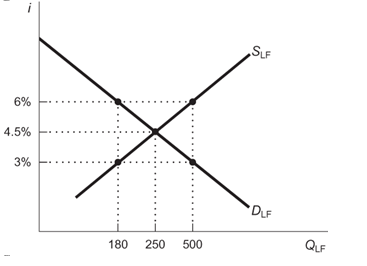 -A shortage of savings in the loanable funds market will:
If $100 is saved at an annual interest rate of 10%,the return in one year will be:
(Multiple Choice)
4.8/5 (82)
(82) The supply of savings function shows the relationship between saving and:
(Multiple Choice)
4.9/5 (77)
(77) Why is saving so minimal in nations with a high population of AIDS victims?
(Multiple Choice)
4.8/5 (72)
(72) If the interest rate rises from 5% to 9%,the number of new businesses will:
(Multiple Choice)
4.8/5 (85)
(85) An increase in the supply of saving curve will cause the equilibrium quantity of borrowing to:
(Multiple Choice)
5.0/5 (79)
(79) Studies have shown that the larger the fraction of government-owned banks in a country,the faster the country's rate of per capita GDP growth.
(True/False)
4.8/5 (77)
(77) Which of the following explains why the supply of savings is upward sloping?
(Multiple Choice)
4.7/5 (98)
(98) Something of value that by agreement becomes the property of the lender if the borrower defaults is called:
(Multiple Choice)
4.8/5 (70)
(70) 
Filters
- Essay(0)
- Multiple Choice(0)
- Short Answer(0)
- True False(0)
- Matching(0)