



 Chat with AI
Exam 21: Political Economy and Public Choice

Exam 1: The Big Ideas253 Questions
Exam 2: The Power of Trade150 Questions
Exam 3: Supply and Demand135 Questions
Exam 4: Equilibrium- How Supply and Demand241 Questions
Exam 5: Price Ceilings and Floors309 Questions
Exam 6: GDP and the Measurement of Progress205 Questions
Exam 7: The Wealth of Nations and Economic Growth269 Questions
Exam 8: Growth,capital Accumulation155 Questions
Exam 9: Saving,investment,and the Financial System285 Questions
Exam 10: Stock Markets and Personal Finance241 Questions
Exam 11: Unemployment and Labor Force Participation186 Questions
Exam 12: Inflation and the Quantity Theory of Money155 Questions
Exam 13: Business Fluctuations231 Questions
Exam 14: Transmission and Amplification Mechanisms219 Questions
Exam 15: The Federal Reserve System271 Questions
Exam 16: Monetary Policy242 Questions
Exam 17: The Federal Budget- Taxes and Spending167 Questions
Exam 18: Fiscal Policy270 Questions
Exam 19: International Trade192 Questions
Exam 20: International Finance289 Questions
Exam 21: Political Economy and Public Choice304 Questions
Select questions type


Do "good politics" and "good economics" always coincide? Explain why or why not.
(Essay)
4.7/5  (65)
(65) Democracy typically brings about more efficient outcomes because:
(Multiple Choice)
4.8/5 (83)
(83) The United States federal government ______ the amount of sugar entering the country.
(Multiple Choice)
4.9/5 (76)
(76) The smaller a special interest group is in term of percentage of the overall population,the more political power it typically has.
(True/False)
4.9/5 (88)
(88) Politicians have a strong incentive to support projects even when their costs outweigh their benefits if:
(Multiple Choice)
4.8/5 (92)
(92) Use the following to answer questions
Figure: Median Voter 2  -(Figure: Median Voter 2)If taxes are the only issue and the candidates' names are in gray,who votes for John Jackson?
 (Multiple Choice)
4.9/5 (82)
(82) Policy A adversely affects 50 million people at a cost of $1 per person.But Policy A also benefits 1,000 people at $30,000 per person.Which of the following statements is TRUE?
(Multiple Choice)
4.8/5 (69)
(69) Economists say that voters are rationally ignorant about politics because:
(Multiple Choice)
4.8/5 (75)
(75) When government makes it possible to externalize the cost of a good:
(Multiple Choice)
4.9/5 (81)
(81) Control of the media do not enable special interest groups to control the government for their own ends.
(True/False)
4.7/5 (82)
(82) According to the text,the 1974 famine in Bangladesh was largely a result of
(Multiple Choice)
4.9/5 (67)
(67) The diffusion of costs and concentration of benefits: I.leads to rational ignorance on the part of voters.
II.is the formula to which the sugar quota owes its existence.
III.is a formula for reelection to political office.
(Multiple Choice)
5.0/5 (82)
(82) The incumbent president is more likely to win reelection if:
(Multiple Choice)
4.9/5 (85)
(85) Special interest groups have a large incentive to be ________ about legislation that benefits them directly,whereas voters tend to be ________ regarding these issues.
(Multiple Choice)
4.9/5 (76)
(76) Figure: Median Voter 3 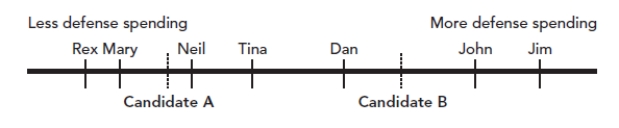 Suppose this figure represents defense spending preferences for seven voters and two candidates.Which candidate is more likely to win the election and why? If the losing candidate knows these preferences BEFORE the election,will that candidate be likely to change his or her public stance on defense spending? How?
 (Essay)
4.7/5 (77)
(77) Public choice theory implies that democracy is a perfect system to serve the social interest.
(True/False)
4.9/5 (88)
(88) If a special interest group represents 10% of society,and there is a proposed public policy that will cost society $1 million and benefit that special interest group $1 million,which of the following is the most likely outcome according to public choice theory?
(Multiple Choice)
4.7/5 (85)
(85) Voter myopia is the notion that voters are largely swayed by current economic conditions when casting their vote.
(True/False)
4.8/5 (80)
(80) Much of public choice argues that what the public wants isn't reflected in elected officials' actions.Yet there is a strong connection between famine prevention and democracy (more democracy means less famine),and this "exception" is completely consistent with ideas from public choice.Why?
(Multiple Choice)
4.9/5 (79)
(79) 
Filters
- Essay(0)
- Multiple Choice(0)
- Short Answer(0)
- True False(0)
- Matching(0)