



 Chat with AI
Exam 5: Price Ceilings and Floors

Exam 1: The Big Ideas253 Questions
Exam 2: The Power of Trade150 Questions
Exam 3: Supply and Demand135 Questions
Exam 4: Equilibrium- How Supply and Demand241 Questions
Exam 5: Price Ceilings and Floors309 Questions
Exam 6: GDP and the Measurement of Progress205 Questions
Exam 7: The Wealth of Nations and Economic Growth269 Questions
Exam 8: Growth,capital Accumulation155 Questions
Exam 9: Saving,investment,and the Financial System285 Questions
Exam 10: Stock Markets and Personal Finance241 Questions
Exam 11: Unemployment and Labor Force Participation186 Questions
Exam 12: Inflation and the Quantity Theory of Money155 Questions
Exam 13: Business Fluctuations231 Questions
Exam 14: Transmission and Amplification Mechanisms219 Questions
Exam 15: The Federal Reserve System271 Questions
Exam 16: Monetary Policy242 Questions
Exam 17: The Federal Budget- Taxes and Spending167 Questions
Exam 18: Fiscal Policy270 Questions
Exam 19: International Trade192 Questions
Exam 20: International Finance289 Questions
Exam 21: Political Economy and Public Choice304 Questions
Select questions type


Use the following to answer questions
Figure: Price Ceilings and Random Allocation 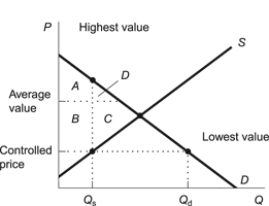 -(Figure: Price Ceilings and Random Allocation)Refer to the figure.When a controlled price is imposed and the quantity of goods is allocated randomly between the highest-valued uses and lowest-valued uses,loss due to random allocation instead of allocation to the highest-valued use is represented by area:
 (Multiple Choice)
4.7/5  (92)
(92) The blat economy described in the text results when price controls are:
(Multiple Choice)
4.8/5 (79)
(79) The quantity traded with a binding price ceiling is lower than the quantity traded without a price ceiling,which means that price ceilings create lost gains from trade.
(True/False)
4.7/5 (87)
(87) If a price floor is above the equilibrium price it will have no effect in the market.
(True/False)
4.9/5 (77)
(77) Setting the maximum legal price above the market price will cause
(Multiple Choice)
4.7/5 (82)
(82) Prices ceilings misallocate resources because with them resources are not necessarily allocated to their highest-valued use.
(True/False)
4.9/5 (75)
(75) Once one accounts for time costs and bribes,it may be more expensive to make purchases at the government-controlled price than at the free-market price.
(True/False)
4.9/5 (83)
(83) A price ceiling is a legal maximum on the price of the good or service.
(True/False)
4.9/5 (92)
(92) If price controls are imposed,gains from trade,including consumer and producer surplus,are likely to increase.
(True/False)
4.7/5 (64)
(64) Which of these statements explains why price ceilings result in lost gains from trade?
(Multiple Choice)
4.8/5 (75)
(75) Use the following to answer questions
Figure: Costs of Price Ceilings 2 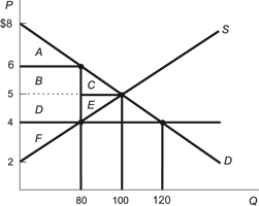 -(Figure: Costs of Price Ceilings 2)Refer to the figure.What is the dollar amount of lost producer surplus after the price ceiling of $4 has been implemented?
 (Multiple Choice)
4.9/5 (84)
(84) How can sellers increase profits when they face a price ceiling?
(Multiple Choice)
4.9/5 (97)
(97) Housing vouchers are a better option than rent controls when a government is attempting to make housing affordable for the poor.The reason is that the housing voucher entitles the tenant to:
(Multiple Choice)
4.8/5 (70)
(70) A major hurricane damages many oil refineries,which increases the market price of gasoline from $3.50 to $5 per gallon.The Attorney General threatens legal action against gas station owners who raise prices above pre-hurricane levels,causing gas station owners to reluctantly sell gas for $3.50 per gallon.At $3.50 per gallon,shortages cause buyers to wait in line for 2 hours.If the average purchase is 15 gallons and buyers value their time at $20 an hour,is the Attorney General helping?
(Multiple Choice)
4.7/5 (83)
(83) If quantity supplied equals 40 units and quantity demanded equals 50 units under a price control,then it is a:
(Multiple Choice)
4.8/5 (76)
(76) 
Filters
- Essay(0)
- Multiple Choice(0)
- Short Answer(0)
- True False(0)
- Matching(0)