



 Chat with AI
Exam 10: Credit Analysis

Exam 1: Overview of Financial Statement Analysis79 Questions
Exam 2: Financial Reporting and Analysis74 Questions
Exam 3: Analyzing Financing Activities82 Questions
Exam 4: Analyzing Investing Activities67 Questions
Exam 5: Analyzing Investing Activities: Intercorporate Investments101 Questions
Exam 6: Analyzing Operating Activities83 Questions
Exam 7: Cash Flow Analysis80 Questions
Exam 8: Return on Invested Capital and Profitability Analysis76 Questions
Exam 9: Prospective Analysis65 Questions
Exam 10: Credit Analysis104 Questions
Exam 11: Equity Analysis and Valuation73 Questions
Select questions type


For purposes of long-term solvency analysis the calculation of balance sheet ratios such as debt/equity or debt to total capital are of limited value and are used mostly as screening mechanisms to indicate whether further analysis is warranted.
(True/False)
4.8/5  (65)
(65) Which of the following statements concerning the current ratio are true?
I. It is always larger than the acid-test (quick) ratio
II. Companies can window-dress their current ratios
III. In isolation the current ratio has little meaning
IV. It is a good indicator of solvency of a company
(Multiple Choice)
4.9/5 (81)
(81) Consider each of the following situations independently of each other. For each of the situations provide one example of when the underlying circumstances may be such that the observed trend is unfavorable and one example of when the underlying circumstances are favorable.
a. Current ratio increases from one period to the next
b. Accounts receivable turnover increases from one period to the next
c. Accounts payable turnover increases from one period to the next
(Essay)
4.9/5 (79)
(79) In assessing the quality of receivables it is important to consider the revenue recognition methods used by a company.
(True/False)
4.7/5 (87)
(87) When examining the current ratio and trends in the current ratio it is important to evaluate the turnover rate of current assets and current liabilities and trends in these turnover ratios.
(True/False)
4.9/5 (73)
(73) The cash ratio is a measure of the degree of current asset liquidity.
(True/False)
4.9/5 (64)
(64) An increase in the current ratio over time is always a good indication of increased liquidity of the firm.
(True/False)
4.8/5 (82)
(82) If accounts payable turnover decreases this could be an indication that suppliers are cutting off credit to the company.
(True/False)
4.8/5 (82)
(82) Which of the following does not represent future expected cash inflows?
(Multiple Choice)
4.9/5 (66)
(66) Capitalization of interest results in an understatement of the times interest earned.
(True/False)
5.0/5 (88)
(88) An analyst should treat preferred stock on a firm's balance sheet as debt when calculating leverage ratios if the preferred stock is:
(Multiple Choice)
4.9/5 (77)
(77) Financial leverage ratio for Company A and B for 2005 are: Company A Company B A) 1.0 1.0 B) 2.0 1.0 C) 0.70 0.6 D) 0.50 1.0
(Multiple Choice)
4.7/5 (93)
(93) Reported operating income for Horace Corporation was $145,000 and reported interest expense was $ 45,000. Times interest earned for Horace Corporation, after necessary adjustments, was:
(Multiple Choice)
4.9/5 (79)
(79) The current ratio is a superior tool to cash flow projections and pro forma financial statements in assessing short-term liquidity.
(True/False)
4.7/5 (89)
(89) A company's return on assets will equal its return on equity if the after-tax cost of debt equals the return on assets.
(True/False)
4.9/5 (70)
(70) Problem Two: Cash Levels and Current Ratio
Indicate the effect of the following actions on cash levels and current ratio. Assume the company has a current ratio greater than one. Indicate whether the effect is to increase (I), decrease (D) or if it has no effect (NE). Consider each action independently of others. Current Ratio Cash Increased credit limits to maintain sales levels Convert to just-in-time inventory system Change from FIFO to weighted average inventory method (rising prices) Pay suppliers more slowly Sell accounts receivable at face value Capitalize leases that were previously called operating leases Increase bad debt expense Sell equity Issue stock dividend Write down inventory
(Essay)
4.9/5 (78)
(78) Problem Four: Dell Financial Risk
Following are Dell's condensed consolidated statement of financial position and condensed consolidated statement of operations, in millions (unaudited).
Statement of Financial Position 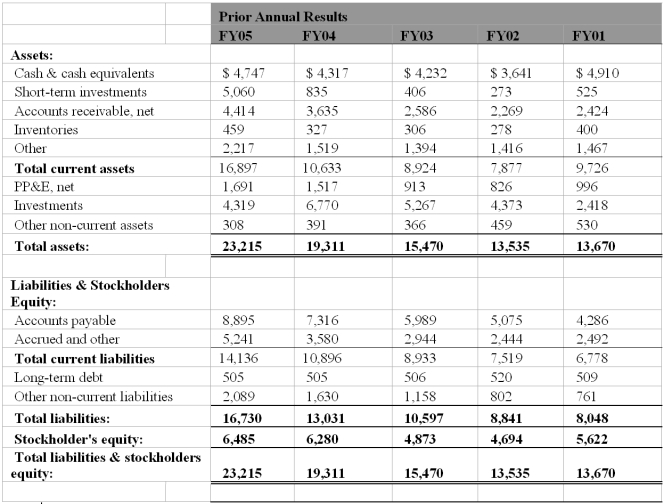 Statement of Operations
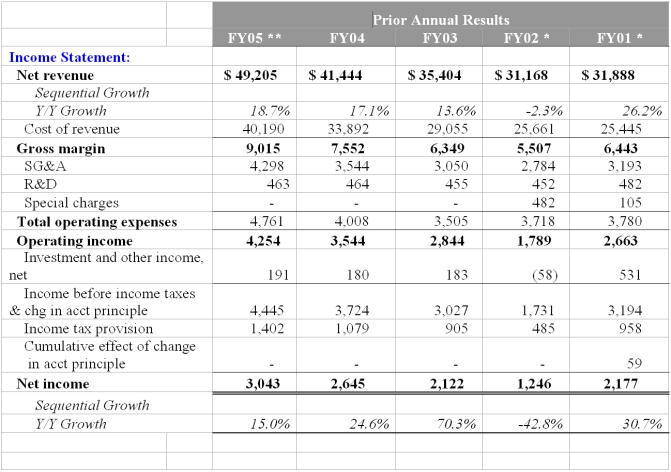 a. Using the above information, calculate the following ratios for FY05 to FY02:
1. Current ratio
2. Quick ratio
3. Working capital
4. Days in accounts receivable
5. Days supply in inventory
6. Days in accounts payable
7. Net days working capital
8. Long-term debt to assets ratio
9. Debt to equity ratio
10. liabilities to total assets
b. Comment on the changes to Dell's liquidity risk
c. Comment on the changes to Dell's solvency risk
Statement of Operations
a. Using the above information, calculate the following ratios for FY05 to FY02:
1. Current ratio
2. Quick ratio
3. Working capital
4. Days in accounts receivable
5. Days supply in inventory
6. Days in accounts payable
7. Net days working capital
8. Long-term debt to assets ratio
9. Debt to equity ratio
10. liabilities to total assets
b. Comment on the changes to Dell's liquidity risk
c. Comment on the changes to Dell's solvency risk (Essay)
4.8/5 (77)
(77) The total debt to total capital ratio is more useful than the total debt to equity capital ratio.
(True/False)
4.9/5 (77)
(77) If a company switches from FIFO to LIFO during a period of rising prices, inventory turnover will probably increase.
(True/False)
4.8/5 (95)
(95) 
Filters
- Essay(0)
- Multiple Choice(0)
- Short Answer(0)
- True False(0)
- Matching(0)