



 Chat with AI
Exam 10: Credit Analysis

Exam 1: Overview of Financial Statement Analysis79 Questions
Exam 2: Financial Reporting and Analysis74 Questions
Exam 3: Analyzing Financing Activities82 Questions
Exam 4: Analyzing Investing Activities67 Questions
Exam 5: Analyzing Investing Activities: Intercorporate Investments101 Questions
Exam 6: Analyzing Operating Activities83 Questions
Exam 7: Cash Flow Analysis80 Questions
Exam 8: Return on Invested Capital and Profitability Analysis76 Questions
Exam 9: Prospective Analysis65 Questions
Exam 10: Credit Analysis104 Questions
Exam 11: Equity Analysis and Valuation73 Questions
Select questions type


Which of the following items would not typically be included in the components of the current ratio?
(Multiple Choice)
4.9/5  (85)
(85) Imagine FASB passes a new rule that required the capitalization of R&D. The effect for a drug company would be to:
(Multiple Choice)
4.9/5 (71)
(71) Which of the following is likely to be used to measure a company's solvency?
(Multiple Choice)
4.9/5 (72)
(72) A leveraged buyout is when a group of investors use equity to buy a highly leveraged company that is in distress, and pay down the debt using their equity.
(True/False)
4.8/5 (77)
(77) Guaranteed debt of unconsolidated subsidiaries should generally be ignored when analyzing the long-term solvency of a parent company, as subsidiaries are separate legal entities.
(True/False)
4.9/5 (70)
(70) Analysis of profitability of a company is more important when considering short-term liquidity than when considering long-term solvency of a company.
(True/False)
4.7/5 (84)
(84) Altman's Z-score uses multiple discriminant analysis in a bankruptcy prediction model.
(True/False)
4.9/5 (80)
(80) Which of the following statements are true?
I. Pre-tax cost of debt is generally higher than the pre-tax cost of equity
II. Interest is tax deductible
III. Preferred dividends are tax deductible
IV. Total cost of capital is normally less than or equal to cost of equity
(Multiple Choice)
5.0/5 (80)
(80) The use of LIFO will inflate the current ratio under normal economic conditions.
(True/False)
5.0/5 (75)
(75) If a firm capitalizes a lease instead of treating the lease as an operating lease, the effect on the current ratio and the debt-to-equity ratio will be to: Current Ratio Debt-to-Equity Ratio A) Increase Increase B) No effect Increase C) No effect Decrease D) Decrease Increase
(Multiple Choice)
4.8/5 (59)
(59) Liquidity depends to a large extent on prospective cash flows and to a lesser extent on the level of cash and cash equivalents.
(True/False)
4.8/5 (82)
(82) Liquidity is generally measured by the company's ability to pay its short term obligations using its short assets.
(True/False)
4.9/5 (85)
(85) Which of the following is not a measure of a company's a solvency?
(Multiple Choice)
4.8/5 (83)
(83) A company wishes to increase its financial leverage. Which of the following actions, all other things being equal, will achieve this?
I. Repurchase stock
II. Issue more dividends
III. Sell accounts receivable at face value
IV. Split stock 2 for 1
(Multiple Choice)
4.7/5 (78)
(78) When examining a company's current ratio it is important to also assess the quality of the current assets and liabilities.
(True/False)
4.9/5 (69)
(69) Which of the following would be least likely to affect the quality of receivables?
(Multiple Choice)
5.0/5 (69)
(69) Which of the following statements are correct with respect to the times interest earned ratio?
I. It is independent of operating income
II. It is independent of the interest rate paid on debt
III. It is independent of the tax rate
IV. It is independent of the amount of dividends paid
(Multiple Choice)
4.9/5 (91)
(91) A decrease in provision for doubtful accounts relative to gross accounts receivable could indicate improved collection of accounts receivable or it could indicate that management has failed to make adequate provisions for non-collectible accounts.
(True/False)
4.9/5 (78)
(78) Problem Six: Wal*Mart
Refer to Wal*Mart's financial statements, below. 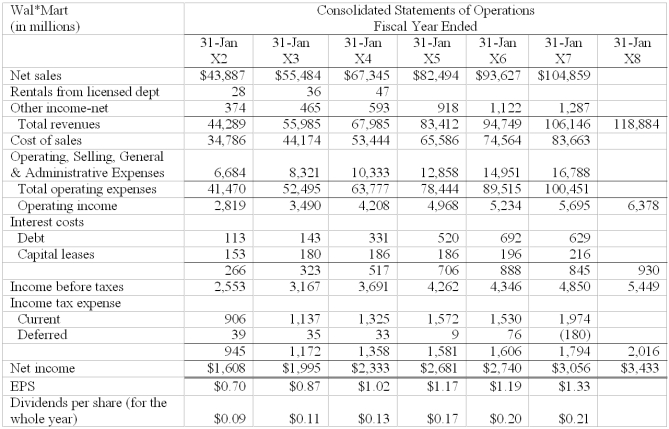
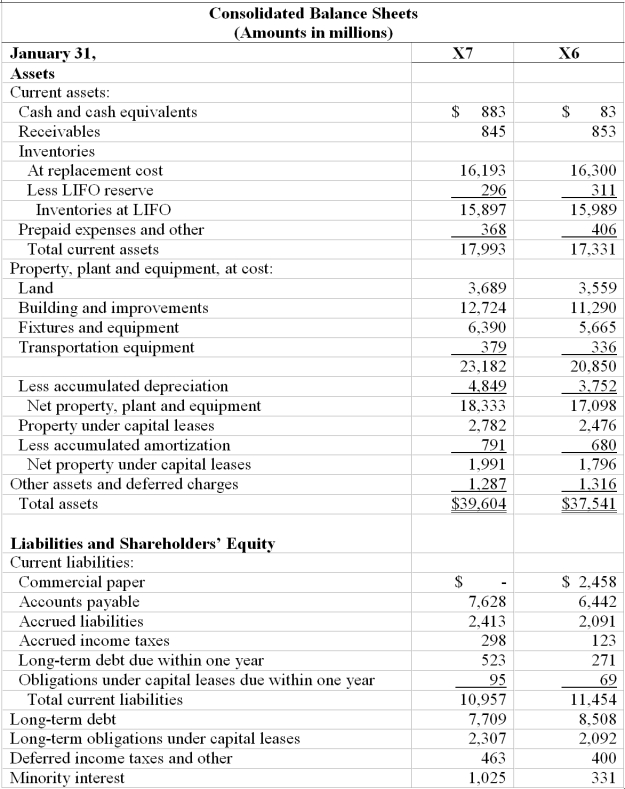 Shareholders' Equity Preferred stock ( 0 par value: 100 share authorized, none issued) Common stock ( \ .10 par value; 5,500 shares authorized. 2,285 and 2,293 issued and outstanding in 1997 and 1996, respectively) 228 229 Capital in excess of par value 547 545 Retained earnings 16,768 14,394 Foreign currency translation adjustment (400) (412) Total shareholders' equity 14,756 Total liabilities and shareholders' equity \ 39,604 \ 37,541
a. Calculate: total debt/equity ratio and times interest earned ratio for fiscal X6 and X7. Comment on your results.
b. Analysis of Wal*Mart's footnotes reveals the existence of significant operating leases. Explain whether this would change your answer in part a) and how you would make the changes.
Shareholders' Equity Preferred stock ( 0 par value: 100 share authorized, none issued) Common stock ( \ .10 par value; 5,500 shares authorized. 2,285 and 2,293 issued and outstanding in 1997 and 1996, respectively) 228 229 Capital in excess of par value 547 545 Retained earnings 16,768 14,394 Foreign currency translation adjustment (400) (412) Total shareholders' equity 14,756 Total liabilities and shareholders' equity \ 39,604 \ 37,541
a. Calculate: total debt/equity ratio and times interest earned ratio for fiscal X6 and X7. Comment on your results.
b. Analysis of Wal*Mart's footnotes reveals the existence of significant operating leases. Explain whether this would change your answer in part a) and how you would make the changes. (Essay)
5.0/5 (78)
(78) Using LIFO rather than FIFO in a time of rising prices:
I. lowers the current ratio
II. increases inventory turnover
III. increases profit margin
IV. increases debt/equity ratio
(Multiple Choice)
4.9/5 (70)
(70) 
Filters
- Essay(0)
- Multiple Choice(0)
- Short Answer(0)
- True False(0)
- Matching(0)