



 Chat with AI
Exam 14: Long-Term Liabilities: Bonds and Notes

Exam 1: Introduction to Accounting and Business190 Questions
Exam 2: Analyzing Transactions224 Questions
Exam 3: The Adjusting Process179 Questions
Exam 4: Completing the Accounting Cycle194 Questions
Exam 5: Accounting Systems160 Questions
Exam 6: Accounting for Merchandising Businesses215 Questions
Exam 7: Inventories165 Questions
Exam 8: Sarbanes-Oxley, Internal Control, and Cash176 Questions
Exam 9: Receivables140 Questions
Exam 10: Fixed Assets and Intangible Assets170 Questions
Exam 11: Current Liabilities and Payroll169 Questions
Exam 12: Accounting for Partnerships and Limited Liability Companies190 Questions
Exam 13: Corporations: Organization, Stock Transactions, and Dividends165 Questions
Exam 14: Long-Term Liabilities: Bonds and Notes185 Questions
Exam 15: Investments and Fair Value Accounting133 Questions
Exam 16: Statement of Cash Flows160 Questions
Exam 17: Financial Statement Analysis185 Questions
Exam 18: Managerial Accounting Concepts and Principles173 Questions
Exam 19: Job Order Costing173 Questions
Exam 20: Process Cost Systems177 Questions
Exam 21: Cost Behavior and Cost-Volume-Profit Analysis215 Questions
Exam 22: Budgeting188 Questions
Exam 23: Performance Evaluation Using Variances From Standard Costs161 Questions
Exam 24: Performance Evaluation for Decentralized Operations200 Questions
Exam 25: Differential Analysis and Product Pricing162 Questions
Exam 26: Capital Investment Analysis179 Questions
Select questions type


The market interest rate related to a bond is also called the
(Multiple Choice)
4.9/5  (80)
(80) When the effective interest method of amortization is used, the amount of interest expense for a given period is calculated by multiplying the face rate of interest by the bond's carrying value at the beginning of the given period.
(True/False)
4.9/5 (78)
(78) The special fund that is set aside to provide for the payment of bonds at maturity is called a sinking fund.
(True/False)
4.8/5 (75)
(75) On the first day of the fiscal year, a company issues a $500,000, 8%, 10 year bond that pays semi-annual interest of $20,000 ($500,000 × 8% × 1/2), receiving cash of $530,000. Journalize the entry to record the issuance of the bonds.
(Essay)
4.7/5 (92)
(92) Using the following table, what is the present value of $5,000 to be received 5 years, if the market rate is 10% compounded annually?
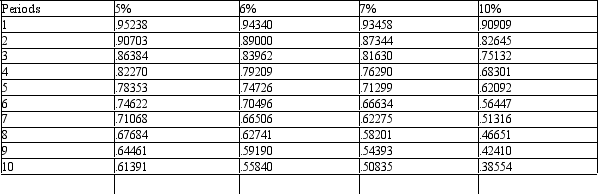
(Short Answer)
4.9/5 (86)
(86) Debtors are interested in the times-interest-earned ratio because they want to
(Multiple Choice)
4.9/5 (89)
(89) If the straight-line method of amortization is used, the amount of unamortized premium on bonds payable will decrease as the bonds approach maturity.
(True/False)
4.8/5 (90)
(90) The buyer determines how much to pay for bonds by computing the present value of future cash receipts using the contract rate of interest.
(True/False)
4.8/5 (88)
(88) On the first day of the fiscal year, a company issues a $500,000, 8%, 10 year bond that pays semi-annual interest of $20,000 ($500,000 × 8% × 1/2), receiving cash of $437,740. Journalize the entry to record the issuance of the bonds.
(Essay)
4.9/5 (84)
(84) Interest payments on 12% bonds with a face value of $20,000 and interest paid semiannually would be $2,400 every 6 months.
(True/False)
4.8/5 (77)
(77) One reason a dollar today is worth more than a dollar 1 year from today is the time value of money.
(True/False)
4.9/5 (74)
(74) Bonds Payable has a balance of $1,000,000 and Premium on Bonds Payable has a balance of $7,000. If the issuing corporation redeems the bonds at 101, what is the amount of gain or loss on redemption?
(Multiple Choice)
4.7/5 (65)
(65) The amount of interest expense reported on the income statement will be more than the interest paid to bondholders if the bonds were originally sold at a discount.
(True/False)
5.0/5 (90)
(90) On January 1, 2011, Citrus Retail Co. issued a $500,000, 5 year, 8% installment note payable with payments of $100,000 principal plus interest due on January 1 of each year for the next 5 years.
1. Prepare the adjusting journal entry at December 31, 2011 to accrue interest for the year.
2. Show the account(s) and amount(s) and where it will appear on a multi-step income statement prepared on December 31, 2011.
3. Show the account(s) and amount(s) and where they will appear on a classified balance sheet prepared on December 31, 2011.
(Essay)
4.9/5 (73)
(73) The times interest earned ratio is calculated by dividing Bonds Payable by Interest Expense.
(True/False)
4.8/5 (66)
(66) Balance sheet and income statement data indicate the following:  Based on the data presented above, what is the number of times bond interest charges were earned (round to two decimal places)?
 (Multiple Choice)
4.8/5 (70)
(70) The carrying amount of the bonds is defined as the face value of the bonds plus any unamortized discount or less any unamortized premium.
(True/False)
4.9/5 (69)
(69) 
Filters
- Essay(0)
- Multiple Choice(0)
- Short Answer(0)
- True False(0)
- Matching(0)