



 Chat with AI
Exam 14: Long-Term Liabilities: Bonds and Notes

Exam 1: Introduction to Accounting and Business190 Questions
Exam 2: Analyzing Transactions224 Questions
Exam 3: The Adjusting Process179 Questions
Exam 4: Completing the Accounting Cycle194 Questions
Exam 5: Accounting Systems160 Questions
Exam 6: Accounting for Merchandising Businesses215 Questions
Exam 7: Inventories165 Questions
Exam 8: Sarbanes-Oxley, Internal Control, and Cash176 Questions
Exam 9: Receivables140 Questions
Exam 10: Fixed Assets and Intangible Assets170 Questions
Exam 11: Current Liabilities and Payroll169 Questions
Exam 12: Accounting for Partnerships and Limited Liability Companies190 Questions
Exam 13: Corporations: Organization, Stock Transactions, and Dividends165 Questions
Exam 14: Long-Term Liabilities: Bonds and Notes185 Questions
Exam 15: Investments and Fair Value Accounting133 Questions
Exam 16: Statement of Cash Flows160 Questions
Exam 17: Financial Statement Analysis185 Questions
Exam 18: Managerial Accounting Concepts and Principles173 Questions
Exam 19: Job Order Costing173 Questions
Exam 20: Process Cost Systems177 Questions
Exam 21: Cost Behavior and Cost-Volume-Profit Analysis215 Questions
Exam 22: Budgeting188 Questions
Exam 23: Performance Evaluation Using Variances From Standard Costs161 Questions
Exam 24: Performance Evaluation for Decentralized Operations200 Questions
Exam 25: Differential Analysis and Product Pricing162 Questions
Exam 26: Capital Investment Analysis179 Questions
Select questions type


There are two methods of amortizing a bond discount or premium: the straight-line method and the double-declining-balance method.
(True/False)
4.8/5  (74)
(74) A $300,000 bond was redeemed at 104 when the carrying value of the bond was $315,000. The entry to record the redemption would include a
(Multiple Choice)
4.8/5 (82)
(82) Sorenson Co., is considering the following alternative plans for financing their company:
 Income tax is estimated at 40% of income.
Determine the earnings per share of common stock under the two alternative financing plans, assuming income before bond interest and income tax is $1,000,000.
Income tax is estimated at 40% of income.
Determine the earnings per share of common stock under the two alternative financing plans, assuming income before bond interest and income tax is $1,000,000. (Essay)
4.7/5 (83)
(83) On the first day of the fiscal year, Lisbon Co. issued $1,000,000 of 10-year, 7% bonds for $1,050,000, with interest payable semiannually. Orange Inc. purchased the bonds on the issue date for the issue price. Present entries to record the following transactions for the current fiscal year:
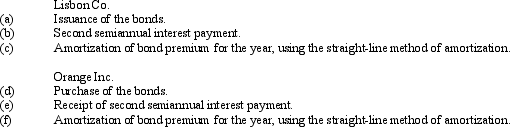
(Essay)
4.7/5 (74)
(74) On the first day of the fiscal year, a company issues a $500,000, 8%, 10 year bond that pays semi-annual interest of $20,000 ($500,000 × 8% × 1/2), receiving cash of $520,000. Journalize the entry to record the first interest payment and amortization of premium using the straight-line method.
(Essay)
4.8/5 (89)
(89) Bondholders claims on the assets of the corporation rank ahead of stockholders.
(True/False)
4.9/5 (69)
(69) A $375,000 bond issue on which there is an unamortized discount of $40,000 is redeemed for $320,000. Journalize the redemption of the bonds.
(Essay)
5.0/5 (69)
(69) A corporation issues for cash $10,000,000 of 8%, 30-year bonds, interest payable annually, at a time when the market rate of interest is 9%. The straight-line method is adopted for the amortization of bond discount or premium. Which of the following statements is true?
(Multiple Choice)
4.9/5 (89)
(89) Ulmer Company is considering the following alternative financing plans:
 Income tax is estimated at 35% of income. Dividends of $1 per share were declared and paid on the preferred stock.
Required: Determine the earnings per share of common stock, assuming income before bond interest and income tax is $600,000.
Income tax is estimated at 35% of income. Dividends of $1 per share were declared and paid on the preferred stock.
Required: Determine the earnings per share of common stock, assuming income before bond interest and income tax is $600,000. (Essay)
4.8/5 (79)
(79) Bonds Payable has a balance of $1,000,000 and Discount on Bonds Payable has a balance of $15,500. If the issuing corporation redeems the bonds at 98.5, what is the amount of gain or loss on redemption?
(Multiple Choice)
4.9/5 (90)
(90) 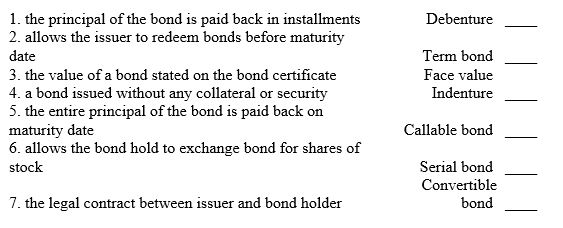
When the corporation issuing the bonds has the right to repurchase the bonds prior to the maturity date for a specific price, the bonds are
(Multiple Choice)
4.7/5 (83)
(83) If the amount of a bond premium on an issued 11%, 4-year, $100,000 bond is $12,928, the annual interest expense is $5,500.
(True/False)
4.8/5 (87)
(87) At 12/31/2009, the cash and securities held in a sinking fund to redeem bonds in 2011 are classified on the balance sheet as current assets.
(True/False)
4.9/5 (86)
(86) Which of the following is not an advantage of issuing bonds instead of common stock?
(Multiple Choice)
4.8/5 (73)
(73) Amortization is the allocation process of writing off bond premiums and discounts to interest expense over the life of the bond issue.
(True/False)
4.8/5 (78)
(78) On January 1, 2014, Gemstone Company obtained a $165,000, 10-year, 7% installment note from Guarantee Bank. The note requires annual payments of $23,492, with the first payment occurring on the last day of the fiscal year. The first payment consists of interest of $11,550 and principal repayment of $11,942. The journal entry to record the issuance of the installment note for cash on January 1, 2014 would include:
(Multiple Choice)
4.9/5 (65)
(65) On January 1, 2014, $1,000,000, 5-year, 10% bonds, were issued for $980,000. Interest is paid semiannually on January 1 and July 1. If the issuing corporation uses the straight-line method to amortize discount on bonds payable, the semiannual amortization amount is
(Multiple Choice)
4.9/5 (89)
(89) The journal entry a company records for the payment of interest, interest expense, and amortization of bond premium is
(Multiple Choice)
4.8/5 (73)
(73) 
Filters
- Essay(0)
- Multiple Choice(0)
- Short Answer(0)
- True False(0)
- Matching(0)