



 Chat with AI
Exam 25: Differential Analysis and Product Pricing

Exam 1: Introduction to Accounting and Business190 Questions
Exam 2: Analyzing Transactions224 Questions
Exam 3: The Adjusting Process179 Questions
Exam 4: Completing the Accounting Cycle194 Questions
Exam 5: Accounting Systems160 Questions
Exam 6: Accounting for Merchandising Businesses215 Questions
Exam 7: Inventories165 Questions
Exam 8: Sarbanes-Oxley, Internal Control, and Cash176 Questions
Exam 9: Receivables140 Questions
Exam 10: Fixed Assets and Intangible Assets170 Questions
Exam 11: Current Liabilities and Payroll169 Questions
Exam 12: Accounting for Partnerships and Limited Liability Companies190 Questions
Exam 13: Corporations: Organization, Stock Transactions, and Dividends165 Questions
Exam 14: Long-Term Liabilities: Bonds and Notes185 Questions
Exam 15: Investments and Fair Value Accounting133 Questions
Exam 16: Statement of Cash Flows160 Questions
Exam 17: Financial Statement Analysis185 Questions
Exam 18: Managerial Accounting Concepts and Principles173 Questions
Exam 19: Job Order Costing173 Questions
Exam 20: Process Cost Systems177 Questions
Exam 21: Cost Behavior and Cost-Volume-Profit Analysis215 Questions
Exam 22: Budgeting188 Questions
Exam 23: Performance Evaluation Using Variances From Standard Costs161 Questions
Exam 24: Performance Evaluation for Decentralized Operations200 Questions
Exam 25: Differential Analysis and Product Pricing162 Questions
Exam 26: Capital Investment Analysis179 Questions
Select questions type


What pricing concept is used if all costs are considered and a fair mark-up is added to determine the selling price?
(Multiple Choice)
4.8/5  (91)
(91) A business received an offer from an exporter for 10,000 units of product at $17.50 per unit. The acceptance of the offer will not affect normal production or domestic sales prices. The following data is available:  What is the amount of gain or loss from acceptance of the offer?
 (Multiple Choice)
4.9/5 (79)
(79) The total cost concept includes all manufacturing costs plus selling and administrative expenses in the cost amount to which the markup is added to determine product price.
(True/False)
4.7/5 (76)
(76) Product J is one of the many products manufactured and sold by Oceanside Company. An income statement by product line for the past year indicated a net loss for Product J of $12,250. This net loss resulted from sales of $275,000, cost of goods sold of $186,500, and operating expenses of $85,750. It is estimated that 30% of the cost of goods sold represents fixed factory overhead costs and that 40% of the operating expense is fixed. If Product J is retained, the revenue, costs, and expenses are not expected to change significantly from those of the current year. Because of the large number of products manufactured, the total fixed costs and expenses are not expected to decline significantly if Product J is discontinued.
Prepare a differential analysis report, dated February 8 of the current year, on the proposal to discontinue Product J.
(Essay)
4.9/5 (86)
(86) Crane Company Division B recorded sales of $360,000, variable cost of goods sold of $315,000, variable selling expenses of $13,000, and fixed costs of $61,000, creating a loss from operations of $29,000. Determine the differential income or loss from the sales of Division
B. Should this division be discontinued?
(Essay)
4.7/5 (70)
(70) Manufacturers must conform to the Robinson-Patman Act which prohibits price discrimination within the United States unless differences in prices can be justified by different costs of serving different customers.
(True/False)
4.7/5 (82)
(82) The Swan Company produces their product at a total cost of $43 per unit. Of this amount $8 per unit is selling and administrative costs. The total variable cost is $30 per unit The desired profit is $20 per unit. Determine the mark up percentage on product cost.
(Multiple Choice)
4.9/5 (82)
(82) Under the total cost concept, manufacturing cost plus desired profit is included in the total cost per unit.
(True/False)
4.9/5 (87)
(87) Hill Co. can further process Product O to produce Product P. Product O is currently selling for $60 per pound and costs $42 per pound to produce. Product P would sell for $82 per pound and would require an additional cost of $13 per pound to produce.
The differential revenue of producing Product P is $82 per pound.
(True/False)
4.8/5 (84)
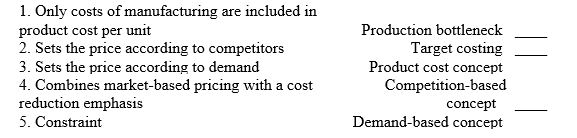
(84) 
Paint Company manufactures Paint X and Paint Y and can sell all it can make of either. Based on the following data, assuming the number of hours is a constraint, which statement is true,? 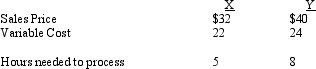
(Multiple Choice)
4.8/5 (75)
(75) Flyer Company sells a product in a competitive marketplace. Market analysis indicates that their product would probably sell at $48 per unit. Flyer management desires a 12.5% profit margin on sales. Their current full cost per unit for the product is $44 per unit. What is the desired profit per unit?
(Multiple Choice)
4.8/5 (67)
(67) A business is considering a cash outlay of $250,000 for the purchase of land, which it could lease for $35,000 per year. If alternative investments are available which yield an 18% return, the opportunity cost of the purchase of the land is:
(Multiple Choice)
4.8/5 (82)
(82) A cost that will not be affected by later decisions is termed a(n):
(Multiple Choice)
4.7/5 (76)
(76) Miramar Industries manufactures two products, A and B The manufacturing operation involves three overhead activities - production setup, material handling, and general factory activities. Miramar uses activity-based costing to allocate overhead to products. An activity analysis of the overhead revealed the following estimated costs and activity bases for these activities:  Each product's total activity in each of the three areas are as follows:
 What is the activity rate for General Overhead?
Each product's total activity in each of the three areas are as follows:
What is the activity rate for General Overhead? (Multiple Choice)
4.8/5 (69)
(69) Partridge Co. can further process Product J to produce Product D Product J is currently selling for $21 per pound and costs $15.75 per pound to produce. Product D would sell for $38 per pound and would require an additional cost of $9.25 per pound to produce.
What is the differential cost of producing Product D?
(Multiple Choice)
4.8/5 (86)
(86) Partridge Co. can further process Product J to produce Product D Product J is currently selling for $21 per pound and costs $15.75 per pound to produce. Product D would sell for $38 per pound and would require an additional cost of $9.25 per pound to produce.
What is the differential revenue of producing Product D?
(Multiple Choice)
4.9/5 (81)
(81) A bottleneck happens when a key piece of manufacturing machinery can produce 1000 units per hour and demand for the product supports a production rate of 1200 units per hour.
(True/False)
4.9/5 (74)
(74) Miramar Industries manufactures two products, A and B The manufacturing operation involves three overhead activities - production setup, material handling, and general factory activities. Miramar uses activity-based costing to allocate overhead to products. An activity analysis of the overhead revealed the following estimated costs and activity bases for these activities:  Each product's total activity in each of the three areas are as follows:
 What is the overhead allocated to Product B using activity-based costing?
Each product's total activity in each of the three areas are as follows:
What is the overhead allocated to Product B using activity-based costing? (Multiple Choice)
4.8/5 (73)
(73) Activity-based costing is determined by charging products for only the services (activities) they used during production.
(True/False)
4.9/5 (74)
(74) 
Filters
- Essay(0)
- Multiple Choice(0)
- Short Answer(0)
- True False(0)
- Matching(0)