



 Chat with AI
Exam 25: Differential Analysis and Product Pricing

Exam 1: Introduction to Accounting and Business190 Questions
Exam 2: Analyzing Transactions224 Questions
Exam 3: The Adjusting Process179 Questions
Exam 4: Completing the Accounting Cycle194 Questions
Exam 5: Accounting Systems160 Questions
Exam 6: Accounting for Merchandising Businesses215 Questions
Exam 7: Inventories165 Questions
Exam 8: Sarbanes-Oxley, Internal Control, and Cash176 Questions
Exam 9: Receivables140 Questions
Exam 10: Fixed Assets and Intangible Assets170 Questions
Exam 11: Current Liabilities and Payroll169 Questions
Exam 12: Accounting for Partnerships and Limited Liability Companies190 Questions
Exam 13: Corporations: Organization, Stock Transactions, and Dividends165 Questions
Exam 14: Long-Term Liabilities: Bonds and Notes185 Questions
Exam 15: Investments and Fair Value Accounting133 Questions
Exam 16: Statement of Cash Flows160 Questions
Exam 17: Financial Statement Analysis185 Questions
Exam 18: Managerial Accounting Concepts and Principles173 Questions
Exam 19: Job Order Costing173 Questions
Exam 20: Process Cost Systems177 Questions
Exam 21: Cost Behavior and Cost-Volume-Profit Analysis215 Questions
Exam 22: Budgeting188 Questions
Exam 23: Performance Evaluation Using Variances From Standard Costs161 Questions
Exam 24: Performance Evaluation for Decentralized Operations200 Questions
Exam 25: Differential Analysis and Product Pricing162 Questions
Exam 26: Capital Investment Analysis179 Questions
Select questions type


Mallard Corporation uses the product cost concept of product pricing. Below is cost information for the production and sale of 45,000 units of its sole product. Mallard desires a profit equal to a 12% rate of return on invested assets of $800,000.  The markup percentage on product cost for the company's product is:
 (Multiple Choice)
4.9/5  (73)
(73) Hummingbird Company uses the product cost concept of applying the cost-plus approach to product pricing. The costs and expenses of producing 25,000 units of Product K are as follows:

 Hummingbird desires a profit equal to a 5% rate of return on invested assets of $642,500.
 Round your markup percentage to one decimal place, and other intermediate calculations and final answer to two decimal places.
Hummingbird desires a profit equal to a 5% rate of return on invested assets of $642,500.
Round your markup percentage to one decimal place, and other intermediate calculations and final answer to two decimal places. (Essay)
4.8/5 (79)
(79) Falcon Co. produces a single product. Its normal selling price is $30.00 per unit. The variable costs are $19.00 per unit. Fixed costs are $25,000 for a normal production run of 5,000 units per month. Falcon received a request for a special order that would not interfere with normal sales. The order was for 1,500 units and a special price of $20.00 per unit. Falcon Co. has the capacity to handle the special order and, for this order, a variable selling cost of $1.00 per unit would be eliminated. If the order is accepted, what would be the impact on net income?
(Multiple Choice)
4.8/5 (72)
(72) What cost concept used in applying the cost-plus approach to product pricing covers selling expenses, administrative expenses, and desired profit in the "markup"?
(Multiple Choice)
4.8/5 (84)
(84) Magpie Corporation uses the total cost concept of product pricing. Below is cost information for the production and sale of 60,000 units of its sole product. Magpie desires a profit equal to a 25% rate of return on invested assets of $700,000.  The dollar amount of desired profit from the production and sale of the company's product is:
 (Multiple Choice)
4.7/5 (88)
(88) When estimated costs are used in applying the cost-plus approach to product pricing, the estimates should be based upon ideal levels of performance.
(True/False)
4.8/5 (74)
(74) Quail Co. can further process Product B to produce Product C Product B is currently selling for $60 per pound and costs $42 per pound to produce. Product C would sell for $92 per pound and would require an additional cost of $13 per pound to produce. What is the differential revenue of producing and selling Product C?
(Multiple Choice)
4.9/5 (67)
(67) Contractors who sell to government agencies would be most likely to use which of the following cost concepts in pricing their products?
(Multiple Choice)
4.9/5 (83)
(83) Holiday Decorations Unique has been approached by the community college to make special decorations for the faculty and staff. The college is willing to buy 5,000 Christmas ornaments with their own design for $6.00 each. The company normally sells its decorations for $12.00 each. A break down of their costs is as follows:
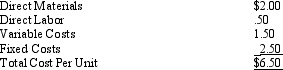 Should Holiday Decorations Unique accept the special order made by the college? The company has enough excess capacity to make this order.
 (Essay)
4.9/5 (70)
(70) Magpie Corporation uses the total cost concept of product pricing. Below is cost information for the production and sale of 60,000 units of its sole product. Magpie desires a profit equal to a 25% rate of return on invested assets of $700,000.  The unit selling price for the company's product is:
 (Multiple Choice)
4.9/5 (78)
(78) Widgeon Co. manufactures three products: Bales; Tales; and Wales. The selling prices are: $55; $78; and $32, respectively. The variable costs for each product are: $20; $50; and $15, respectively. Each product must go through the same processing in a machine that is limited to 2,000 hours per month. Bales take 5 hours to process, Tales take 7 hours, and Wales take 1 hour. What is the contribution margin per machine hour for Bales?
(Multiple Choice)
4.7/5 (82)
(82) What pricing concept considers the price that other providers charge for the same product?
(Multiple Choice)
4.9/5 (89)
(89) Miramar Industries manufactures two products, A and B The manufacturing operation involves three overhead activities - production setup, material handling, and general factory activities. Miramar uses activity-based costing to allocate overhead to products. An activity analysis of the overhead revealed the following estimated costs and activity bases for these activities:  Each product's total activity in each of the three areas are as follows:
 What is the activity rate for Production Setup?
Each product's total activity in each of the three areas are as follows:
What is the activity rate for Production Setup? (Multiple Choice)
4.9/5 (82)
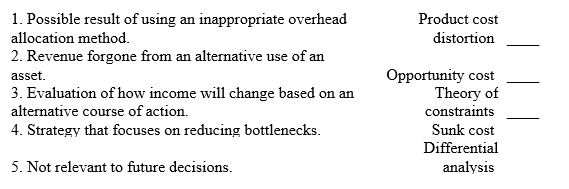
(82) 
When estimated costs are used in applying the cost-plus approach to product pricing, the estimates should be based upon normal levels of performance.
(True/False)
4.8/5 (80)
(80) Moon Company uses the variable cost concept of applying the cost-plus approach to product pricing. The costs and expenses of producing and selling 75,000 units of Product T are as follows:
 Moon desires a profit equal to a 18% rate of return on invested assets of $1,440,000.
 Round your markup percentage to one decimal place and other intermediate calculations and final answer to two decimal places.
Moon desires a profit equal to a 18% rate of return on invested assets of $1,440,000.
Round your markup percentage to one decimal place and other intermediate calculations and final answer to two decimal places. (Essay)
4.8/5 (84)
(84) Hill Co. can further process Product O to produce Product P. Product O is currently selling for $60 per pound and costs $42 per pound to produce. Product P would sell for $82 per pound and would require an additional cost of $13 per pound to produce.
The differential revenue of producing Product P is $22 per pound.
(True/False)
4.8/5 (77)
(77) Rachel Cake Factory normally sells their specialty cake for $22. An offer to buy 100 cakes for $19 per cake was made by an organization hosting a national event in the city. The variable cost per cake is $11. A special decoration per cake will add another $1 to the cost. Determine the differential income or loss per cake from selling the cakes.
(Essay)
4.8/5 (84)
(84) Differential analysis can aid management in making decisions on a variety of alternatives, including whether to discontinue an unprofitable segment and whether to replace usable plant assets.
(True/False)
5.0/5 (78)
(78) 
Filters
- Essay(0)
- Multiple Choice(0)
- Short Answer(0)
- True False(0)
- Matching(0)