



 Chat with AI
Exam 25: Differential Analysis and Product Pricing

Exam 1: Introduction to Accounting and Business190 Questions
Exam 2: Analyzing Transactions224 Questions
Exam 3: The Adjusting Process179 Questions
Exam 4: Completing the Accounting Cycle194 Questions
Exam 5: Accounting Systems160 Questions
Exam 6: Accounting for Merchandising Businesses215 Questions
Exam 7: Inventories165 Questions
Exam 8: Sarbanes-Oxley, Internal Control, and Cash176 Questions
Exam 9: Receivables140 Questions
Exam 10: Fixed Assets and Intangible Assets170 Questions
Exam 11: Current Liabilities and Payroll169 Questions
Exam 12: Accounting for Partnerships and Limited Liability Companies190 Questions
Exam 13: Corporations: Organization, Stock Transactions, and Dividends165 Questions
Exam 14: Long-Term Liabilities: Bonds and Notes185 Questions
Exam 15: Investments and Fair Value Accounting133 Questions
Exam 16: Statement of Cash Flows160 Questions
Exam 17: Financial Statement Analysis185 Questions
Exam 18: Managerial Accounting Concepts and Principles173 Questions
Exam 19: Job Order Costing173 Questions
Exam 20: Process Cost Systems177 Questions
Exam 21: Cost Behavior and Cost-Volume-Profit Analysis215 Questions
Exam 22: Budgeting188 Questions
Exam 23: Performance Evaluation Using Variances From Standard Costs161 Questions
Exam 24: Performance Evaluation for Decentralized Operations200 Questions
Exam 25: Differential Analysis and Product Pricing162 Questions
Exam 26: Capital Investment Analysis179 Questions
Select questions type


Miramar Industries manufactures two products, A and B The manufacturing operation involves three overhead activities - production setup, material handling, and general factory activities. Miramar uses activity-based costing to allocate overhead to products. An activity analysis of the overhead revealed the following estimated costs and activity bases for these activities:  Each product's total activity in each of the three areas are as follows:
 What is the activity rate for Material Handling?
Each product's total activity in each of the three areas are as follows:
What is the activity rate for Material Handling? (Multiple Choice)
4.8/5  (77)
(77) A business received an offer from an exporter for 20,000 units of product at $15 per unit. The acceptance of the offer will not affect normal production or domestic sales prices. The following data are available:  What is the differential revenue from the acceptance of the offer?
 (Multiple Choice)
5.0/5 (75)
(75) Ptarmigan Company produces two products. Product A has a contribution margin of $20 and requires 4 machine hours. Product B has a contribution margin of $18 and requires 3 machine hours. Determine the most profitable product assuming the machine hours are the constraint.
(Essay)
4.8/5 (89)
(89) Widgeon Co. manufactures three products: Bales; Tales; and Wales. The selling prices are: $55; $78; and $32, respectively. The variable costs for each product are: $20; $50; and $15, respectively. Each product must go through the same processing in a machine that is limited to 2,000 hours per month. Bales take 5 hours to process, Tales take 7 hours, and Wales take 1 hour. Assuming that Widgeon Co. can sell all of the products they can make, what is the maximum contribution margin they can earn per month?
(Multiple Choice)
4.9/5 (74)
(74) Mighty Safe Fire Alarm is currently buying 50,000 motherboard from MotherBoard, Inc. at a price of $65 per board. Mighty Safe is considering making its own boards. The costs to make the board are as follows: Direct Materials $32 per unit, Direct labor $10 per unit, Variable Factory Overhead $16.00, Fixed Costs for the plant would increase by $75,000. Which option should be selected and why?
(Multiple Choice)
4.9/5 (81)
(81) Assume that Penguin Co. is considering disposing of equipment that cost $50,000 and has $40,000 of accumulated depreciation to date. Penguin Co. can sell the equipment through a broker for $25,000 less 5% commission. Alternatively, Teal Co. has offered to lease the equipment for five years for a total of $48,750. Penguin will incur repair, insurance, and property tax expenses estimated at $10,000. At lease-end, the equipment is expected to have no residual value. The net differential income from the lease alternative is:
(Multiple Choice)
4.9/5 (68)
(68) Hill Co. can further process Product O to produce Product P. Product O is currently selling for $60 per pound and costs $42 per pound to produce. Product P would sell for $82 per pound and would require an additional cost of $13 per pound to produce.
The differential cost of producing Product P is $13 per pound.
(True/False)
4.7/5 (76)
(76) Which of the following reasons would cause a company to reject an offer to accept business at a special price?
(Multiple Choice)
4.9/5 (71)
(71) Raven Company is considering replacing equipment which originally cost $500,000 and which has $420,000 accumulated depreciation to date. A new machine will cost $790,000. What is the sunk cost in this situation?
(Multiple Choice)
4.8/5 (78)
(78) A business received an offer from an exporter for 30,000 units of product at $16 per unit. The acceptance of the offer will not affect normal production or domestic sales prices. The following data are available:  What is the differential cost from the acceptance of the offer?
 (Multiple Choice)
4.8/5 (80)
(80) A practical approach which is frequently used by managers when setting normal long-run prices is the:
(Multiple Choice)
4.9/5 (84)
(84) Hill Co. can further process Product O to produce Product P. Product O is currently selling for $60 per pound and costs $42 per pound to produce. Product P would sell for $82 per pound and would require an additional cost of $13 per pound to produce.
The differential cost of producing Product P is $55 per pound.
(True/False)
4.8/5 (75)
(75) Magpie Corporation uses the total cost concept of product pricing. Below is cost information for the production and sale of 60,000 units of its sole product. Magpie desires a profit equal to a 25% rate of return on invested assets of $700,000.  The markup percentage on total cost for the company's product is:
 (Multiple Choice)
4.9/5 (87)
(87) Falcon Inc. manufactures Product B, incurring variable costs of $15.00 per unit and fixed costs of $70,000. Falcon desires a profit equal to a 12% rate of return on assets, $785,000 of assets are devoted to producing Product B, and 100,000 units are expected to be produced and sold.
 Round your intermediate calculations and final answer to two decimal places.
 (Essay)
5.0/5 (78)
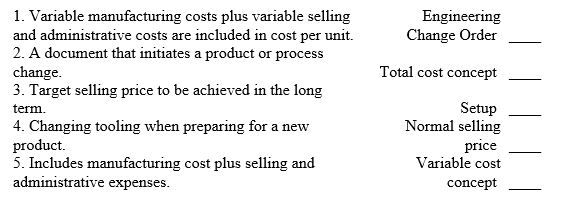
(78) 
Widgeon Co. manufactures three products: Bales; Tales; and Wales. The selling prices are: $55; $78; and $32, respectively. The variable costs for each product are: $20; $50; and $15, respectively. Each product must go through the same processing in a machine that is limited to 2,000 hours per month. Bales take 5 hours to process, Tales take 7 hours, and Wales take 1 hour. What is the contribution margin per machine hour for Tales?
(Multiple Choice)
4.7/5 (72)
(72) A practical approach which is frequently used by managers when setting normal long-run prices is the cost-plus approach.
(True/False)
4.9/5 (83)
(83) All of the following should be considered in a make or buy decision except
(Multiple Choice)
4.8/5 (95)
(95) Lockrite Security Company manufacturers home alarms. Currently it is manufacturing one of its components at a total cost of $45 which includes fixed costs of $15 per unit. An outside provider of this component has offered to sell them the component for $40. Provide a differential analysis of the outside purchase proposal.
(Essay)
4.8/5 (75)
(75) Cost plus methods determine the normal selling price by estimating a cost amount per unit and adding a markup.
(True/False)
4.8/5 (75)
(75) 
Filters
- Essay(0)
- Multiple Choice(0)
- Short Answer(0)
- True False(0)
- Matching(0)