



 Chat with AI
Exam 13: Budgeting and Standard Cost Systems

Exam 1: The Role of Accounting in Business96 Questions
Exam 2: Basic Accounting Concepts89 Questions
Exam 3: Accrual Accounting Concepts111 Questions
Exam 4: Accounting for Merchandising Businesses138 Questions
Exam 5: Sarbanes-Oxley, Internal Control, and Cash110 Questions
Exam 6: Receivables and Inventories102 Questions
Exam 7: Fixed Assets and Intangible Assets86 Questions
Exam 8: Liabilities and Stockholders Equity131 Questions
Exam 9: Financial Statement Analysis83 Questions
Exam 10: Accounting Systems for Manufacturing Businesses120 Questions
Exam 11: Cost Behavior and Cost-Volume-Profit Analysis140 Questions
Exam 12: Differential Analysis and Product Pricing99 Questions
Exam 13: Budgeting and Standard Cost Systems168 Questions
Exam 14: Performance Evaluation for Decentralized Operations137 Questions
Exam 15: Capital Investment Analysis103 Questions
Select questions type


The direct labor time variance measures the efficiency of the direct labor force.
(True/False)
4.7/5  (86)
(86) The fact that workers are unable to meet a properly determined direct labor standard is sufficient cause to change the standard.
(True/False)
4.8/5 (85)
(85) Production and sales estimates for June are as follows: 8,000 Estimated inventory (units), June 1 9,000 Desired inventory (unit), June 30 Expected sales volume (units): 3,000 Area X 4,000 AreaY 5,500 Area Z \ 25 Unit sales price
The budgeted total sales for June is:
(Multiple Choice)
5.0/5 (85)
(85) The cost of available but unused productive capacity is indicated by the:
(Multiple Choice)
4.9/5 (77)
(77) Based on the following production and sales estimates for May, determine the number of units expected to be manufactured in May. 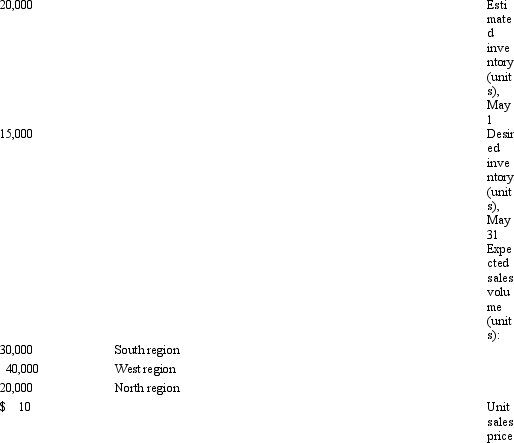
(Multiple Choice)
4.9/5 (75)
(75) Periodic comparisons between planned objectives and actual performance are reported in:
(Multiple Choice)
5.0/5 (73)
(73) If the standard to produce a given amount of product is 900 units of direct materials at $11 and the actual was 800 units at $12, the direct materials quantity variance was $1,100 unfavorable.
(True/False)
4.9/5 (74)
(74) Standards are designed to evaluate price and quantity variances separately.
(True/False)
4.8/5 (83)
(83) A favorable cost variance occurs when actual cost is less than budgeted cost at actual volumes.
(True/False)
4.9/5 (83)
(83) As of January 1 of the current year, the Butner Company had accounts receivables of $50,000. Sales for January, February, and March were as follows: $120,000, $140,000, and $150,000. 20% of each month's sales are for cash. Of the remaining 80% (the credit sales), 60% are collected in the month of sale, with the remaining 40% collected in the following month. What is the total cash collected (both from accounts receivable and for cash sales) in the month of February?
(Multiple Choice)
4.8/5 (75)
(75) If the standard to produce certain quantity of product is 16,000 hours at a factory overhead rate of $5 ($3 fixed, $2 variable), actual variable factory overhead is $26,400, actual fixed factory overhead is $45,000, and 100% of productive capacity is 15,000 hours, the volume variance is $3,000 favorable.
(True/False)
4.7/5 (68)
(68) Benjamin Corporation began its operations on September 1 of the current year. Budgeted sales for the first three months of business are $250,000, $300,000, and $420,000, respectively, for September, October, and November. The company expects to sell 20% of its merchandise for cash. Of sales on account, 70% are expected to be collected in the month of the sale, 25% in the month following the sale, and the remainder in the following month. Refer to the information provided for Benjamin Corporation. The cash collections from accounts receivable in November are:
(Multiple Choice)
4.9/5 (75)
(75) Financial reporting systems that are guided by the principle of exceptions concept focus attention on variances from standard costs.
(True/False)
4.8/5 (83)
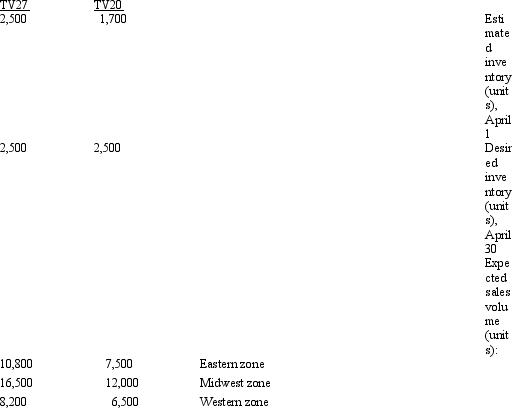
(83) Merle Company manufactures two models of Television, TV20 and TV27. Based on the following production data for April of the current year, prepare a production budget for April.
(Essay)
4.8/5 (88)
(88) Which of the following doesn't result in an unfavorable fixed overhead volume variance?
(Multiple Choice)
4.9/5 (74)
(74) Favorable volume variances are never harmful since achieving them encourages managers to run the factory above normal capacity.
(True/False)
4.9/5 (80)
(80) Efficient Corporation uses a standard cost system. The following information was provided for the period that just ended: \ 11.75 Actual price per gallon 5,000 Actual gallons of material used \ 17.00 Actual hourly labor rate 24,300 Actual hours of prochuction \ 12.00 Standard price per gallon 1/2 Standard gallons per completed urit \ 12.00 Standard hourly labor rate 3. Standard time per completed urit 9,000 Units completed churingthe period Refer to the information provided for Efficient Corporation. The total direct labor variance is:
(Multiple Choice)
4.8/5 (85)
(85) The standard factory overhead rate is $12 per machine hour ($10 for variable factory overhead and $2 for fixed factory overhead) based on 100% capacity of 42,000 machine hours. The standard cost and the actual cost of factory overhead for the production of 2,000 units were as follows:
950,500 Actun: Vurable furtary ovehead 84,000 Fired factary overhen ad 420,000 Standard:35,000 hars @ \ 12 Determine the (a) volume variance, (b) controllable variance, and (c) total factory overhead cost variance.
(Essay)
4.8/5 (69)
(69) 
Filters
- Essay(0)
- Multiple Choice(0)
- Short Answer(0)
- True False(0)
- Matching(0)