



 Chat with AI
Exam 13: Mass Spectrometry and Infrared Spectroscopy

Exam 1: Structure and Bonding70 Questions
Exam 2: Acids and Bases48 Questions
Exam 3: Introduction to Organic Molecules and Functional Groups48 Questions
Exam 4: Alkanes56 Questions
Exam 5: Stereochemistry68 Questions
Exam 6: Understanding Organic Reactions43 Questions
Exam 7: Alkyl Halides and Nucleophilic Substitution64 Questions
Exam 8: Alkyl Halides and Elimination Reactions45 Questions
Exam 9: Alcohols, Ethers and Epoxides49 Questions
Exam 10: Alkenes47 Questions
Exam 11: Alkynes45 Questions
Exam 12: Oxidation and Reduction43 Questions
Exam 13: Mass Spectrometry and Infrared Spectroscopy42 Questions
Exam 14: Nuclear Magnetic Resonance Spectroscopy43 Questions
Exam 15: Radical Reactions43 Questions
Exam 16: Conjugation, Resonance, and Dienes44 Questions
Exam 17: Benzene and Aromatic Compounds40 Questions
Exam 18: Electrophilic Aromatic Substitution51 Questions
Exam 19: Carboxylic Acids and the Acidity of the O-H Bond44 Questions
Exam 20: Introduction to Carbonyl Chemistry; Organometallic Reagents; Oxidation and Reduction53 Questions
Exam 21: Aldehydes and Ketones Nucleophilic Addition45 Questions
Exam 22: Carboxylic Acids and Derivatives47 Questions
Exam 23: Substitution Reactions of Carbonyl Compounds at the Alpha-Carbon41 Questions
Exam 24: Carbonyl Condensation Reactions45 Questions
Exam 25: Amines58 Questions
Exam 26: Carbon-Carbon Bond Forming Reactions in Organic Synthesis41 Questions
Exam 27: Pericyclic Reactions52 Questions
Exam 28: Carbohydrates41 Questions
Exam 29: Amino Acids and Proteins41 Questions
Exam 30: Lipids41 Questions
Exam 31: Synthetic Polymers41 Questions
Select questions type


13C NMR is a technique in which the total number of signals represents the number of unique carbon atoms in a molecule. Propose a structure that is consistent with the following data.
(a) The IR includes peaks at 1603 and 1495 cm-1.
(b) The 13C NMR has a total of 7 signals.
(c) The compound has one acidic proton. 
(Multiple Choice)
4.8/5  (77)
(77) 
A compound X shows a molecular ion peak at m/z 72 in its mass spectrum, and a strong peak at ~1715 cm-1 in its IR spectrum. Which structures are possible for compound X? 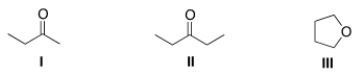
(Multiple Choice)
5.0/5 (83)
(83) When the phenol shown below is treated with KOH, it forms a product whose IR spectrum does not show an absorption in the 3200-3600 cm-1 region. Propose a structure for the product. 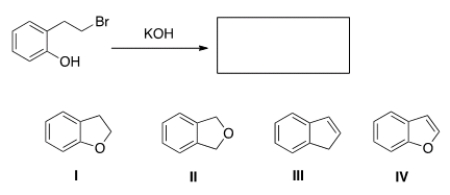
(Multiple Choice)
4.9/5 (95)
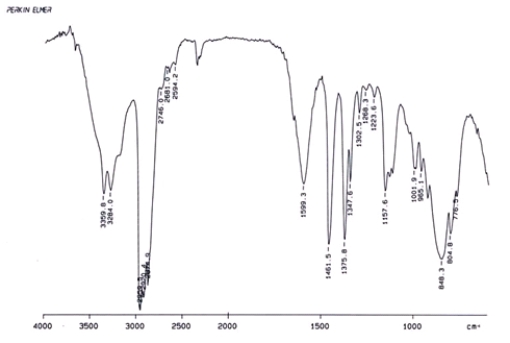
(95) 
Which of the following statements is (are) true about a compound that has a molecular ion peak in its mass spectrum at mass 94, and shows prominent peaks in its IR spectrum at 3600-3200 and 1600 cm-1?
(Multiple Choice)
4.8/5 (84)
(84) Which of the indicated C-H bonds absorbs at the lowest wave number in the IR spectrum? 
(Multiple Choice)
4.9/5 (72)
(72) An alkyne C-H bond absorbs at higher wave number than an alkene C-H bond. What does this tell you about the strength of these two bonds?
(Multiple Choice)
4.9/5 (80)
(80) What type of signal(s) would you observe in the mass and (or) infrared spectrum of the following compound? 
(Multiple Choice)
4.8/5 (66)
(66) In a typical mass spectrum, a smaller signal is observed at a mass 1 amu higher than the molecular ion peak. Why?
(Multiple Choice)
4.8/5 (71)
(71) Which of the following compounds will have the lowest wavenumber for carbonyl absorption? 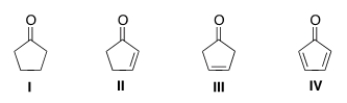
(Multiple Choice)
4.8/5 (68)
(68) 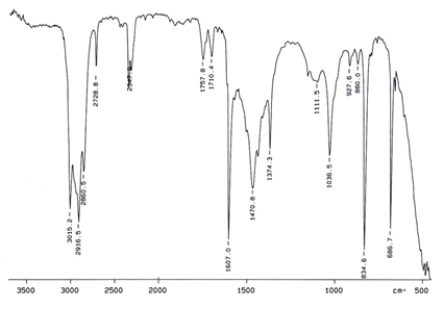
In electron impact mass spectrometry (EIMS), what is being detected?
(Multiple Choice)
4.8/5 (76)
(76) 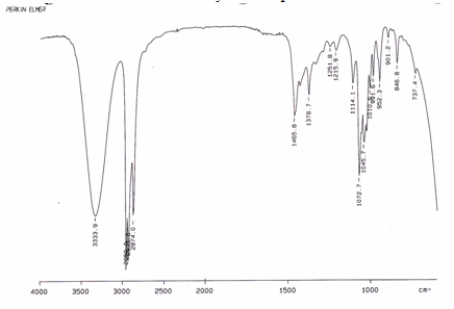
Which of the following statements about the base peak of a mass spectrum is always true?
(Multiple Choice)
4.8/5 (75)
(75) An IR spectrum has the following potentially important absorptions: 3091, 3067, 2963, 2921, 2252, 1603, 1499, 1455, 1416, 1078, 1031, 941, 735, and 696 cm-1. Indicate which structure corresponds to the IR data. 
(Multiple Choice)
5.0/5 (72)
(72) What type of feature will be observed in the EI mass spectrum of chlorobenzene?
(Multiple Choice)
4.7/5 (97)
(97) Compared to a C-H bond, a C-D bond will vibrate where in the infrared spectrum?
(Multiple Choice)
4.8/5 (74)
(74) Which of the following statements is (are) true about the IR spectrum of the compound drawn below? 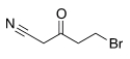
(Multiple Choice)
4.8/5 (87)
(87) What type(s) of molecular motion is (are) observed using infrared spectroscopy?
(Multiple Choice)
4.9/5 (87)
(87) 
Filters
- Essay(0)
- Multiple Choice(0)
- Short Answer(0)
- True False(0)
- Matching(0)