



 Chat with AI
Exam 25: Amines

Exam 1: Structure and Bonding70 Questions
Exam 2: Acids and Bases48 Questions
Exam 3: Introduction to Organic Molecules and Functional Groups48 Questions
Exam 4: Alkanes56 Questions
Exam 5: Stereochemistry68 Questions
Exam 6: Understanding Organic Reactions43 Questions
Exam 7: Alkyl Halides and Nucleophilic Substitution64 Questions
Exam 8: Alkyl Halides and Elimination Reactions45 Questions
Exam 9: Alcohols, Ethers and Epoxides49 Questions
Exam 10: Alkenes47 Questions
Exam 11: Alkynes45 Questions
Exam 12: Oxidation and Reduction43 Questions
Exam 13: Mass Spectrometry and Infrared Spectroscopy42 Questions
Exam 14: Nuclear Magnetic Resonance Spectroscopy43 Questions
Exam 15: Radical Reactions43 Questions
Exam 16: Conjugation, Resonance, and Dienes44 Questions
Exam 17: Benzene and Aromatic Compounds40 Questions
Exam 18: Electrophilic Aromatic Substitution51 Questions
Exam 19: Carboxylic Acids and the Acidity of the O-H Bond44 Questions
Exam 20: Introduction to Carbonyl Chemistry; Organometallic Reagents; Oxidation and Reduction53 Questions
Exam 21: Aldehydes and Ketones Nucleophilic Addition45 Questions
Exam 22: Carboxylic Acids and Derivatives47 Questions
Exam 23: Substitution Reactions of Carbonyl Compounds at the Alpha-Carbon41 Questions
Exam 24: Carbonyl Condensation Reactions45 Questions
Exam 25: Amines58 Questions
Exam 26: Carbon-Carbon Bond Forming Reactions in Organic Synthesis41 Questions
Exam 27: Pericyclic Reactions52 Questions
Exam 28: Carbohydrates41 Questions
Exam 29: Amino Acids and Proteins41 Questions
Exam 30: Lipids41 Questions
Exam 31: Synthetic Polymers41 Questions
Select questions type


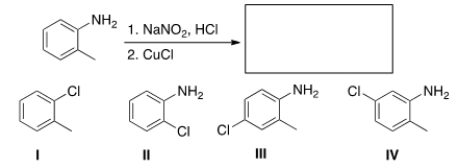
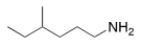

Select the reagent(s) required for the following transformation. 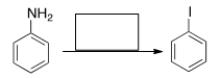
(Multiple Choice)
4.9/5  (94)
(94) Arrange the following compounds in order of decreasing boiling point, putting the compound with the highest boiling point first.
(Multiple Choice)
4.9/5 (75)
(75) A compound with molecular formula C6H15N exhibits a singlet at 0.9 (1H), a triplet at 1.10 (3H), a singlet at 1.15 (9H), and a quartet at 2.6 (2H) in its 1HNMR spectrum. Its IR spectrum shows one medium absorption band near 3400 cm-1. What is the structure of this compound? 
(Multiple Choice)
4.8/5 (84)
(84) Why is direct nucleophilic substitution of an alkyl halide with NH3 not a very useful method for preparing primary amines?
(Multiple Choice)
4.8/5 (83)
(83) Why are 1°, 2°, and 3° alkylamines more basic than ammonia (NH3)?
(Multiple Choice)
4.8/5 (64)
(64) 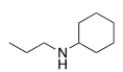
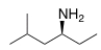
Rank the following compounds in order of decreasing basicity, putting the most basic first. 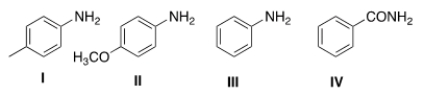
(Multiple Choice)
4.9/5 (79)
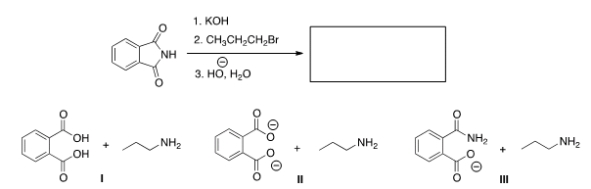
(79) 
Rank the nitrogen atoms in chloroquine, shown below, in order of decreasing basicity, putting the most basic nitrogen atom first. 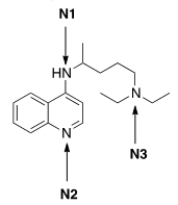
(Multiple Choice)
4.9/5 (84)
(84) Rank the following compounds in order of decreasing basicity, putting the most basic compound first. 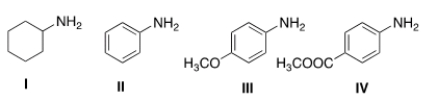
(Multiple Choice)
5.0/5 (86)
(86) Arrange the following amines in order of decreasing water solubility, putting the most soluble amine first. 
(Multiple Choice)
4.8/5 (85)
(85) What is the major organic product obtained in the following reaction? 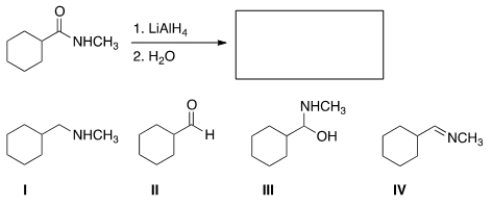
(Multiple Choice)
4.9/5 (80)
(80) What is the approximate bond angle of the substituents around a nitrogen atom in amines?
(Multiple Choice)
4.8/5 (69)
(69) 
Filters
- Essay(0)
- Multiple Choice(0)
- Short Answer(0)
- True False(0)
- Matching(0)