



 Chat with AI
Exam 5: Stereochemistry

Exam 1: Structure and Bonding70 Questions
Exam 2: Acids and Bases48 Questions
Exam 3: Introduction to Organic Molecules and Functional Groups48 Questions
Exam 4: Alkanes56 Questions
Exam 5: Stereochemistry68 Questions
Exam 6: Understanding Organic Reactions43 Questions
Exam 7: Alkyl Halides and Nucleophilic Substitution64 Questions
Exam 8: Alkyl Halides and Elimination Reactions45 Questions
Exam 9: Alcohols, Ethers and Epoxides49 Questions
Exam 10: Alkenes47 Questions
Exam 11: Alkynes45 Questions
Exam 12: Oxidation and Reduction43 Questions
Exam 13: Mass Spectrometry and Infrared Spectroscopy42 Questions
Exam 14: Nuclear Magnetic Resonance Spectroscopy43 Questions
Exam 15: Radical Reactions43 Questions
Exam 16: Conjugation, Resonance, and Dienes44 Questions
Exam 17: Benzene and Aromatic Compounds40 Questions
Exam 18: Electrophilic Aromatic Substitution51 Questions
Exam 19: Carboxylic Acids and the Acidity of the O-H Bond44 Questions
Exam 20: Introduction to Carbonyl Chemistry; Organometallic Reagents; Oxidation and Reduction53 Questions
Exam 21: Aldehydes and Ketones Nucleophilic Addition45 Questions
Exam 22: Carboxylic Acids and Derivatives47 Questions
Exam 23: Substitution Reactions of Carbonyl Compounds at the Alpha-Carbon41 Questions
Exam 24: Carbonyl Condensation Reactions45 Questions
Exam 25: Amines58 Questions
Exam 26: Carbon-Carbon Bond Forming Reactions in Organic Synthesis41 Questions
Exam 27: Pericyclic Reactions52 Questions
Exam 28: Carbohydrates41 Questions
Exam 29: Amino Acids and Proteins41 Questions
Exam 30: Lipids41 Questions
Exam 31: Synthetic Polymers41 Questions
Select questions type


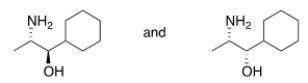
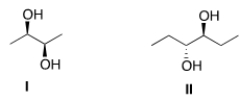

How many isomers (constitutional and stereoisomers) exist for dimethylcyclobutane?
(Multiple Choice)
4.9/5  (65)
(65) A natural product was isolated in the laboratory, and its observed rotation was +10° when measured in a 1 dm sample tube containing 1.0 g of compound in 10 mL of H2O. What is the specific rotation of this compound?
(Multiple Choice)
4.9/5 (65)
(65) 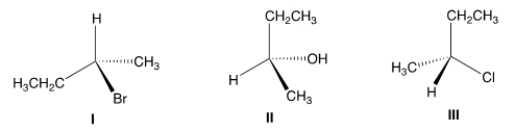
Rank the following groups in order of decreasing priority according to the Cahn-Ingold-Prelog system. -= - - - I II III IV
(Multiple Choice)
4.7/5 (73)
(73) How many stereogenic centers are present in fructose, a simple sugar? 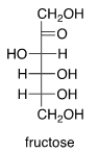
(Multiple Choice)
4.9/5 (68)
(68) How many stereogenic centers are present in the following compound? 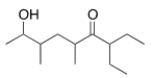
(Multiple Choice)
4.8/5 (68)
(68) 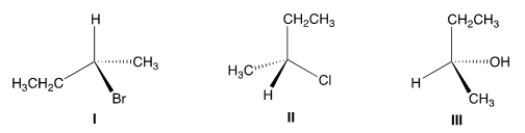
Rank the following groups in order of decreasing priority according to the Cahn-Ingold-Prelog system. - - - - I II III IV
(Multiple Choice)
4.8/5 (74)
(74) Which of the following molecules has a plane of symmetry? \begin{array}{l}\begin{array} { l l l l } \text {\mathrm { CHBrClF }}&\text {\(\mathrm { CH } _ { 2 } \mathrm { BrCl }\)}&\text {\(\mathrm { CH } _ { 3 } \mathrm { CHClBr }\)}&\text {\(\mathrm { CH } _ { 3 } \mathrm { CH } _ { 2 } \mathrm { CHBrF }\)}\\I&II&III&IV\end{array}\end{array}
(Multiple Choice)
4.9/5 (77)
(77) Which of the following compounds does not have a plane of symmetry? 
(Multiple Choice)
4.9/5 (96)
(96) What is the relationship between the following two compounds? 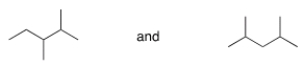
(Multiple Choice)
4.8/5 (66)
(66) 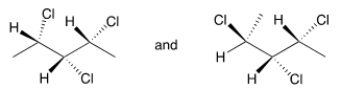
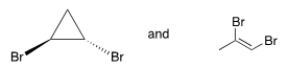
What is the relationship between the following two compounds? 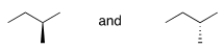
(Multiple Choice)
4.9/5 (86)
(86) How many stereogenic centers are present in gabapentin, used clinically to treat seizures and certain types of chronic pain? 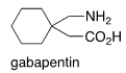
(Multiple Choice)
4.9/5 (69)
(69) How many stereogenic centers are present in the following molecule? 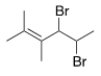
(Multiple Choice)
4.9/5 (85)
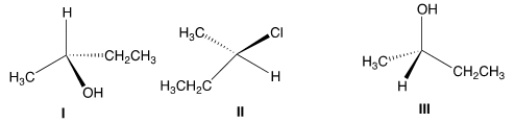
(85) 
Rank the following groups in order of decreasing priority according to the Cahn-Ingold-Prelog system. - - - - I II III IV
(Multiple Choice)
4.8/5 (67)
(67) 
Filters
- Essay(0)
- Multiple Choice(0)
- Short Answer(0)
- True False(0)
- Matching(0)