



 Chat with AI
Exam 14: Partnerships: Formation and Operation

Exam 1: The Equity Method of Accounting for Investments119 Questions
Exam 2: Consolidation of Financial Information118 Questions
Exam 3: Consolidations - Subsequent to the Date of Acquisition121 Questions
Exam 4: Consolidated Financial Statements and Outside Ownership116 Questions
Exam 5: Consolidated Financial Statements - Intercompany Asset Transactions127 Questions
Exam 6: Intercompany Debt, Consolidated Statement of Cash Flows, and Other Issues114 Questions
Exam 7: Consolidated Financial Statements - Ownership Patterns and Income Taxes117 Questions
Exam 8: Segment and Interim Reporting113 Questions
Exam 9: Foreign Currency Transactions and Hedging Foreign Exchange Risk93 Questions
Exam 10: Translation of Foreign Currency Financial Statements97 Questions
Exam 11: Worldwide Accounting Diversity and International Accounting Standards60 Questions
Exam 12: Financial Reporting and the Securities and Exchange Commission76 Questions
Exam 13: Accounting for Legal Reorganizations and Liquidations83 Questions
Exam 14: Partnerships: Formation and Operation88 Questions
Exam 15: Partnerships: Termination and Liquidation70 Questions
Exam 16: Accounting for State and Local Governments78 Questions
Exam 17: Accounting for State and Local Governments51 Questions
Exam 18: Accounting for Not-For-Profit Organizations64 Questions
Exam 19: Accounting for Estates and Trusts80 Questions
Select questions type


The advantages of the partnership form of business organization, compared to corporations, include
(Multiple Choice)
5.0/5  (72)
(72) Cleary, Wasser, and Nolan formed a partnership on January 1, 2010, with investments of $100,000, $150,000, and $200,000, respectively. For division of income, they agreed to (1) interest of 10% of the beginning capital balance each year, (2) annual compensation of $10,000 to Wasser, and (3) sharing the remainder of the income or loss in a ratio of 20% for Cleary, and 40% each for Wasser and Nolan. Net income was $150,000 in 2010 and $180,000 in 2011. Each partner withdrew $1,000 for personal use every month during 2010 and 2011. What was Wasser's total share of net income for 2011?
(Multiple Choice)
4.9/5 (73)
(73) What theoretical argument could be made against the recognition of goodwill when there is a change in the ownership of a partnership?
(Essay)
4.8/5 (67)
(67) A partnership began its first year of operations with the following capital balances: 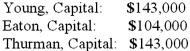 The Articles of Partnership stipulated that profits and losses be assigned in the following manner: Young was to be awarded an annual salary of $26,000 with $13,000 salary assigned to Thurman.
Each partner was to be attributed with interest equal to 10% of the capital balance as of the first day of the year.
The remainder was to be assigned on a 5:2:3 basis to Young, Eaton, and Thurman, respectively.
Each partner withdrew $13,000 per year.
Assume that the net loss for the first year of operations was $26,000 with net income of $52,000 in the second year.
What was Thurman's total share of net loss for the first year?
The Articles of Partnership stipulated that profits and losses be assigned in the following manner: Young was to be awarded an annual salary of $26,000 with $13,000 salary assigned to Thurman.
Each partner was to be attributed with interest equal to 10% of the capital balance as of the first day of the year.
The remainder was to be assigned on a 5:2:3 basis to Young, Eaton, and Thurman, respectively.
Each partner withdrew $13,000 per year.
Assume that the net loss for the first year of operations was $26,000 with net income of $52,000 in the second year.
What was Thurman's total share of net loss for the first year? (Multiple Choice)
4.8/5 (74)
(74) Cleary, Wasser, and Nolan formed a partnership on January 1, 2010, with investments of $100,000, $150,000, and $200,000, respectively. For division of income, they agreed to (1) interest of 10% of the beginning capital balance each year, (2) annual compensation of $10,000 to Wasser, and (3) sharing the remainder of the income or loss in a ratio of 20% for Cleary, and 40% each for Wasser and Nolan. Net income was $150,000 in 2010 and $180,000 in 2011. Each partner withdrew $1,000 for personal use every month during 2010 and 2011. What was Wasser's capital balance at the end of 2010?
(Multiple Choice)
4.9/5 (72)
(72) P, L, and O are partners with capital balances of $50,000, $30,000 and $20,000 and who share in the profit and loss of the PLO partnership 30%, 20%, and 50%, respectively, when they agree to admit C for a 20% interest. If C contributes $40,000 to the partnership and the goodwill method is used, what amount will be debited for goodwill?
(Multiple Choice)
4.9/5 (84)
(84) Cleary, Wasser, and Nolan formed a partnership on January 1, 2010, with investments of $100,000, $150,000, and $200,000, respectively. For division of income, they agreed to (1) interest of 10% of the beginning capital balance each year, (2) annual compensation of $10,000 to Wasser, and (3) sharing the remainder of the income or loss in a ratio of 20% for Cleary, and 40% each for Wasser and Nolan. Net income was $150,000 in 2010 and $180,000 in 2011. Each partner withdrew $1,000 for personal use every month during 2010 and 2011. What was Nolan's capital balance at the end of 2010?
(Multiple Choice)
4.9/5 (78)
(78) On January 1, 2011, Lamb and Mona LLP admitted Noris to a 20% interest in net assets for an investment of $50,000 cash. Prior to the admission of Noris, Lamb and Mona had net assets of $100,000 and an income-sharing ratio of 25% to Lamb and 75% to Mona. After the admission of Noris, the partnership contract included the following provisions:
• Salary of $40,000 a year to Noris.
• Remaining net income in ratio Lamb 20%, Mona 60%, Noris 20%
• During the fiscal year ended December 31, 2011, the partnership had income of $90,000 prior to recognition of salary to Noris.
Record the journal entry to record the remainder of net income to the capital accounts.
(Essay)
4.8/5 (75)
(75) A partnership began its first year of operations with the following capital balances: 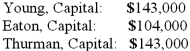 The Articles of Partnership stipulated that profits and losses be assigned in the following manner: Young was to be awarded an annual salary of $26,000 with $13,000 salary assigned to Thurman.
Each partner was to be attributed with interest equal to 10% of the capital balance as of the first day of the year.
The remainder was to be assigned on a 5:2:3 basis to Young, Eaton, and Thurman, respectively.
Each partner withdrew $13,000 per year.
Assume that the net loss for the first year of operations was $26,000 with net income of $52,000 in the second year.
What was Young's total share of net loss for the first year?
The Articles of Partnership stipulated that profits and losses be assigned in the following manner: Young was to be awarded an annual salary of $26,000 with $13,000 salary assigned to Thurman.
Each partner was to be attributed with interest equal to 10% of the capital balance as of the first day of the year.
The remainder was to be assigned on a 5:2:3 basis to Young, Eaton, and Thurman, respectively.
Each partner withdrew $13,000 per year.
Assume that the net loss for the first year of operations was $26,000 with net income of $52,000 in the second year.
What was Young's total share of net loss for the first year? (Multiple Choice)
4.9/5 (91)
(91) A partnership began its first year of operations with the following capital balances: 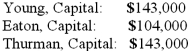 The Articles of Partnership stipulated that profits and losses be assigned in the following manner: Young was to be awarded an annual salary of $26,000 with $13,000 salary assigned to Thurman.
Each partner was to be attributed with interest equal to 10% of the capital balance as of the first day of the year.
The remainder was to be assigned on a 5:2:3 basis to Young, Eaton, and Thurman, respectively.
Each partner withdrew $13,000 per year.
Assume that the net loss for the first year of operations was $26,000 with net income of $52,000 in the second year.
What was the balance in Thurman's Capital account at the end of the second year?
The Articles of Partnership stipulated that profits and losses be assigned in the following manner: Young was to be awarded an annual salary of $26,000 with $13,000 salary assigned to Thurman.
Each partner was to be attributed with interest equal to 10% of the capital balance as of the first day of the year.
The remainder was to be assigned on a 5:2:3 basis to Young, Eaton, and Thurman, respectively.
Each partner withdrew $13,000 per year.
Assume that the net loss for the first year of operations was $26,000 with net income of $52,000 in the second year.
What was the balance in Thurman's Capital account at the end of the second year? (Multiple Choice)
4.9/5 (91)
(91) Max, Jones and Waters shared profits and losses 20%, 40%, and 40% respectively and their partnership capital balance is $10,000, $30,000 and $50,000 respectively. Max has decided to withdraw from the partnership. An appraisal of the business and its property estimates the fair value to be $200,000. Land with a book value of $30,000 has a fair value of $45,000. Max has agreed to receive $20,000 in exchange for her partnership interest after revaluation. At what amount should land be recorded on the partnership books?
(Multiple Choice)
4.8/5 (73)
(73) The disadvantages of the partnership form of business organization, compared to corporations, include
(Multiple Choice)
4.9/5 (70)
(70) Which of the following statements is correct regarding the admission of a new partner?
(Multiple Choice)
4.8/5 (82)
(82) When Danny withdrew from John, Daniel, Harry, and Danny, LLP, he was paid $80,000, although his capital account balance was only $60,000. The four partners shared net income and losses equally. The journal entry to record the effect on John's capital due to Danny's withdrawal would include:
(Multiple Choice)
4.8/5 (78)
(78) A partnership began its first year of operations with the following capital balances: 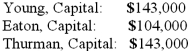 The Articles of Partnership stipulated that profits and losses be assigned in the following manner: Young was to be awarded an annual salary of $26,000 with $13,000 salary assigned to Thurman.
Each partner was to be attributed with interest equal to 10% of the capital balance as of the first day of the year.
The remainder was to be assigned on a 5:2:3 basis to Young, Eaton, and Thurman, respectively.
Each partner withdrew $13,000 per year.
Assume that the net loss for the first year of operations was $26,000 with net income of $52,000 in the second year.
What was the balance in Young's Capital account at the end of the second year?
The Articles of Partnership stipulated that profits and losses be assigned in the following manner: Young was to be awarded an annual salary of $26,000 with $13,000 salary assigned to Thurman.
Each partner was to be attributed with interest equal to 10% of the capital balance as of the first day of the year.
The remainder was to be assigned on a 5:2:3 basis to Young, Eaton, and Thurman, respectively.
Each partner withdrew $13,000 per year.
Assume that the net loss for the first year of operations was $26,000 with net income of $52,000 in the second year.
What was the balance in Young's Capital account at the end of the second year? (Multiple Choice)
4.7/5 (71)
(71) A partnership began its first year of operations with the following capital balances: 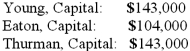 The Articles of Partnership stipulated that profits and losses be assigned in the following manner: Young was to be awarded an annual salary of $26,000 with $13,000 salary assigned to Thurman.
Each partner was to be attributed with interest equal to 10% of the capital balance as of the first day of the year.
The remainder was to be assigned on a 5:2:3 basis to Young, Eaton, and Thurman, respectively.
Each partner withdrew $13,000 per year.
Assume that the net loss for the first year of operations was $26,000 with net income of $52,000 in the second year.
What was the balance in Eaton's Capital account at the end of the first year?
The Articles of Partnership stipulated that profits and losses be assigned in the following manner: Young was to be awarded an annual salary of $26,000 with $13,000 salary assigned to Thurman.
Each partner was to be attributed with interest equal to 10% of the capital balance as of the first day of the year.
The remainder was to be assigned on a 5:2:3 basis to Young, Eaton, and Thurman, respectively.
Each partner withdrew $13,000 per year.
Assume that the net loss for the first year of operations was $26,000 with net income of $52,000 in the second year.
What was the balance in Eaton's Capital account at the end of the first year? (Multiple Choice)
4.8/5 (82)
(82) Brown and Green are forming a business as partners. If they do not create a formal written partnership agreement, what risks are they exposing themselves to?
(Essay)
4.8/5 (85)
(85) For what events or conditions should the Articles of Partnership make provision?
(Essay)
4.9/5 (81)
(81) Donald, Anne, and Todd have the following capital balances; $40,000, $50,000 and $30,000 respectively. The partners share profits and losses 20%, 40%, and 40% respectively.
What is the total partnership capital after Anne retires receiving $80,000 and using the bonus method?
(Multiple Choice)
5.0/5 (75)
(75) Cleary, Wasser, and Nolan formed a partnership on January 1, 2010, with investments of $100,000, $150,000, and $200,000, respectively. For division of income, they agreed to (1) interest of 10% of the beginning capital balance each year, (2) annual compensation of $10,000 to Wasser, and (3) sharing the remainder of the income or loss in a ratio of 20% for Cleary, and 40% each for Wasser and Nolan. Net income was $150,000 in 2010 and $180,000 in 2011. Each partner withdrew $1,000 for personal use every month during 2010 and 2011. What was Wasser's total share of net income for 2010?
(Multiple Choice)
4.8/5 (93)
(93) 
Filters
- Essay(0)
- Multiple Choice(0)
- Short Answer(0)
- True False(0)
- Matching(0)