



 Chat with AI
Exam 14: Long-Term Liabilities: Bonds and Notes

Exam 1: Introduction to Accounting and Business191 Questions
Exam 2: Analyzing Transactions226 Questions
Exam 3: The Adjusting Process180 Questions
Exam 4: Completing the Accounting Cycle195 Questions
Exam 5: Accounting Systems160 Questions
Exam 6: Accounting for Merchandising Businesses218 Questions
Exam 7: Inventories169 Questions
Exam 8: Sarbanes-Oxley, Internal Control, and Cash177 Questions
Exam 9: Receivables151 Questions
Exam 10: Fixed Assets and Intangible Assets172 Questions
Exam 11: Current Liabilities and Payroll171 Questions
Exam 12: Accounting for Partnerships and Limited Liability Companies192 Questions
Exam 13: Corporations: Organization, Stock Transactions, and Dividends171 Questions
Exam 14: Long-Term Liabilities: Bonds and Notes188 Questions
Exam 15: Investments and Fair Value Accounting133 Questions
Exam 16: Statement of Cash Flows165 Questions
Exam 17: Financial Statement Analysis186 Questions
Select questions type


The effective-interest method of amortizing a bond discount or premium is the preferred method.
(True/False)
4.8/5  (83)
(83) On January 1, 2011, Citrus Retail Co. issued a $500,000, 5 year, 8% installment note payable with payments of $100,000 principal plus interest due on January 1 of each year for the next 5 years.
1. Prepare the adjusting journal entry at December 31, 2011 to accrue interest for the year.
2. Show the account(s) and amount(s) and where it will appear on a multi-step income statement prepared on December 31, 2011.
3. Show the account(s) and amount(s) and where they will appear on a classified balance sheet prepared on December 31, 2011.
(Essay)
4.9/5 (82)
(82) Premium on bonds payable may be amortized by the straight-line method if the results obtained by its use do materially differ from the results obtained by use of the interest method.
(True/False)
5.0/5 (72)
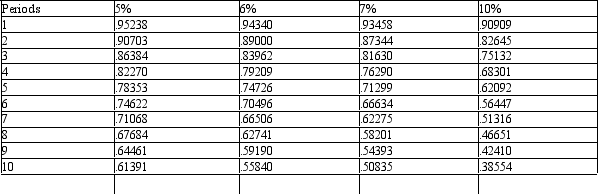
(72) Use the following tables to calculate the present value of a $25,000 7%, 5 year bond that pays $1,750 ($25,000 × 7%) interest annually, if the market rate of interest is 7%
Present Value of $1 at Compound Interest
 Present Value of Annuity of $1 at Compound Interest
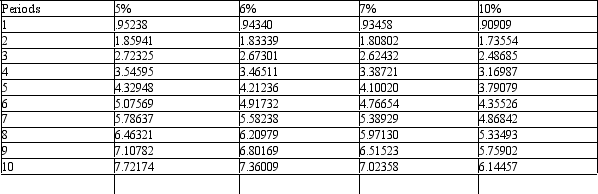
Present Value of Annuity of $1 at Compound Interest
(Essay)
4.9/5 (68)
(68) On January 1, 2014, Gemstone Company obtained a $165,000, 10-year, 7% installment note from Guarantee Bank. The note requires annual payments of $23,492, with the first payment occurring on the last day of the fiscal year. The first payment consists of interest of $11,550 and principal repayment of $11,942. The journal entry to record the issuance of the installment note for cash on January 1, 2014 would include:
(Multiple Choice)
4.9/5 (92)
(92) On the first day of the fiscal year, Hawthorne Company obtained a $ 88,000, seven-year, 5% installment note from Sea Side Bank. The note requires annual payments of $15,208, with the first payment occurring on the last day of the fiscal year. The first payment consists of interest of $4,400 and principal repayment of $10,808. The journal entry Hawthorne would record to make the first annual payment due on the note would include:
(Multiple Choice)
4.9/5 (77)
(77) On January 1, 2011, Zero Company obtained a $52,000, four-year, 6.5% installment note from Regional Bank. The note requires annual payments of $15,179, beginning on December 31, 2011. The December 31, 2013 carrying amount in the amortization table for this installment note will be equal to:
(Multiple Choice)
4.8/5 (68)
(68) Bonds payable would be listed at their carrying value on the balance sheet.
(True/False)
4.8/5 (88)
(88) A $500,000 bond issue on which there is an unamortized discount of $20,000 is redeemed for $475,000. Journalize the redemption of the bonds.
(Essay)
4.8/5 (74)
(74) Prepare an amortization schedule for the 1st 2 years (effective method) using the following data:
1. On January 1, 2010, ABC Co. issued $2,000,000, 5%, 10 year bonds, interest payable on June 30th and December 31st to yield 6%. Use the following format and round to nearest dollar (may have small rounding error). The bonds were issued for $1,851,234.
 2. Show how this bond would be reported on the balance sheet at 12/31/11.
 (Essay)
4.8/5 (87)
(87) A corporation issues for cash $1,000,000 of 10%, 20-year bonds, interest payable annually, at a time when the market rate of interest is 12%. The straight-line method is adopted for the amortization of bond discount or premium. Which of the following statements is true?
(Multiple Choice)
4.9/5 (72)
(72) Interest payments on 12% bonds with a face value of $20,000 and interest paid semiannually would be $2,400 every 6 months.
(True/False)
4.7/5 (68)
(68) There are two methods of amortizing a bond discount or premium: the straight-line method and the double-declining-balance method.
(True/False)
5.0/5 (87)
(87) Amortization is the allocation process of writing off bond premiums and discounts to interest expense over the life of the bond issue.
(True/False)
5.0/5 (81)
(81) On the first day of the current fiscal year, $1,500,000 of 10-year, 8% bonds, with interest payable semiannually, were sold for $1,225,000. Present entries to record the following transactions for the current fiscal year:

(Essay)
4.8/5 (80)
(80) If $1,000,000 of 8% bonds are issued at 105, the amount of cash received from the sale is
(Multiple Choice)
4.8/5 (74)
(74) The cash and securities comprising a sinking fund established to redeem bonds at maturity in 2015 should be classified on the balance sheet as
(Multiple Choice)
4.9/5 (84)
(84) On the first day of the fiscal year, Lisbon Co. issued $1,000,000 of 10-year, 7% bonds for $1,050,000, with interest payable semiannually. Orange Inc. purchased the bonds on the issue date for the issue price. Present entries to record the following transactions for the current fiscal year:

(Essay)
4.7/5 (84)
(84) The journal entry a company records for the issuance of bonds when the contract rate is greater than the market rate would be
(Multiple Choice)
4.8/5 (79)
(79) 
Filters
- Essay(0)
- Multiple Choice(0)
- Short Answer(0)
- True False(0)
- Matching(0)