



 Chat with AI
Exam 14: Long-Term Liabilities: Bonds and Notes

Exam 1: Introduction to Accounting and Business191 Questions
Exam 2: Analyzing Transactions226 Questions
Exam 3: The Adjusting Process180 Questions
Exam 4: Completing the Accounting Cycle195 Questions
Exam 5: Accounting Systems160 Questions
Exam 6: Accounting for Merchandising Businesses218 Questions
Exam 7: Inventories169 Questions
Exam 8: Sarbanes-Oxley, Internal Control, and Cash177 Questions
Exam 9: Receivables151 Questions
Exam 10: Fixed Assets and Intangible Assets172 Questions
Exam 11: Current Liabilities and Payroll171 Questions
Exam 12: Accounting for Partnerships and Limited Liability Companies192 Questions
Exam 13: Corporations: Organization, Stock Transactions, and Dividends171 Questions
Exam 14: Long-Term Liabilities: Bonds and Notes188 Questions
Exam 15: Investments and Fair Value Accounting133 Questions
Exam 16: Statement of Cash Flows165 Questions
Exam 17: Financial Statement Analysis186 Questions
Select questions type


The journal entry a company records for the payment of interest, interest expense, and amortization of bond discount is
(Multiple Choice)
4.9/5  (70)
(70) A legal document that indicates the name of the issuer, the face value of the bond and such other data is called
(Multiple Choice)
4.9/5 (90)
(90) On the first day of the fiscal year, a company issues a $500,000, 8%, 10 year bond that pays semi-annual interest of $20,000 ($500,000 × 8% × 1/2), receiving cash of $530,000. Journalize the entry to record the issuance of the bonds.
(Essay)
4.8/5 (92)
(92) On January 1, 2010 Orange Retail Co. issued a $300,000, 3 year, 6% installment note payable with payments of $100,000 principal and interest due on January 1st for each of the next 3 years.
1. Prepare the adjusting journal entry to accrue interest at the end of the 2nd year - 12/31/11.
2. Show the account(s) and amount (s) and where the account(s) will appear on a multi-step income statement prepared on December 31, 2011.
3. Show the account(s) and amount(s) and where the account(s) will appear on a classified balance sheet prepared on December 31, 2011.
(Essay)
4.9/5 (72)
(72) The Merchant Company issued 10-year bonds on January 1, 2011. The 15% bonds have a face value of $100,000 and pay interest every January 1 and July 1. The bonds were sold for $117,205 based on the market interest rate of 12%. Merchant uses the effective-interest method to amortize bond discounts and premiums. On July 1, 2011, Merchant should record interest expense (round to the nearest dollar) of
(Multiple Choice)
4.8/5 (77)
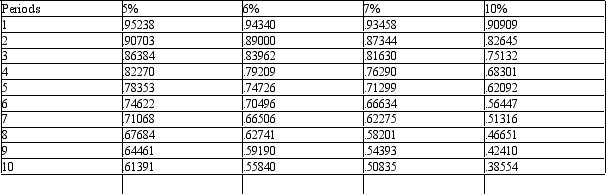
(77) Using the following table, what is the present value of $25,000 to be received 5 years, if the market rate is 7% compounded annually?
(Short Answer)
4.7/5 (70)
(70) Both callable and non-callable bonds can be purchased by the issuing corporation in the open market.
(True/False)
5.0/5 (80)
(80) (a) Prepare the journal entry to issue $100,000 bonds which sold for $94,000.
(b) Prepare the journal entry to issue $100,000 bonds which sold for $104,000.
(Essay)
4.7/5 (79)
(79) Balance sheet and income statement data indicate the following:  Based on the data presented above, what is the number of times bond interest charges were earned (round to two decimal places)?
 (Multiple Choice)
4.8/5 (81)
(81) An installment note is a debt that requires the borrower to make equal periodic payments to the lender for the term of the note.
(True/False)
4.8/5 (88)
(88) Match the following descriptions to their terms
Correct Answer: Verified
Premises:
Responses:
(Matching)
4.9/5 (81)
(81) 

A secured bond is called a debenture bond and is backed only by the general creditworthiness of the corporation.
(True/False)
4.9/5 (85)
(85) If $1,000,000 of 8% bonds are issued at 103 1/2, the amount of cash received from the sale is
(Multiple Choice)
4.7/5 (68)
(68) Which of the following is not an advantage of issuing bonds instead of common stock?
(Multiple Choice)
4.9/5 (86)
(86) The interest expense recorded on an interest payment date is increased
(Multiple Choice)
4.8/5 (83)
(83) The Designer Company issued 10-year bonds on January 1, 2011. The 6% bonds have a face value of $800,000 and pay interest every January 1 and July 1. The bonds were sold for $690,960 based on the market interest rate of 8%. Designer uses the effective-interest method to amortize bond discounts and premiums. On July 1, 2011, Designer should record interest expense (round to the nearest dollar) of
(Multiple Choice)
4.9/5 (70)
(70) Given the following data, determine the times interest earned ratio.
Net income - $70,000
Bonds Payable (issued at face value), 8% - $5,000,000
Preferred Stock ($50 par value, 6%, 10,000 shares issued & outstanding)
Tax rate - 30%
(Short Answer)
5.0/5 (79)
(79) If the market rate of interest is 8%, the price of 6% bonds paying interest semiannually with a face value of $250,000 will be
(Multiple Choice)
4.9/5 (82)
(82) The balance in Premium on Bonds Payable should be reported as a deduction from Bonds Payable on the balance sheet.
(True/False)
4.7/5 (78)
(78) 
Filters
- Essay(0)
- Multiple Choice(0)
- Short Answer(0)
- True False(0)
- Matching(0)