



 Chat with AI
Exam 14: Long-Term Liabilities: Bonds and Notes

Exam 1: Introduction to Accounting and Business191 Questions
Exam 2: Analyzing Transactions226 Questions
Exam 3: The Adjusting Process180 Questions
Exam 4: Completing the Accounting Cycle195 Questions
Exam 5: Accounting Systems160 Questions
Exam 6: Accounting for Merchandising Businesses218 Questions
Exam 7: Inventories169 Questions
Exam 8: Sarbanes-Oxley, Internal Control, and Cash177 Questions
Exam 9: Receivables151 Questions
Exam 10: Fixed Assets and Intangible Assets172 Questions
Exam 11: Current Liabilities and Payroll171 Questions
Exam 12: Accounting for Partnerships and Limited Liability Companies192 Questions
Exam 13: Corporations: Organization, Stock Transactions, and Dividends171 Questions
Exam 14: Long-Term Liabilities: Bonds and Notes188 Questions
Exam 15: Investments and Fair Value Accounting133 Questions
Exam 16: Statement of Cash Flows165 Questions
Exam 17: Financial Statement Analysis186 Questions
Select questions type


Glover Corporation issued $2,000,000 of 7.5%, 6-year bonds dated March 1, 2011, with semiannual interest payments on September 1 and March 1. The bonds were issued on March 1, 2011, at 97. Glover's year-end is December 31.
a) Were the bonds issued at a premium, a discount, or at par?
b) Was the market rate of interest higher, lower, or the same as the contract rate of interest?
c) If the company uses the straight-line method of amortization, what is the amount of interest expense Glover Corporation will show for the year ended December 31, 2011?
d) What is the carrying value of the bonds on December 31, 2011?
(Essay)
4.7/5  (77)
(77) The journal entry a company records for the payment of interest, interest expense, and amortization of bond premium is
(Multiple Choice)
4.9/5 (80)
(80) A corporation often issues callable bonds to protect itself against significant declines in future interest rates.
(True/False)
4.9/5 (66)
(66) Two companies are financed as follows:
 Income tax is estimated at 40% of income.
Determine for each company the earnings per share of common stock, assuming that the income before bond interest and income taxes is $2,280,000 each.
Income tax is estimated at 40% of income.
Determine for each company the earnings per share of common stock, assuming that the income before bond interest and income taxes is $2,280,000 each. (Essay)
4.8/5 (78)
(78) Bonds with a face amount $1,000,000, are sold at 96. The entry to record the issuance is
(Multiple Choice)
4.8/5 (90)
(90) If a company borrows money from a bank as an installment note, the interest portion of each annual payment will:
(Multiple Choice)
5.0/5 (84)
(84) On the first day of the current fiscal year, $2,000,000 of 10-year, 7% bonds, with interest payable annually, were sold for $2,125,000. Present entries to record the following transactions for the current fiscal year:

(Essay)
4.8/5 (81)
(81) Bonds may be purchased directly from the issuing corporation or through one of the bond exchanges.
(True/False)
4.9/5 (79)
(79) If bonds are sold for a discount, the carrying value of the bonds is equal to the face value less the unamortized discount.
(True/False)
5.0/5 (79)
(79) A $500,000 bond issue on which there is an unamortized discount of $35,000 is redeemed for $475,000. Journalize the redemption of the bonds.
(Essay)
4.8/5 (83)
(83) On January 1, 2014, $1,000,000, 5-year, 10% bonds, were issued for $980,000. Interest is paid semiannually on January 1 and July 1. If the issuing corporation uses the straight-line method to amortize discount on bonds payable, the semiannual amortization amount is
(Multiple Choice)
4.9/5 (76)
(76) The present value of $40,000 to be received in one year, at 6% compounded annually, is (rounded to nearest dollar)
(Multiple Choice)
4.9/5 (85)
(85) Only callable bonds can be purchased by the issuing corporation before maturity.
(True/False)
4.7/5 (91)
(91) Bonds with a face amount $1,000,000, are sold at 108. The entry to record the issuance is
(Multiple Choice)
4.9/5 (66)
(66) On January 1, 2011, Zero Company obtained a $52,000, four-year, 6.5% installment note from Regional Bank. The note requires annual payments consisting of principal and interest of $15,179, beginning on December 31, 2011. The December 31, 2011 carrying amount in the amortization table for this installment note will be equal to:
(Multiple Choice)
4.8/5 (86)
(86) When the effective interest method of amortization is used, the amount of interest expense for a given period is calculated by multiplying the face rate of interest by the bond's carrying value at the beginning of the given period.
(True/False)
4.8/5 (83)
(83) Using the following table, what is the present value of $5,000 to be received 5 years, if the market rate is 10% compounded annually?
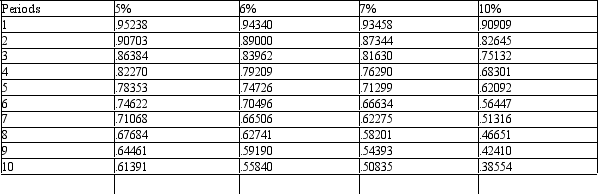
(Short Answer)
4.7/5 (82)
(82) The interest rate specified in the bond indenture is called the
(Multiple Choice)
4.8/5 (81)
(81) If the market rate of interest is 10%, a $10,000, 12%, 10-year bond that pays interest semiannually would sell at an amount
(Multiple Choice)
4.9/5 (92)
(92) 
Filters
- Essay(0)
- Multiple Choice(0)
- Short Answer(0)
- True False(0)
- Matching(0)