



 Chat with AI
Exam 5: Gases and the Kinetic-Molecular Theory

Exam 1: Keys to the Study of Chemistry79 Questions
Exam 2: The Components of Matter105 Questions
Exam 3: Stoichiometry of Formulas and Equations87 Questions
Exam 4: The Major Classes of Chemical Reactions124 Questions
Exam 5: Gases and the Kinetic-Molecular Theory115 Questions
Exam 6: Thermochemistry: Energy Flow and Chemical Change85 Questions
Exam 7: Quantum Theory and Atomic Structure83 Questions
Exam 8: Electron Configuration and Chemical Periodicity85 Questions
Exam 9: Models of Chemical Bonding74 Questions
Exam 10: The Shapes of Molecules109 Questions
Exam 11: Theories of Covalent Bonding58 Questions
Exam 12: Intermolecular Forces: Liquids, Solids, and Phase Changes111 Questions
Exam 13: The Properties of Mixtures: Solutions and Colloids105 Questions
Exam 14: Periodic Patterns in the Main Group Elements: Bonding, Structure, and Reactivity118 Questions
Exam 15: Organic Compounds and the Atomic Properties of Carbon118 Questions
Exam 16: Kinetics: Rates and Mechanisms of Chemical Reactions88 Questions
Exam 17: Equilibrium: the Extent of Chemical Reactions104 Questions
Exam 18: Acid-Base Equilibria103 Questions
Exam 19: Ionic Equilibria in Aqueous Systems119 Questions
Exam 20: Thermodynamics: Entropy, Free Energy, and the Direction of Chemical Reactions94 Questions
Exam 21: Electrochemistry: Chemical Change and Electrical Work102 Questions
Exam 22: The Elements in Nature and Industry57 Questions
Exam 23: The Transition Elements and Their Coordination Compounds92 Questions
Exam 24: Nuclear Reactions and Their Applications94 Questions
Select questions type


The volume of a single molecule of water is 2.99 × 10⁻²³ mL. For a sample of gaseous water at 1.00 atm and 150 °C, what fraction of the container's volume is occupied by the molecules themselves?
(Multiple Choice)
4.9/5  (76)
(76) The temperature of the carbon dioxide atmosphere near the surface of Venus is 475°C. Calculate the average kinetic energy per mole of carbon dioxide molecules on Venus.
(Multiple Choice)
4.9/5 (82)
(82) Calculate the temperature of an argon sample at 55.4 kPa and 18.6 L if it occupies 25.8 L at 75.0°C and 41.1 kPa.
(Multiple Choice)
4.9/5 (78)
(78) A 0.850-mole sample of nitrous oxide, a gas used as an anesthetic by dentists, has a volume of 20.46 L at 123°C and 1.35 atm. What would be its volume at 468°C and 1.35 atm?
(Multiple Choice)
5.0/5 (79)
(79) A 3.0-L sample of helium was placed in a container fitted with a porous membrane. Half of the helium effused through the membrane in 24 hours. A 3.0-L sample of oxygen was placed in an identical container. How many hours will it take for half of the oxygen to effuse through the membrane?
(Multiple Choice)
4.8/5 (79)
(79) Calculate the root-mean-square speed of methane, CH4 (g), at 78°C.
(Multiple Choice)
4.9/5 (92)
(92) Which of the lines on the figure below is the best representation of the relationship between the volume and the number of moles of a gas, measured at constant temperature and pressure? 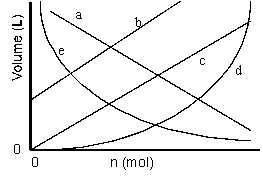
(Short Answer)
4.8/5 (74)
(74) Lithium oxide is an effective absorber of carbon dioxide and can be used to purify air in confined areas such as space vehicles. What volume of carbon dioxide can be absorbed by 1.00 kg of lithium oxide at 25°C and 1.00 atm? Li2O(aq) + CO2(g) Li2CO3(s)
(Multiple Choice)
4.9/5 (74)
(74) A 3.60-L gas sample is at a pressure of 95.5 kPa and a temperature of 25.0°C.
a. Calculate the volume occupied by the gas at STP, assuming it behaves ideally.
b. If the gas sample weighs 6.10 g, calculate the molar mass of the gas.
(Essay)
4.9/5 (86)
(86) According to the postulates of kinetic-molecular theory, the molecules of all gases at a given temperature have the same average speed.
(True/False)
4.8/5 (76)
(76) At what temperature in kelvin is the root mean square speed of helium atoms (atomic weight = 4.00) equal to that of oxygen molecules (molecular weight = 32.00) at 300. K?
(Multiple Choice)
4.9/5 (85)
(85) Nitrogen dioxide is a red-brown gas that is responsible for the color of photochemical smog. A sample of nitrogen dioxide has a volume of 28.6 L at 45.3°C and 89.9 kPa. What is its volume at STP?
(Multiple Choice)
4.8/5 (83)
(83) A sample of propane, a component of LP gas, has a volume of 35.3 L at 315 K and 922 torr. What is its volume at STP?
(Multiple Choice)
4.7/5 (75)
(75) "The volume of an ideal gas is directly proportional to its absolute temperature at constant pressure and number of moles" is a statement of ________________ Law.
(Multiple Choice)
4.9/5 (74)
(74) Briefly state the conditions corresponding to STP (standard temperature and pressure).
(Essay)
4.9/5 (84)
(84) At a temperature of absolute zero, the volume of an ideal gas is zero.
(True/False)
5.0/5 (90)
(90) For a pure gas sample, the average kinetic energy is also the most probable kinetic energy.
(True/False)
4.8/5 (75)
(75) A sample of nitrogen gas is confined to a 14.0 L container at 375 torr and 37.0°C. How many moles of nitrogen are in the container?
(Multiple Choice)
4.7/5 (81)
(81) Assuming ideal behavior, what is the density of argon gas at STP, in g/L?
(Multiple Choice)
4.9/5 (88)
(88) Given that pressure has dimensions of force ÷ area; that force has dimensions of mass × acceleration; and that the S.I. unit of pressure is the pascal, what is 1 pascal in terms of S.I. base units?
(Multiple Choice)
4.7/5 (74)
(74) 
Filters
- Essay(0)
- Multiple Choice(0)
- Short Answer(0)
- True False(0)
- Matching(0)