



 Chat with AI
Exam 5: Gases and the Kinetic-Molecular Theory

Exam 1: Keys to the Study of Chemistry79 Questions
Exam 2: The Components of Matter105 Questions
Exam 3: Stoichiometry of Formulas and Equations87 Questions
Exam 4: The Major Classes of Chemical Reactions124 Questions
Exam 5: Gases and the Kinetic-Molecular Theory115 Questions
Exam 6: Thermochemistry: Energy Flow and Chemical Change85 Questions
Exam 7: Quantum Theory and Atomic Structure83 Questions
Exam 8: Electron Configuration and Chemical Periodicity85 Questions
Exam 9: Models of Chemical Bonding74 Questions
Exam 10: The Shapes of Molecules109 Questions
Exam 11: Theories of Covalent Bonding58 Questions
Exam 12: Intermolecular Forces: Liquids, Solids, and Phase Changes111 Questions
Exam 13: The Properties of Mixtures: Solutions and Colloids105 Questions
Exam 14: Periodic Patterns in the Main Group Elements: Bonding, Structure, and Reactivity118 Questions
Exam 15: Organic Compounds and the Atomic Properties of Carbon118 Questions
Exam 16: Kinetics: Rates and Mechanisms of Chemical Reactions88 Questions
Exam 17: Equilibrium: the Extent of Chemical Reactions104 Questions
Exam 18: Acid-Base Equilibria103 Questions
Exam 19: Ionic Equilibria in Aqueous Systems119 Questions
Exam 20: Thermodynamics: Entropy, Free Energy, and the Direction of Chemical Reactions94 Questions
Exam 21: Electrochemistry: Chemical Change and Electrical Work102 Questions
Exam 22: The Elements in Nature and Industry57 Questions
Exam 23: The Transition Elements and Their Coordination Compounds92 Questions
Exam 24: Nuclear Reactions and Their Applications94 Questions
Select questions type


A weather balloon was initially at a pressure of 0.950 atm, and its volume was 35.0 L. The pressure decreased to 0.750 atm, without loss of gas or change in temperature. What was the change in the volume?
(Multiple Choice)
4.9/5  (75)
(75) A sample of carbon dioxide gas at 125°C and 248 torr occupies a volume of 275 L. What will the gas pressure be if the volume is increased to 321 L at 125°C?
(Multiple Choice)
4.9/5 (81)
(81) Aluminum metal shavings (10.0 g) are placed in 100. mL of 6.00 M hydrochloric acid. What is the maximum volume of hydrogen, measured at STP, which can be produced?
2Al(s) + 6HCl(aq) 2AlCl3(aq) + 3H2(g)
(Short Answer)
4.8/5 (90)
(90) Which of the lines on the figure below is the best representation of the relationship between the volume of a gas and its absolute temperature, other factors remaining constant? 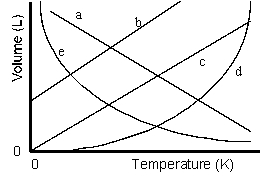
(Short Answer)
4.9/5 (82)
(82) For an ideal gas, a plot of PV/nRT versus P gives a straight line with a positive slope.
(True/False)
4.8/5 (71)
(71) What is the pressure in a 7.50-L flask if 0.15 mol of carbon dioxide is added to 0.33 mol of oxygen? The temperature of the mixture is 48.0°C.
(Multiple Choice)
4.7/5 (75)
(75) A 500-mL sample of argon at 800 torr has its absolute temperature quadrupled. If the volume remains unchanged what is the new pressure?
(Multiple Choice)
4.9/5 (77)
(77) A flask containing neon gas is connected to an open-ended mercury manometer. The open end is exposed to the atmosphere, where the prevailing pressure is 745 torr. The mercury level in the open arm is 50. mm below that in the arm connected to the flask of neon. What is the neon pressure, in torr?
(Multiple Choice)
4.7/5 (89)
(89) A sample of an ideal gas has its volume doubled while its temperature remains constant. If the original pressure was 100 torr, what is the new pressure?
(Multiple Choice)
4.9/5 (79)
(79) The most probable speed of an oxygen molecule in the gas phase at room temperature is 450 m/s. The root-mean-square speed (urms) is therefore
(Multiple Choice)
4.8/5 (81)
(81) A sample of ammonia gas at 65.5°C and 524 torr has a volume of 15.31 L. What is its volume when the temperature is -15.8°C and its pressure is 524 torr?
(Multiple Choice)
4.9/5 (67)
(67) A flask containing argon gas is connected to a closed-ended mercury manometer. The closed end is under vacuum. If the mercury level in the closed arm is 230. mm above that in the arm connected to the flask, what is the argon pressure, in torr?
(Multiple Choice)
4.8/5 (74)
(74) According to the kinetic theory of gases, in a collision between two molecules the kinetic energy of one molecule will decrease by the same amount that the kinetic energy of the other one increases.
(True/False)
4.9/5 (78)
(78) A 20.0-L container holds 15.3 mol of Cl2 gas at 227°C.
a. Calculate the pressure in atmospheres, assuming ideal behavior.
b. Calculate the pressure in atmospheres, assuming van der Waals behavior. The van der Waals constants for Cl2 are a = 6.49 atmL2/mol2 and b = 0.0562 L/mol.
(Essay)
4.9/5 (79)
(79) If 0.750 L of argon at 1.50 atm and 177°C and 0.235 L of sulfur dioxide at 95.0 kPa and 63.0°C are added to a 1.00-L flask and the flask's temperature is adjusted to 25.0°C, what is the resulting pressure in the flask?
(Multiple Choice)
4.8/5 (70)
(70) At very high pressures (~ 1000 atm), the measured pressure exerted by real gases is greater than that predicted by the ideal gas equation. This is mainly because
(Multiple Choice)
4.9/5 (74)
(74) Starting from the Ideal Gas Equation, derive an equation corresponding to Charles's Law, stating all important assumptions or conditions.
(Essay)
4.7/5 (84)
(84) 
Filters
- Essay(0)
- Multiple Choice(0)
- Short Answer(0)
- True False(0)
- Matching(0)