



 Chat with AI
Exam 5: Gases and the Kinetic-Molecular Theory

Exam 1: Keys to the Study of Chemistry79 Questions
Exam 2: The Components of Matter105 Questions
Exam 3: Stoichiometry of Formulas and Equations87 Questions
Exam 4: The Major Classes of Chemical Reactions124 Questions
Exam 5: Gases and the Kinetic-Molecular Theory115 Questions
Exam 6: Thermochemistry: Energy Flow and Chemical Change85 Questions
Exam 7: Quantum Theory and Atomic Structure83 Questions
Exam 8: Electron Configuration and Chemical Periodicity85 Questions
Exam 9: Models of Chemical Bonding74 Questions
Exam 10: The Shapes of Molecules109 Questions
Exam 11: Theories of Covalent Bonding58 Questions
Exam 12: Intermolecular Forces: Liquids, Solids, and Phase Changes111 Questions
Exam 13: The Properties of Mixtures: Solutions and Colloids105 Questions
Exam 14: Periodic Patterns in the Main Group Elements: Bonding, Structure, and Reactivity118 Questions
Exam 15: Organic Compounds and the Atomic Properties of Carbon118 Questions
Exam 16: Kinetics: Rates and Mechanisms of Chemical Reactions88 Questions
Exam 17: Equilibrium: the Extent of Chemical Reactions104 Questions
Exam 18: Acid-Base Equilibria103 Questions
Exam 19: Ionic Equilibria in Aqueous Systems119 Questions
Exam 20: Thermodynamics: Entropy, Free Energy, and the Direction of Chemical Reactions94 Questions
Exam 21: Electrochemistry: Chemical Change and Electrical Work102 Questions
Exam 22: The Elements in Nature and Industry57 Questions
Exam 23: The Transition Elements and Their Coordination Compounds92 Questions
Exam 24: Nuclear Reactions and Their Applications94 Questions
Select questions type


Dry air is approximately 78% nitrogen, 21% oxygen, and 1% argon, by number of molecules. What is the partial pressure of oxygen in a sample of dry air, if atmospheric pressure is 751 torr?
(Short Answer)
4.9/5  (83)
(83) A 255-mL gas sample weighing 0.292 g is at 52810 Pa and 127°C.
a. How many moles of gas are present?
b. What is the molar mass of the gas?
(Essay)
4.8/5 (78)
(78) A 750-mL sample of hydrogen exerts a pressure of 822 torr at 325 K. What pressure does it exert if the temperature is raised to 475 K at constant volume?
(Multiple Choice)
4.9/5 (73)
(73) A sample container of carbon monoxide occupies a volume of 435 mL at a pressure of 785 torr and a temperature of 298 K. What would its temperature be if the volume were changed to 265 mL at a pressure of 785 torr?
(Multiple Choice)
4.9/5 (65)
(65) Magnesium metal (0.100 mol) and a volume of aqueous hydrochloric acid that contains 0.500 mol of HCl are combined and react to completion. How many liters of hydrogen gas, measured at STP, are produced? Mg(s) + 2HCl(aq) MgCl2(aq) + H2(g)
(Multiple Choice)
4.8/5 (71)
(71) A sample of nitrogen gas at 298 K and 745 torr has a volume of 37.42 L. What volume will it occupy if the pressure is increased to 894 torr at constant temperature?
(Multiple Choice)
4.8/5 (76)
(76) Calculate the rms speed of carbon dioxide molecules at STP.
(Multiple Choice)
4.8/5 (77)
(77) The pressure of hydrogen sulfide gas in a container is 35,650 Pa. What is this pressure in torr?
(Multiple Choice)
4.9/5 (82)
(82) A 1.00-L sample of a pure gas weighs 0.785 g and is at 0.965 atm and 29.2°C.
a. What is the molar mass of the gas?
b. If the volume and temperature are kept constant while 0.400 g of the same gas are added to that already in the container, what will the new pressure be?
(Essay)
5.0/5 (78)
(78) Arrange the following gases in order of increasing rate of effusion. C2H6 Ar HCl PH3
(Multiple Choice)
4.7/5 (80)
(80) Which of the lines on the figure below is the best representation of the relationship between the volume of a gas and its pressure, other factors remaining constant? 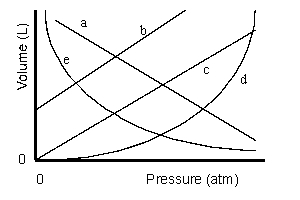
(Short Answer)
4.9/5 (82)
(82) Methane, CH4(g), reacts with steam to give synthesis gas, a mixture of carbon monoxide and hydrogen, which is used as starting material for the synthesis of a number of organic and inorganic compounds. CH4(g) + H2O(g) CO(g) + H2(g) [unbalanced]
What mass of hydrogen is formed if 275 L of methane (measured at STP) is converted to synthesis gas?
(Multiple Choice)
4.9/5 (85)
(85) What is the density of carbon dioxide gas at -25.2°C and 98.0 kPa?
(Multiple Choice)
4.9/5 (66)
(66) A sample of oxygen gas has its absolute temperature halved while the pressure of the gas remained constant. If the initial volume is 400 mL, what is the final volume?
(Multiple Choice)
4.9/5 (86)
(86) Hydrogen gas exerts a pressure of 466 torr in a container. What is this pressure in atmospheres?
(Multiple Choice)
4.9/5 (69)
(69) Chlorofluorocarbons are important air pollutants implicated in global warming and ozone depletion. How fast does the chlorofluorocarbon CF2Cl2 diffuse relative to N2, the main component of the atmosphere?
In other words, calculate the ratio of diffusion rates: 
(Short Answer)
4.8/5 (82)
(82) A gas mixture, with a total pressure of 300. torr, consists of equal masses of Ne (atomic weight 20.) and Ar (atomic weight 40.). What is the partial pressure of Ar, in torr?
(Multiple Choice)
4.8/5 (80)
(80) A gas consists of 85.7 % carbon and 14.3 % hydrogen, by weight. A sample of this gas weighing 0.673 g occupies 729 mL at a pressure of 720.0 mmHg and a temperature of 77°C. Calculate its empirical and molecular formulas.
(Multiple Choice)
4.8/5 (71)
(71) 
Filters
- Essay(0)
- Multiple Choice(0)
- Short Answer(0)
- True False(0)
- Matching(0)