



 Chat with AI
Exam 1: The Equity Method of Accounting for Investments

Exam 1: The Equity Method of Accounting for Investments119 Questions
Exam 2: Consolidation of Financial Information107 Questions
Exam 3: Consolidations - Subsequent to the Date of Acquisition122 Questions
Exam 4: Consolidated Financial Statements and Outside Ownership116 Questions
Exam 5: Consolidated Financial Statements Intra-Entity Asset Transactions127 Questions
Exam 6: Variable Interest Entities, Intra-Entity Debt, Consolidated Cash Flows, and Other Issues115 Questions
Exam 7: Consolidated Financial Statements - Ownership Patterns and Income Taxes115 Questions
Exam 8: Segment and Interim Reporting116 Questions
Exam 9: Foreign Currency Transactions and Hedging Foreign Exchange Risk93 Questions
Exam 10: Translation of Foreign Currency Financial Statements97 Questions
Exam 11: Worldwide Accounting Diversity and International Accounting Standards60 Questions
Exam 12: Financial Reporting and the Securities and Exchange Commission77 Questions
Exam 13: Accounting for Legal Reorganizations and Liquidations83 Questions
Exam 14: Partnerships: Formation and Operation88 Questions
Exam 15: Partnerships: Termination and Liquidation73 Questions
Exam 16: Accounting for State and Local Governments78 Questions
Exam 17: Accounting for State and Local Governments49 Questions
Exam 18: Accounting and Reporting for Private Not-For-Profit Organizations62 Questions
Exam 19: Accounting for Estates and Trusts80 Questions
Select questions type


Tinker Co. owns 25% of the common stock of Harbor Co. and uses the equity method to account for the investment. During 2013, Harbor reported income of $120,000 and paid dividends of $40,000. Harbor owns a building with a useful life of twenty years which is undervalued by $80,000.
Required:
Prepare a schedule to show the equity income Tinker should recognize for 2013 related to this investment.
(Essay)
4.8/5  (82)
(82) On January 3, 2013, Jenkins Corp. acquired 40% of the outstanding common stock of Bolivar Co. for $1,200,000. This acquisition gave Jenkins the ability to exercise significant influence over the investee. The book value of the acquired shares was $950,000. Any excess cost over the underlying book value was assigned to a patent that was undervalued on Bolivar's balance sheet. This patent has a remaining useful life of ten years. For the year ended December 31, 2013, Bolivar reported net income of $312,000 and paid cash dividends of $96,000.
Required:
Prepare a schedule to show the balance Jenkins should report as its Investment in Bolivar Co. at December 31, 2013.
(Essay)
4.9/5 (85)
(85) Dodge, Incorporated acquires 15% of Gates Corporation on January 1, 2013, for $105,000 when the book value of Gates was $600,000. During 2013 Gates reported net income of $150,000 and paid dividends of $50,000. On January 1, 2014, Dodge purchased an additional 25% of Gates for $200,000. Any excess cost over book value is attributable to goodwill with an indefinite life. The fair-value method was used during 2013 but Dodge has deemed it necessary to change to the equity method after the second purchase. During 2014 Gates reported net income of $200,000 and reported dividends of $75,000.
The balance in the investment account at December 31, 2014, is
(Multiple Choice)
5.0/5 (72)
(72) On January 1, 2012, Mehan, Incorporated purchased 15,000 shares of Cook Company for $150,000 giving Mehan a 15% ownership of Cook. On January 1, 2013 Mehan purchased an additional 25,000 shares (25%) of Cook for $300,000. This last purchase gave Mehan the ability to apply significant influence over Cook. The book value of Cook on January 1, 2012, was $1,000,000. The book value of Cook on January 1, 2013, was $1,150,000. Any excess of cost over book value for this second transaction is assigned to a database and amortized over five years.
Cook reports net income and dividends as follows. These amounts are assumed to have occurred evenly throughout the years: 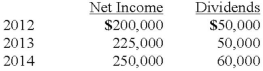 On April 1, 2014, just after its first dividend receipt, Mehan sells 10,000 shares of its investment.
What is the balance in the investment account at December 31, 2012?
On April 1, 2014, just after its first dividend receipt, Mehan sells 10,000 shares of its investment.
What is the balance in the investment account at December 31, 2012? (Multiple Choice)
4.7/5 (83)
(83) Atlarge Inc. owns 30% of the outstanding voting common stock of Ticker Co. and has the ability to significantly influence the investee's operations and decision making. On January 1, 2013, the balance in the Investment in Ticker Co. account was $402,000. Amortization associated with the purchase of this investment is $8,000 per year. During 2013, Ticker earned income of $108,000 and paid cash dividends of $36,000. Previously in 2012, Ticker had sold inventory costing $28,800 to Atlarge for $48,000. All but 25% of this merchandise was consumed by Atlarge during 2012. The remainder was used during the first few weeks of 2013. Additional sales were made to Atlarge in 2013; inventory costing $33,600 was transferred at a price of $60,000. Of this total, 40% was not consumed until 2014.
What was the balance in the Investment in Ticker Co. account at the end of 2013?
(Multiple Choice)
4.9/5 (70)
(70) Acker Inc. bought 40% of Howell Co. on January 1, 2012 for $576,000. The equity method of accounting was used. The book value and fair value of the net assets of Howell on that date were $1,440,000. Acker began supplying inventory to Howell as follows:  Howell reported net income of $100,000 in 2012 and $120,000 in 2013 while paying $40,000 in dividends each year.
What is the balance in Acker's Investment in Howell account at December 31, 2012?
Howell reported net income of $100,000 in 2012 and $120,000 in 2013 while paying $40,000 in dividends each year.
What is the balance in Acker's Investment in Howell account at December 31, 2012? (Multiple Choice)
4.8/5 (88)
(88) Renfroe, Inc. acquires 10% of Stanley Corporation on January 1, 2012, for $90,000 when the book value of Stanley was $1,000,000. During 2012, Stanley reported net income of $215,000 and paid dividends of $50,000. On January 1, 2013, Renfroe purchased an additional 30% of Stanley for $325,000. Any excess of cost over book value is attributable to goodwill with an indefinite life. During 2013, Renfroe reported net income of $320,000 and paid dividends of $50,000.
What is the balance in the Investment in Stanley Corporation on December 31, 2013?
(Multiple Choice)
4.9/5 (65)
(65) On January 4, 2013, Mason Co. purchased 40,000 shares (40%) of the common stock of Hefly Corp., paying $560,000. At that time, the book value and fair value of Hefly's net assets was $1,400,000. The investment gave Mason the ability to exercise significant influence over the operations of Hefly. During 2013, Hefly reported income of $150,000 and paid dividends of $40,000. On January 2, 2014, Mason sold 10,000 shares for $150,000.
What is the balance in the investment account after the sale of the 10,000 shares?
(Multiple Choice)
4.8/5 (74)
(74) You are auditing a company that owns twenty percent of the voting common stock of another corporation and uses the equity method to account for the investment. How would you verify that the equity method is appropriate in this case?
(Essay)
4.8/5 (86)
(86) Jager Inc. holds 30% of the outstanding voting shares of Kinson Co. and appropriately applies the equity method of accounting. Amortization associated with this investment equals $11,000 per year. For 2013, Kinson reported earnings of $100,000 and paid cash dividends of $40,000. During 2013, Kinson acquired inventory for $62,400, which was then sold to Jager for $96,000. At the end of 2013, Jager still held some of this inventory at its transfer price of $50,000.
Required:
Determine the amount of Equity in Investee Income that Jager should have reported for 2013.
(Essay)
4.9/5 (73)
(73) Atlarge Inc. owns 30% of the outstanding voting common stock of Ticker Co. and has the ability to significantly influence the investee's operations and decision making. On January 1, 2013, the balance in the Investment in Ticker Co. account was $402,000. Amortization associated with the purchase of this investment is $8,000 per year. During 2013, Ticker earned income of $108,000 and paid cash dividends of $36,000. Previously in 2012, Ticker had sold inventory costing $28,800 to Atlarge for $48,000. All but 25% of this merchandise was consumed by Atlarge during 2012. The remainder was used during the first few weeks of 2013. Additional sales were made to Atlarge in 2013; inventory costing $33,600 was transferred at a price of $60,000. Of this total, 40% was not consumed until 2014.
What amount of equity income would Atlarge have recognized in 2013 from its ownership interest in Ticker?
(Multiple Choice)
4.9/5 (84)
(84) Steven Company owns 40% of the outstanding voting common stock of Nicole Corp. and has the ability to significantly influence the investee's operations. On January 3, 2013, the balance in the Investment in Nicole Corp. account was $503,000. Amortization associated with this acquisition is $12,000 per year. During 2013, Nicole earned net income of $120,000 and paid cash dividends of $40,000. Previously in 2012, Nicole had sold inventory costing $35,000 to Steven for $50,000. All but 25% of that inventory had been sold to outsiders by Steven during 2012. Additional sales were made to Steven in 2013 at a transfer price of $75,000 that had cost Nicole $54,000. Only 10% of the 2013 purchases had not been sold to outsiders by the end of 2013.
What amount of unrealized intra-entity profit should be deferred by Steven at December 31, 2013?
(Short Answer)
4.8/5 (91)
(91) Cayman Inc. bought 30% of Maya Company on January 1, 2013 for $450,000. The equity method of accounting was used. The book value and fair value of the net assets of Maya on that date were $1,500,000. Maya began supplying inventory to Cayman as follows:  Maya reported net income of $100,000 in 2013 and $120,000 in 2014 while paying $40,000 in dividends each year.
What is the balance in Cayman's Investment in Maya account at December 31, 2013?
Maya reported net income of $100,000 in 2013 and $120,000 in 2014 while paying $40,000 in dividends each year.
What is the balance in Cayman's Investment in Maya account at December 31, 2013? (Multiple Choice)
4.8/5 (83)
(83) On January 3, 2013, Roberts Company purchased 30% of the 100,000 shares of common stock of Thomas Corporation, paying $1,500,000. There was no goodwill or other cost allocation associated with the investment. Roberts has significant influence over Thomas. During 2013, Thomas reported income of $300,000 and paid dividends of $100,000. On January 4, 2014, Roberts sold 15,000 shares for $800,000.
What was the balance in the investment account before the shares were sold?
(Multiple Choice)
4.7/5 (78)
(78) Acker Inc. bought 40% of Howell Co. on January 1, 2012 for $576,000. The equity method of accounting was used. The book value and fair value of the net assets of Howell on that date were $1,440,000. Acker began supplying inventory to Howell as follows:  Howell reported net income of $100,000 in 2012 and $120,000 in 2013 while paying $40,000 in dividends each year.
What is the balance in Acker's Investment in Howell account at December 31, 2013?
Howell reported net income of $100,000 in 2012 and $120,000 in 2013 while paying $40,000 in dividends each year.
What is the balance in Acker's Investment in Howell account at December 31, 2013? (Multiple Choice)
4.9/5 (77)
(77) On January 1, 2013, Jackie Corp. purchased 30% of the voting common stock of Rob Co., paying $2,000,000. Jackie properly accounts for this investment using the equity method. At the time of the investment, Rob's total stockholders' equity was $3,000,000. Jackie gathered the following information about Rob's assets and liabilities whose book values and fair values differed:  Any excess of cost over fair value was attributed to goodwill, which has not been impaired. Rob Co. reported net income of $300,000 for 2013, and paid dividends of $100,000 during that year.
How much goodwill is associated with this investment?
Any excess of cost over fair value was attributed to goodwill, which has not been impaired. Rob Co. reported net income of $300,000 for 2013, and paid dividends of $100,000 during that year.
How much goodwill is associated with this investment? (Multiple Choice)
4.7/5 (93)
(93) On January 1, 2012, Mehan, Incorporated purchased 15,000 shares of Cook Company for $150,000 giving Mehan a 15% ownership of Cook. On January 1, 2013 Mehan purchased an additional 25,000 shares (25%) of Cook for $300,000. This last purchase gave Mehan the ability to apply significant influence over Cook. The book value of Cook on January 1, 2012, was $1,000,000. The book value of Cook on January 1, 2013, was $1,150,000. Any excess of cost over book value for this second transaction is assigned to a database and amortized over five years.
Cook reports net income and dividends as follows. These amounts are assumed to have occurred evenly throughout the years: 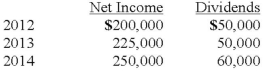 On April 1, 2014, just after its first dividend receipt, Mehan sells 10,000 shares of its investment.
What was the balance in the investment account at December 31, 2013?
On April 1, 2014, just after its first dividend receipt, Mehan sells 10,000 shares of its investment.
What was the balance in the investment account at December 31, 2013? (Multiple Choice)
4.9/5 (87)
(87) Which statement is true concerning unrealized profits in intra-entity inventory transfers when an investor uses the equity method?
(Multiple Choice)
4.8/5 (79)
(79) On January 4, 2013, Mason Co. purchased 40,000 shares (40%) of the common stock of Hefly Corp., paying $560,000. At that time, the book value and fair value of Hefly's net assets was $1,400,000. The investment gave Mason the ability to exercise significant influence over the operations of Hefly. During 2013, Hefly reported income of $150,000 and paid dividends of $40,000. On January 2, 2014, Mason sold 10,000 shares for $150,000.
What is the gain/loss on the sale of the 10,000 shares?
(Multiple Choice)
4.7/5 (73)
(73) 
Filters
- Essay(0)
- Multiple Choice(0)
- Short Answer(0)
- True False(0)
- Matching(0)