



 Chat with AI
Exam 5: Consolidated Financial Statements Intra-Entity Asset Transactions

Exam 1: The Equity Method of Accounting for Investments119 Questions
Exam 2: Consolidation of Financial Information107 Questions
Exam 3: Consolidations - Subsequent to the Date of Acquisition122 Questions
Exam 4: Consolidated Financial Statements and Outside Ownership116 Questions
Exam 5: Consolidated Financial Statements Intra-Entity Asset Transactions127 Questions
Exam 6: Variable Interest Entities, Intra-Entity Debt, Consolidated Cash Flows, and Other Issues115 Questions
Exam 7: Consolidated Financial Statements - Ownership Patterns and Income Taxes115 Questions
Exam 8: Segment and Interim Reporting116 Questions
Exam 9: Foreign Currency Transactions and Hedging Foreign Exchange Risk93 Questions
Exam 10: Translation of Foreign Currency Financial Statements97 Questions
Exam 11: Worldwide Accounting Diversity and International Accounting Standards60 Questions
Exam 12: Financial Reporting and the Securities and Exchange Commission77 Questions
Exam 13: Accounting for Legal Reorganizations and Liquidations83 Questions
Exam 14: Partnerships: Formation and Operation88 Questions
Exam 15: Partnerships: Termination and Liquidation73 Questions
Exam 16: Accounting for State and Local Governments78 Questions
Exam 17: Accounting for State and Local Governments49 Questions
Exam 18: Accounting and Reporting for Private Not-For-Profit Organizations62 Questions
Exam 19: Accounting for Estates and Trusts80 Questions
Select questions type


Strickland Company sells inventory to its parent, Carter Company, at a profit during 2012. One-third of the inventory is sold by Carter in 2012.
In the consolidation worksheet for 2012, which of the following choices would be a debit entry to eliminate the intra-entity transfer of inventory?
(Multiple Choice)
4.8/5  (82)
(82) Pepe, Incorporated acquired 60% of Devin Company on January 1, 2012. On that date Devin sold equipment to Pepe for $45,000. The equipment had a cost of $120,000 and accumulated depreciation of $66,000 with a remaining life of 9 years. Devin reported net income of $300,000 and $325,000 for 2012 and 2013, respectively. Pepe uses the equity method to account for its investment in Devin.
Compute the income from Devin reported on Pepe's books for 2012.
(Multiple Choice)
4.9/5 (92)
(92) Stiller Company, an 80% owned subsidiary of Leo Company, purchased land from Leo on March 1, 2012, for $75,000. The land originally cost Leo $60,000. Stiller reported net income of $125,000 and $140,000 for 2012 and 2013, respectively. Leo uses the equity method to account for its investment.
Compute income from Stiller on Leo's books for 2013.
(Multiple Choice)
4.8/5 (77)
(77) Strickland Company sells inventory to its parent, Carter Company, at a profit during 2012. One-third of the inventory is sold by Carter in 2012.
In the consolidation worksheet for 2012, which of the following choices would be a debit entry to eliminate unrealized intra-entity gross profit with regard to the 2012 intra-entity sales?
(Multiple Choice)
4.9/5 (79)
(79) On January 1, 2013, Pride, Inc. acquired 80% of the outstanding voting common stock of Strong Corp. for $364,000. There is no active market for Strong's stock. Of this payment, $28,000 was allocated to equipment (with a five-year life) that had been undervalued on Strong's books by $35,000. Any remaining excess was attributable to goodwill which has not been impaired.
As of December 31, 2013, before preparing the consolidated worksheet, the financial statements appeared as follows: 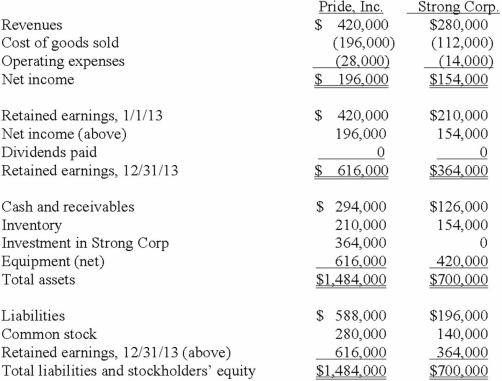 During 2013, Pride bought inventory for $112,000 and sold it to Strong for $140,000. Only half of this purchase had been paid for by Strong by the end of the year. 60% of these goods were still in the company's possession on December 31, 2013.
What is the total of consolidated operating expenses?
During 2013, Pride bought inventory for $112,000 and sold it to Strong for $140,000. Only half of this purchase had been paid for by Strong by the end of the year. 60% of these goods were still in the company's possession on December 31, 2013.
What is the total of consolidated operating expenses? (Multiple Choice)
4.8/5 (72)
(72) On January 1, 2013, Race Corp. acquired 80% of the voting common stock of Gallow Inc. During the year, Race sold to Gallow for $450,000 goods which cost $330,000. Gallow still owned 15% of the goods at year-end. Gallow's reported net income was $204,000, and Race's net income was $806,000. Race decided to use the equity method to account for this investment. What was the non-controlling interest's share of consolidated net income?
(Multiple Choice)
4.8/5 (79)
(79) Several years ago Polar Inc. acquired an 80% interest in Icecap Co. The book values of Icecap's asset and liability accounts at that time were considered to be equal to their fair values. Polar's acquisition value corresponded to the underlying book value of Icecap so that no allocations or goodwill resulted from the transaction.
The following selected account balances were from the individual financial records of these two companies as of December 31, 2013:  Assume that Polar sold inventory to Icecap at a markup equal to 25% of cost. Intra-entity transfers were $130,000 in 2012 and $165,000 in 2013. Of this inventory, $39,000 of the 2012 transfers were retained and then sold by Icecap in 2013, while $55,000 of the 2013 transfers were held until 2014.
Required:
For the consolidated financial statements for 2013, determine the balances that would appear for the following accounts: (1) Cost of Goods Sold, (2) Inventory, and (3) Non-controlling Interest in Subsidiary's Net Income.
Assume that Polar sold inventory to Icecap at a markup equal to 25% of cost. Intra-entity transfers were $130,000 in 2012 and $165,000 in 2013. Of this inventory, $39,000 of the 2012 transfers were retained and then sold by Icecap in 2013, while $55,000 of the 2013 transfers were held until 2014.
Required:
For the consolidated financial statements for 2013, determine the balances that would appear for the following accounts: (1) Cost of Goods Sold, (2) Inventory, and (3) Non-controlling Interest in Subsidiary's Net Income. (Essay)
4.8/5 (82)
(82) 
Filters
- Essay(0)
- Multiple Choice(0)
- Short Answer(0)
- True False(0)
- Matching(0)