



 Chat with AI
Exam 14: Partnerships: Formation and Operation

Exam 1: The Equity Method of Accounting for Investments119 Questions
Exam 2: Consolidation of Financial Information107 Questions
Exam 3: Consolidations - Subsequent to the Date of Acquisition122 Questions
Exam 4: Consolidated Financial Statements and Outside Ownership116 Questions
Exam 5: Consolidated Financial Statements Intra-Entity Asset Transactions127 Questions
Exam 6: Variable Interest Entities, Intra-Entity Debt, Consolidated Cash Flows, and Other Issues115 Questions
Exam 7: Consolidated Financial Statements - Ownership Patterns and Income Taxes115 Questions
Exam 8: Segment and Interim Reporting116 Questions
Exam 9: Foreign Currency Transactions and Hedging Foreign Exchange Risk93 Questions
Exam 10: Translation of Foreign Currency Financial Statements97 Questions
Exam 11: Worldwide Accounting Diversity and International Accounting Standards60 Questions
Exam 12: Financial Reporting and the Securities and Exchange Commission77 Questions
Exam 13: Accounting for Legal Reorganizations and Liquidations83 Questions
Exam 14: Partnerships: Formation and Operation88 Questions
Exam 15: Partnerships: Termination and Liquidation73 Questions
Exam 16: Accounting for State and Local Governments78 Questions
Exam 17: Accounting for State and Local Governments49 Questions
Exam 18: Accounting and Reporting for Private Not-For-Profit Organizations62 Questions
Exam 19: Accounting for Estates and Trusts80 Questions
Select questions type


Cleary, Wasser, and Nolan formed a partnership on January 1, 2012, with investments of $100,000, $150,000, and $200,000, respectively. For division of income, they agreed to (1) interest of 10% of the beginning capital balance each year, (2) annual compensation of $10,000 to Wasser, and (3) sharing the remainder of the income or loss in a ratio of 20% for Cleary, and 40% each for Wasser and Nolan. Net income was $150,000 in 2012 and $180,000 in 2013. Each partner withdrew $1,000 for personal use every month during 2012 and 2013.
What was Cleary's capital balance at the end of 2012?
(Multiple Choice)
4.8/5  (69)
(69) Cleary, Wasser, and Nolan formed a partnership on January 1, 2012, with investments of $100,000, $150,000, and $200,000, respectively. For division of income, they agreed to (1) interest of 10% of the beginning capital balance each year, (2) annual compensation of $10,000 to Wasser, and (3) sharing the remainder of the income or loss in a ratio of 20% for Cleary, and 40% each for Wasser and Nolan. Net income was $150,000 in 2012 and $180,000 in 2013. Each partner withdrew $1,000 for personal use every month during 2012 and 2013.
What was Cleary's total share of net income for 2012?
(Multiple Choice)
4.8/5 (70)
(70) Which of the following could be used as a basis to allocate profits among partners who are active in the management of the partnership?
1) allocation of salaries.
2) the number of years with the partnership.
3) the amount of time each partner works.
4) the average capital invested.
(Multiple Choice)
4.8/5 (86)
(86) Cleary, Wasser, and Nolan formed a partnership on January 1, 2012, with investments of $100,000, $150,000, and $200,000, respectively. For division of income, they agreed to (1) interest of 10% of the beginning capital balance each year, (2) annual compensation of $10,000 to Wasser, and (3) sharing the remainder of the income or loss in a ratio of 20% for Cleary, and 40% each for Wasser and Nolan. Net income was $150,000 in 2012 and $180,000 in 2013. Each partner withdrew $1,000 for personal use every month during 2012 and 2013.
What was the amount of interest attributed to Wasser for 2013?
(Multiple Choice)
4.8/5 (79)
(79) How is accounting for a partnership different from accounting for a corporation?
(Essay)
4.9/5 (81)
(81) A partnership began its first year of operations with the following capital balances:
Young, Capital: $143,000
Eaton, Capital: $104,000
Thurman, Capital: $143,000
The Articles of Partnership stipulated that profits and losses be assigned in the following manner:
Young was to be awarded an annual salary of $26,000 with $13,000 salary assigned to Thurman.
Each partner was to be attributed with interest equal to 10% of the capital balance as of the first day of the year.
The remainder was to be assigned on a 5:2:3 basis to Young, Eaton, and Thurman, respectively.
Each partner withdrew $13,000 per year.
Assume that the net loss for the first year of operations was $26,000 with net income of $52,000 in the second year.
What was the balance in Young's Capital account at the end of the second year?
(Multiple Choice)
4.8/5 (82)
(82) A partnership began its first year of operations with the following capital balances:
Young, Capital: $143,000
Eaton, Capital: $104,000
Thurman, Capital: $143,000
The Articles of Partnership stipulated that profits and losses be assigned in the following manner:
Young was to be awarded an annual salary of $26,000 with $13,000 salary assigned to Thurman.
Each partner was to be attributed with interest equal to 10% of the capital balance as of the first day of the year.
The remainder was to be assigned on a 5:2:3 basis to Young, Eaton, and Thurman, respectively.
Each partner withdrew $13,000 per year.
Assume that the net loss for the first year of operations was $26,000 with net income of $52,000 in the second year.
What was the balance in Thurman's Capital account at the end of the second year?
(Multiple Choice)
4.7/5 (70)
(70) Assume the partnership of Dean, Hardin, and Roth has been in existence for a number of years. Dean decides to withdraw from the partnership when the partners' capital balances are as follows: 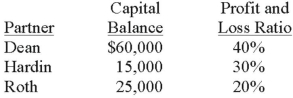 An appraisal of the business and its property estimates the fair value to be $100,000. Dean has agreed to receive $64,000 in exchange for his partnership interest.
What are the remaining partners' capital balances after Dean's interest is dissolved, assuming the bonus method is applied?
An appraisal of the business and its property estimates the fair value to be $100,000. Dean has agreed to receive $64,000 in exchange for his partnership interest.
What are the remaining partners' capital balances after Dean's interest is dissolved, assuming the bonus method is applied? (Essay)
4.8/5 (93)
(93) 
Filters
- Essay(0)
- Multiple Choice(0)
- Short Answer(0)
- True False(0)
- Matching(0)