



 Chat with AI
Exam 15: Partnerships: Termination and Liquidation

Exam 1: The Equity Method of Accounting for Investments119 Questions
Exam 2: Consolidation of Financial Information107 Questions
Exam 3: Consolidations - Subsequent to the Date of Acquisition122 Questions
Exam 4: Consolidated Financial Statements and Outside Ownership116 Questions
Exam 5: Consolidated Financial Statements Intra-Entity Asset Transactions127 Questions
Exam 6: Variable Interest Entities, Intra-Entity Debt, Consolidated Cash Flows, and Other Issues115 Questions
Exam 7: Consolidated Financial Statements - Ownership Patterns and Income Taxes115 Questions
Exam 8: Segment and Interim Reporting116 Questions
Exam 9: Foreign Currency Transactions and Hedging Foreign Exchange Risk93 Questions
Exam 10: Translation of Foreign Currency Financial Statements97 Questions
Exam 11: Worldwide Accounting Diversity and International Accounting Standards60 Questions
Exam 12: Financial Reporting and the Securities and Exchange Commission77 Questions
Exam 13: Accounting for Legal Reorganizations and Liquidations83 Questions
Exam 14: Partnerships: Formation and Operation88 Questions
Exam 15: Partnerships: Termination and Liquidation73 Questions
Exam 16: Accounting for State and Local Governments78 Questions
Exam 17: Accounting for State and Local Governments49 Questions
Exam 18: Accounting and Reporting for Private Not-For-Profit Organizations62 Questions
Exam 19: Accounting for Estates and Trusts80 Questions
Select questions type


The following account balances were available for the Perry, Quincy, and Renquist partnership just before it entered liquidation:  Included in Perry's capital balance is a $20,000 partnership loan owed to Perry. Perry, Quincy, and Renquist shared profits and losses in a ratio of 2:4:4. Liquidation expenses were expected to be $15,000.
All partners were solvent.
What amount would noncash assets need to be sold for in order for any partner to receive some cash?
Included in Perry's capital balance is a $20,000 partnership loan owed to Perry. Perry, Quincy, and Renquist shared profits and losses in a ratio of 2:4:4. Liquidation expenses were expected to be $15,000.
All partners were solvent.
What amount would noncash assets need to be sold for in order for any partner to receive some cash? (Multiple Choice)
4.8/5  (85)
(85) The Keaton, Lewis, and Meador partnership had the following balance sheet just before entering liquidation:  Keaton, Lewis, and Meador share profits and losses in a ratio of 2:4:4. The partnership feels confident it will be able to eventually sell the noncash assets and wants to distribute some cash before paying liabilities. How much would each partner receive of a total $60,000 distribution of cash?
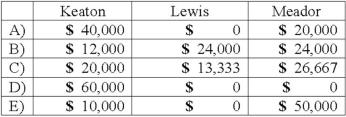
Keaton, Lewis, and Meador share profits and losses in a ratio of 2:4:4. The partnership feels confident it will be able to eventually sell the noncash assets and wants to distribute some cash before paying liabilities. How much would each partner receive of a total $60,000 distribution of cash? (Multiple Choice)
4.9/5 (80)
(80) A local partnership was considering the possibility of liquidation since one of the partners (Ding) was personally insolvent. Capital balances at that time were as follows. Profits and losses were divided on a 4:2:2:2 basis, respectively. 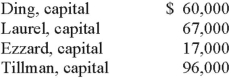 Creditors of partner Ding filed a $25,000 claim against the partnership's assets. At that time, the partnership held noncash assets reported at $360,000 and liabilities of $120,000. There was no cash on hand at the time.
If the assets could be sold for $228,000, what is the minimum amount that Laurel's creditors would have received?
Creditors of partner Ding filed a $25,000 claim against the partnership's assets. At that time, the partnership held noncash assets reported at $360,000 and liabilities of $120,000. There was no cash on hand at the time.
If the assets could be sold for $228,000, what is the minimum amount that Laurel's creditors would have received? (Multiple Choice)
4.8/5 (69)
(69) The Keaton, Lewis, and Meador partnership had the following balance sheet just before entering liquidation:  Keaton, Lewis, and Meador share profits and losses in a ratio of 2:4:4. Noncash assets were sold for $180,000. Liquidation expenses were $10,000.
Assume that Lewis was personally insolvent and could not contribute any assets to the partnership, while Keaton and Meador were both solvent. What amount of cash would Keaton have received from the distribution of partnership assets?
Keaton, Lewis, and Meador share profits and losses in a ratio of 2:4:4. Noncash assets were sold for $180,000. Liquidation expenses were $10,000.
Assume that Lewis was personally insolvent and could not contribute any assets to the partnership, while Keaton and Meador were both solvent. What amount of cash would Keaton have received from the distribution of partnership assets? (Multiple Choice)
4.8/5 (79)
(79) A local partnership was in the process of liquidating and reported the following capital balances:  Douglass indicated that the $14,000 deficit would be covered by a forthcoming contribution. However, the two remaining partners asked to receive the $31,000 that was then in the cash account.
How much of this money should Zobart receive?
Douglass indicated that the $14,000 deficit would be covered by a forthcoming contribution. However, the two remaining partners asked to receive the $31,000 that was then in the cash account.
How much of this money should Zobart receive? (Multiple Choice)
4.9/5 (78)
(78) The partners of Donald, Chief & Berry LLP decided to liquidate on August 1, 2013. The balance sheet of the partnership is as follows, with the profit and loss ratio of 25%, 45%, and 30%, respectively. 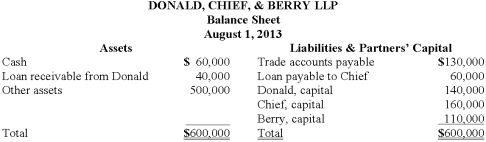 The disposal of Other Assets with a carrying amount of $200,000 realized $140,000, and all available cash was distributed.
Prepare the schedule to compute the cash payments to the partners.
The disposal of Other Assets with a carrying amount of $200,000 realized $140,000, and all available cash was distributed.
Prepare the schedule to compute the cash payments to the partners. (Essay)
4.8/5 (80)
(80) The Henry, Isaac, and Jacobs partnership was about to enter liquidation with the following account balances:  Estimated expenses of liquidation were $5,000. Henry, Isaac, and Jacobs shared profits and losses in a ratio of 2:4:4.
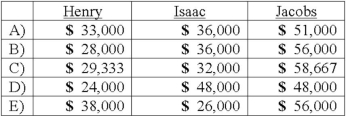
Before liquidating any assets, the partners determined the amount of cash for safe payments and distributed it. The noncash assets were then sold for $120,000. The liquidation expenses of $5,000 were paid. How would the $120,000 be distributed to the partners? (Hint: Either a predistribution plan or a schedule of safe payments would be appropriate for solving this item.)
Estimated expenses of liquidation were $5,000. Henry, Isaac, and Jacobs shared profits and losses in a ratio of 2:4:4.
Before liquidating any assets, the partners determined the amount of cash for safe payments and distributed it. The noncash assets were then sold for $120,000. The liquidation expenses of $5,000 were paid. How would the $120,000 be distributed to the partners? (Hint: Either a predistribution plan or a schedule of safe payments would be appropriate for solving this item.) (Multiple Choice)
4.8/5 (66)
(66) A local partnership has assets of cash of $5,000 and a building recorded at $80,000. All liabilities have been paid. The partners' capital accounts are as follows Harry $40,000, Landers $30,000 and Waters 15,000. The partners share profits and losses 4:4:2.
If the building is sold for $50,000, how much cash will Harry receive in the final settlement?
(Multiple Choice)
4.8/5 (81)
(81) The Albert, Boynton, and Creamer partnership was in the process of liquidating its assets and going out of business. Albert, Boynton, and Creamer had capital account balances of $80,000, $120,000, and $200,000, respectively, and shared profits and losses in the ratio of 1:3:2. Equipment that had cost $90,000 and had a book value of $60,000 was sold for $24,000 cash.
Required:
Prepare the appropriate journal entry to record the sale of the equipment, distributing any gain or loss directly to the partners.
(Essay)
5.0/5 (76)
(76) Harding, Jones, and Sandy is in the process of liquidating and the partners have the following capital balances; $24,000, $24,000, and ($9,000) respectively. The partners share all profits and losses 16%, 48%, and 36%, respectively. Sandy has indicated that the ($9,000) deficit will be covered with a forthcoming contribution. The remaining partners have requested to immediately receive $20,000 in cash that is available. How should this cash be distributed?
(Multiple Choice)
4.9/5 (85)
(85) The Abrams, Bartle, and Creighton partnership began the process of liquidation with the following balance sheet:  Abrams, Bartle, and Creighton share profits and losses in a ratio of 3:2:5. Liquidation expenses are expected to be $12,000.
The noncash assets were sold for $134,000. Which partner(s) would have had to contribute assets to the partnership to cover a deficit in his or her capital account?
Abrams, Bartle, and Creighton share profits and losses in a ratio of 3:2:5. Liquidation expenses are expected to be $12,000.
The noncash assets were sold for $134,000. Which partner(s) would have had to contribute assets to the partnership to cover a deficit in his or her capital account? (Multiple Choice)
4.8/5 (82)
(82) Hardin, Sutton, and Williams have operated a local business as a partnership for several years. All profits and losses have been allocated in a 3:2:1 ratio, respectively. Recently, Williams has undergone personal financial problems, and is insolvent. To satisfy Williams' creditors, the partnership has decided to liquidate.
The following balance sheet has been produced:  During the liquidation process, the following transactions take place:
- Noncash assets are sold for $116,000.
- Liquidation expenses of $12,000 are paid. No further expenses are expected.
- Safe capital distributions are made to the partners.
- Payment is made of all business liabilities.
- Any deficit capital balances are deemed to be uncollectible.
Prepare journal entries to record the actual liquidation transactions.
During the liquidation process, the following transactions take place:
- Noncash assets are sold for $116,000.
- Liquidation expenses of $12,000 are paid. No further expenses are expected.
- Safe capital distributions are made to the partners.
- Payment is made of all business liabilities.
- Any deficit capital balances are deemed to be uncollectible.
Prepare journal entries to record the actual liquidation transactions. (Essay)
4.8/5 (83)
(83) A local partnership has assets of cash of $5,000 and a building recorded at $80,000. All liabilities have been paid. The partners' capital accounts are as follows Harry $40,000, Landers $30,000 and Waters 15,000. The partners share profits and losses 4:4:2.
If the building is sold for $50,000, how much cash will Waters receive in the final settlement?
(Multiple Choice)
4.9/5 (98)
(98) 
Filters
- Essay(0)
- Multiple Choice(0)
- Short Answer(0)
- True False(0)
- Matching(0)