



 Chat with AI
Exam 8: Managing in Competitive, Monopolistic, and Monopolistically Competitive Markets

Exam 1: The Fundamentals of Managerial Economics143 Questions
Exam 2: Market Forces: Demand and Supply150 Questions
Exam 3: Quantitative Demand Analysis170 Questions
Exam 4: The Theory of Individual Behavior179 Questions
Exam 5: The Production Process and Costs173 Questions
Exam 6: The Organization of the Firm157 Questions
Exam 7: The Nature of Industry123 Questions
Exam 8: Managing in Competitive, Monopolistic, and Monopolistically Competitive Markets130 Questions
Exam 9: Basic Oligopoly Models134 Questions
Exam 10: Game Theory: Inside Oligopoly140 Questions
Exam 11: Pricing Strategies for Firms With Market Power140 Questions
Exam 12: The Economics of Information128 Questions
Exam 13: Advanced Topics in Business Strategy89 Questions
Exam 14: A Managers Guide to Government in the Marketplace112 Questions
Select questions type


Which of the following formulas correctly measures the profit of a monopoly?
(Multiple Choice)
4.8/5  (81)
(81) If a monopolistically competitive firm's marginal cost increases, then in order to maximize profits, the firm will:
(Multiple Choice)
4.8/5 (74)
(74) Suppose you are the manager of Alpha Enterprises, a firm that holds a patent that makes it the exclusive manufacturer of bubble memory chips. Based on the estimates provided by a consultant, you know that the relevant demand and cost functions for bubble memory chips are Q = 25 - 0.5P; C = 50 + 2Q.
a. What is the firm's inverse demand function?
b. What is the firm's marginal revenue when producing four units of output?
c. What are the levels of output and price when you are maximizing profits?
d. What will be the level of your profits?
(Essay)
4.9/5 (88)
(88) Which of the following market structures would you expect to yield the greatest product variety?
(Multiple Choice)
4.7/5 (69)
(69) Which of the following is NOT a basic feature of a monopolistically competitive industry?
(Multiple Choice)
5.0/5 (86)
(86) Which of the following industries is best characterized as monopolistically competitive?
(Multiple Choice)
4.8/5 (81)
(81) Suppose that initially the price is $20 in a perfectly competitive market. Firms are making zero economic profits. Then the market demand shrinks permanently, some firms leave the industry, and the industry returns to a long-run equilibrium. What will be the new equilibrium price, assuming cost conditions in the industry remain constant?
(Multiple Choice)
4.8/5 (75)
(75) You are the general manager of TU Modems Inc., and your accounting department has provided you with the following information about the total cost of producing three potential quantities of a commercial-grade modem: 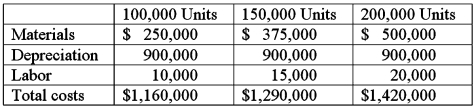 The market is saturated with modems, and your sales department has been able to identify only one potential buyer of your modems. This customer has numerous options and as a result is only willing to pay $300 per modem for an order of 100,000 modems. You must decide whether to sign a contract under these terms or simply shut down your operations. What is your optimal decision?
 (Essay)
4.8/5 (65)
(65) Regardless of the economic environment, every firm will maximize profits by operating at the minimum point of its average total cost curves. Is this statement true or false? Explain.
(True/False)
4.8/5 (79)
(79) John provides cheese (H) and milk (M) to the market with the following total cost function C(H, M) = 8 + 0.5H2 + 0.1M2. The prices of cheese and milk in the market are $3 and $4 respectively. Assume that the cheese and milk markets are perfectly competitive. What output of milk maximizes profits?
(Multiple Choice)
4.9/5 (73)
(73) You are a manager in a perfectly competitive market. The price is $14. Your total cost curve is C(Q) = 10 + 4Q + 0.5Q2. What level of output should you produce in the short run?
(Multiple Choice)
4.9/5 (78)
(78) In a monopoly where the marginal revenue and price are, respectively, given by $0.50 and $2, the price elasticity of demand is:
(Multiple Choice)
4.8/5 (73)
(73) If a monopolist has an own price demand elasticity of -.8, is it maximizing profits? Explain.
(Essay)
4.9/5 (92)
(92) Which of the following statements is NOT correct about monopoly?
(Multiple Choice)
4.7/5 (87)
(87) Eric provides cheese (H) and milk (M) to the market with the following total cost function: C(H, M) = 10 + 0.4H2 + 0.2M2. The prices of cheese and milk in the market are $2 and $5 respectively. Assume that the cheese and milk markets are perfectly competitive. What output of milk maximizes profits?
(Multiple Choice)
4.8/5 (70)
(70) 
Filters
- Essay(0)
- Multiple Choice(0)
- Short Answer(0)
- True False(0)
- Matching(0)