



 Chat with AI
Exam 8: Managing in Competitive, Monopolistic, and Monopolistically Competitive Markets

Exam 1: The Fundamentals of Managerial Economics143 Questions
Exam 2: Market Forces: Demand and Supply150 Questions
Exam 3: Quantitative Demand Analysis170 Questions
Exam 4: The Theory of Individual Behavior179 Questions
Exam 5: The Production Process and Costs173 Questions
Exam 6: The Organization of the Firm157 Questions
Exam 7: The Nature of Industry123 Questions
Exam 8: Managing in Competitive, Monopolistic, and Monopolistically Competitive Markets130 Questions
Exam 9: Basic Oligopoly Models134 Questions
Exam 10: Game Theory: Inside Oligopoly140 Questions
Exam 11: Pricing Strategies for Firms With Market Power140 Questions
Exam 12: The Economics of Information128 Questions
Exam 13: Advanced Topics in Business Strategy89 Questions
Exam 14: A Managers Guide to Government in the Marketplace112 Questions
Select questions type


A monopoly has two production plants with cost functions C1 = 40 + 0.2Q12 and C2 = 50 + 0.1Q22. The demand it faces is Q = 480 - 5P. What is the profit-maximizing price?
(Multiple Choice)
4.7/5  (69)
(69) The number of efficient plants compatible with domestic consumption of the refrigerator industry in Sweden is 0.7. Which of the following implications is(are) correct?
(Multiple Choice)
4.8/5 (74)
(74) Which of the following is true under monopolistic competition in the short run?
(Multiple Choice)
4.8/5 (93)
(93) Which of the following features is common to both perfectly competitive markets and monopolistically competitive markets?
(Multiple Choice)
4.9/5 (83)
(83) Suppose you are a monopolist operating two plants at different locations. Both plants produce the same product; Q1 is the quantity produced at plant 1, and Q2 is the quantity produced at plant 2. You face the following inverse demand function: P = 500 - 2Q, where Q = Q1 + Q2. The cost functions for the two plants are 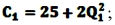
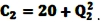 a. What are your marginal revenue and marginal cost functions?
b. To maximize profits, how much should you produce at plant 1? At plant 2?
c. What is the price that maximizes profits?
d. What are the maximum profits?
a. What are your marginal revenue and marginal cost functions?
b. To maximize profits, how much should you produce at plant 1? At plant 2?
c. What is the price that maximizes profits?
d. What are the maximum profits? (Essay)
4.9/5 (90)
(90) Let the demand function for a product be Q = 50 - 5P. The inverse demand function of this demand function is:
(Multiple Choice)
4.8/5 (91)
(91) You are the manager of a firm that produces output in two plants. The demand for your firm's product is P = 20 - Q, where Q = Q1 + Q2. The marginal costs associated with producing in the two plants are MC1 = 2 and MC2 = 2Q2. What is the profit-maximizing price that the firm should charge?
(Multiple Choice)
4.9/5 (81)
(81) You are the manager of a monopolistically competitive firm. The present demand curve you face is P = 100 - 4Q. Your cost function is C(Q) = 50 + 8.5Q2.
a. What level of output should you choose to maximize profits?
b. What price should you charge?
c. What will happen in your market in the long run? Explain.
(Essay)
5.0/5 (86)
(86) "Monopolistic competition is literally a kind of competition. Hence, there is no deadweight loss in a monopolistically competitive market."
(Multiple Choice)
4.8/5 (81)
(81) Would you expect an industry to be monopolistically competitive if consumers did not value variety in the market? Explain.
(Essay)
4.9/5 (82)
(82) One of the sources of monopoly power for a monopoly may be:
(Multiple Choice)
4.8/5 (72)
(72) You are a manager in a perfectly competitive market. The price in your market is $14. Your total cost curve is C(Q) = 10 + 4Q + 0.5Q2. What will happen in the long run if there is no change in the demand curve?
(Multiple Choice)
4.8/5 (69)
(69) A monopolist estimates that the own price elasticity of demand for its product is -4.5 and its advertising elasticity of demand is 1.5. Assuming these elasticities are constant, what fraction of the firm's revenues should the firm "reinvest" in advertising to maximize profits?
(Essay)
4.8/5 (65)
(65) In the long run, perfectly competitive firms produce a level of output such that:
(Multiple Choice)
4.9/5 (75)
(75) Consider firms operating in an industry where the own price elasticity of demand is infinite; that is,  Use this information to determine the type of industry in which these firms operate and the optimal advertising-to-sales ratio.
 (Multiple Choice)
4.8/5 (71)
(71) You are a manager in a perfectly competitive market. The price in your market is $14. Your total cost curve is C(Q) = 10 + 4Q + 0.5Q2. What price should you charge in the short run?
(Multiple Choice)
4.8/5 (79)
(79) In a competitive industry with identical firms, long-run equilibrium is characterized by:
(Multiple Choice)
4.9/5 (86)
(86) Which of the following statements concerning monopoly is NOT true?
(Multiple Choice)
4.8/5 (74)
(74) Which of the following conditions must hold to ensure that profits are, in fact, at a maximum?
(Multiple Choice)
4.9/5 (70)
(70) The XYZ Company produces output using labor (which it purchases on an as-needed basis in the market for unskilled workers at a wage of $5 per hour) and one machine (which it is obligated to lease at a rental rate of $300 per hour). The planning horizon precludes XYZ from renting or purchasing any additional machines, as the current machine has a capacity of 80 units of output per hour, which exceeds the projected demand for the firm's product. The firm has no alternative use for the machine it leases, and the contract precludes it from subleasing it to another party. The company currently employs one worker who produces 10 units of output per hour. A recent report from the engineering department reveals that, given the plant's current capacity, two workers could produce 20 units of output per hour, three workers could produce 30 units of output per hour, and four workers could produce a total of 40 units of output per hour.
a. Complete the following table: 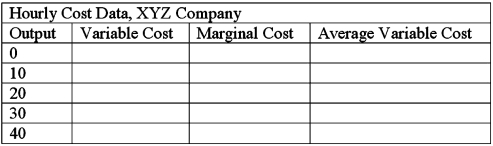 b. Suppose that XYZ can sell up to 40 units of output per hour at a price of $.60 per unit but cannot even get a penny for units produced in excess of 40 units per hour. How much output should XYZ produce each hour in order to maximize profits?
c. At what price would XYZ find it profitable to shut down its operation?
b. Suppose that XYZ can sell up to 40 units of output per hour at a price of $.60 per unit but cannot even get a penny for units produced in excess of 40 units per hour. How much output should XYZ produce each hour in order to maximize profits?
c. At what price would XYZ find it profitable to shut down its operation? (Essay)
4.9/5 (79)
(79) 
Filters
- Essay(0)
- Multiple Choice(0)
- Short Answer(0)
- True False(0)
- Matching(0)