



 Chat with AI
Exam 11: Corporations: Organization, Stock Transactions, and Dividends

Exam 1: Introduction to Accounting and Business188 Questions
Exam 2: Analyzing Transactions216 Questions
Exam 3: The Adjusting Process179 Questions
Exam 4: Completing the Accounting Cycle198 Questions
Exam 5: Accounting for Merchandising Businesses220 Questions
Exam 6: Inventories170 Questions
Exam 7: Sarbanes-Oxley, Internal Control, and Cash178 Questions
Exam 8: Receivables148 Questions
Exam 9: Fixed Assets and Intangible Assets177 Questions
Exam 10: Current Liabilities and Payroll174 Questions
Exam 11: Corporations: Organization, Stock Transactions, and Dividends172 Questions
Exam 12: Long-Term Liabilities: Bonds and Notes186 Questions
Exam 13: Investments and Fair Value Accounting133 Questions
Exam 14: Statement of Cash Flows161 Questions
Exam 15: Financial Statement Analysis184 Questions
Exam 16: Managerial Accounting Concepts and Principles175 Questions
Exam 17: Job Order Costing176 Questions
Exam 18: Process Cost Systems177 Questions
Exam 19: Cost Behavior and Cost-Volume-Profit Analysis215 Questions
Exam 20: Variable Costing for Management Analysis154 Questions
Exam 21: Budgeting185 Questions
Exam 22: Performance Evaluation Using Variances From Standard Costs160 Questions
Exam 23: Performance Evaluation for Decentralized Operations198 Questions
Exam 24: Differential Analysis and Product Pricing161 Questions
Exam 25: Capital Investment Analysis179 Questions
Exam 26: Cost Allocation and Activity-Based Costing111 Questions
Exam 27: Cost Management for Just-In-Time Environments122 Questions
Select questions type


On January 1, 20xx, Swenson Corporation had 40,000 shares of $10 par value common stock issued and outstanding. All 40,000 shares had been issued in a prior period at $20.00 per share. On February 1, 20xx, Swenson purchased 4,000 shares of treasury stock for $24 per share and later sold the treasury shares for $21 per share on March 1, 20xx. The journal entry to record the purchase of the treasury shares on February 1, 20xx, would include a
(Multiple Choice)
5.0/5  (73)
(73) Which of the following is not a prerequisite to paying a cash dividend?
(Multiple Choice)
5.0/5 (90)
(90) The cost of treasury stock is deducted from total paid-in capital and retained earnings in determining total stockholders' equity.
(True/False)
4.9/5 (85)
(85) The charter of a corporation provides for the issuance of 100,000 shares of common stock. Assume that 60,000 shares were originally issued and 10,000 were subsequently reacquired. What is the amount of cash dividends to be paid if a $2 per share dividend is declared?
(Multiple Choice)
4.9/5 (59)
(59) The price at which a stock can be sold depends upon a number of factors. Which statement below is not one of those factors?
(Multiple Choice)
4.9/5 (79)
(79) Which of the following is not characteristic of a corporation?
(Multiple Choice)
4.8/5 (89)
(89) Retained earnings represents past net incomes less past dividends, therefore any balance in this account would be listed on the income statement.
(True/False)
5.0/5 (76)
(76) 
For accounting purposes, stated value is treated the same way as par value.
(True/False)
4.8/5 (74)
(74) The number of shares of outstanding stock is equal to the number of shares authorized minus the number of shares issued.
(True/False)
4.7/5 (70)
(70) A corporation, which had 18,000 shares of common stock outstanding, declared a 3-for-1 stock split.

(Essay)
4.9/5 (76)
(76) Sabas Company has 40,000 shares of $100 par, 1% preferred stock and 100,000 shares of $50 par common stock. The following amounts were distributed as dividends:
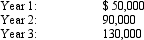 Determine the dividends per share for preferred and common stock for each year.
 (Essay)
4.8/5 (72)
(72) Treasury Stock is listed in the stockholders' equity section on the balance sheet.
(True/False)
4.9/5 (74)
(74) The cost method of accounting for the purchase and sale of treasury stock is a commonly used method.
(True/False)
4.9/5 (84)
(84) Preferred stockholders must receive their current year dividends before the common stockholders can receive any dividends.
(True/False)
4.7/5 (84)
(84) If paid-in-capital in excess of par/preferred stock is $30,000, preferred stock is $200,000, paid-in-capital in excess of par/common stock is $20,000, common stock is $525,000, and retained earnings is $105,000 (deficit), the total stockholders' equity is $880,000.
(True/False)
4.8/5 (80)
(80) The charter of a corporation provides for the issuance of 100,000 shares of common stock. Assume that 30,000 shares were originally issued and 5,000 were subsequently reacquired. What is the number of shares outstanding?
(Multiple Choice)
4.9/5 (83)
(83) 
Filters
- Essay(0)
- Multiple Choice(0)
- Short Answer(0)
- True False(0)
- Matching(0)