



 Chat with AI
Exam 12: Long-Term Liabilities: Bonds and Notes

Exam 1: Introduction to Accounting and Business188 Questions
Exam 2: Analyzing Transactions216 Questions
Exam 3: The Adjusting Process179 Questions
Exam 4: Completing the Accounting Cycle198 Questions
Exam 5: Accounting for Merchandising Businesses220 Questions
Exam 6: Inventories170 Questions
Exam 7: Sarbanes-Oxley, Internal Control, and Cash178 Questions
Exam 8: Receivables148 Questions
Exam 9: Fixed Assets and Intangible Assets177 Questions
Exam 10: Current Liabilities and Payroll174 Questions
Exam 11: Corporations: Organization, Stock Transactions, and Dividends172 Questions
Exam 12: Long-Term Liabilities: Bonds and Notes186 Questions
Exam 13: Investments and Fair Value Accounting133 Questions
Exam 14: Statement of Cash Flows161 Questions
Exam 15: Financial Statement Analysis184 Questions
Exam 16: Managerial Accounting Concepts and Principles175 Questions
Exam 17: Job Order Costing176 Questions
Exam 18: Process Cost Systems177 Questions
Exam 19: Cost Behavior and Cost-Volume-Profit Analysis215 Questions
Exam 20: Variable Costing for Management Analysis154 Questions
Exam 21: Budgeting185 Questions
Exam 22: Performance Evaluation Using Variances From Standard Costs160 Questions
Exam 23: Performance Evaluation for Decentralized Operations198 Questions
Exam 24: Differential Analysis and Product Pricing161 Questions
Exam 25: Capital Investment Analysis179 Questions
Exam 26: Cost Allocation and Activity-Based Costing111 Questions
Exam 27: Cost Management for Just-In-Time Environments122 Questions
Select questions type


At 12/31/2009, the cash and securities held in a sinking fund to redeem bonds in 2011 are classified on the balance sheet as current assets.
(True/False)
4.9/5  (93)
(93) (a) Prepare the journal entry to issue $100,000 bonds which sold for $94,000.
(b) Prepare the journal entry to issue $100.000 bonds which sold for $104,000
(Essay)
4.8/5 (80)
(80) If $500,000 of 10-year bonds, with interest payable semiannually, are sold for $494,040 based on (1) the present value of $500,000 due in 20 periods at 5% plus (2) the present value of twenty, $25,000 payments at 5%, the nominal or contract rate and the market rate of interest for the bonds are both 10%.
(True/False)
4.9/5 (70)
(70) Bonds may be purchased directly from the issuing corporation or through one of the bond exchanges.
(True/False)
4.8/5 (71)
(71) The effective-interest method of amortizing a bond discount or premium is the preferred method.
(True/False)
4.8/5 (83)
(83) Bondholders claims on the assets of the corporation rank ahead of stockholders.
(True/False)
4.7/5 (64)
(64) The market rate of interest is affected by a variety of factors, including investors' assessment of current economic conditions.
(True/False)
4.9/5 (86)
(86) A corporation issues for cash $9,000,000 of 8%, 25-year bonds, interest payable semiannually. The amount received for the bonds will be
(Multiple Choice)
4.8/5 (79)
(79) Amortization is the allocation process of writing off bond premiums and discounts to interest expense over the life of the bond issue.
(True/False)
5.0/5 (84)
(84) On January 1, 2014, Gemstone Company obtained a $165,000, 10-year, 7% installment note from Guarantee Bank. The note requires annual payments of $23,492, with the first payment occurring on the last day of the fiscal year. The first payment consists of interest of $11,550 and principal repayment of $11,942. The journal entry to record the issuance of the installment note for cash on January 1, 2014 would include:
(Multiple Choice)
4.8/5 (76)
(76) The cash and securities comprising a sinking fund established to redeem bonds at maturity in 2015 should be classified on the balance sheet as
(Multiple Choice)
4.8/5 (66)
(66) On the first day of the fiscal year, a company issues a $500,000, 8%, 10 year bond that pays semi-annual interest of $20,000 ($500,000 ´ 8% ´ 1/2), receiving cash of $437,740. Journalize the entry to record the issuance of the bonds.
(Essay)
4.8/5 (78)
(78) The price of a bond is equal to the sum of the interest payments and the face amount of the bonds.
(True/False)
4.9/5 (75)
(75) The Marx Company issued $100,000 of 12% bonds on April 1, 2010 at face value. The bonds pay interest semiannually on January 1 and July 1. The bonds are dated January 1, 2010, and mature on January 1, 2014. The total interest expense related to these bonds for the year ended December 31, 2010 is
(Multiple Choice)
4.9/5 (75)
(75) On January 1, 2011, Citrus Retail Co. issued a $500,000, 5 year, 8% installment note payable with payments of $100,000 principal plus interest due on January 1 of each year for the next 5 years.
1. Prepare the adjusting journal entry at December 31, 2011 to accrue interest for the year.
2. Show the account(s) and amount(s) and where it will appear on a multi-step income statement prepared on December 31, 2011.
3. Show the account(s) and amount(s) and where they will appear on a classified balance sheet prepared on December 31, 2011.
(Essay)
4.7/5 (76)
(76) Given the following data, prepare an amortization table (use the effective method)
1/1/10 - issue $800,000, 9%, 3 year bonds, interest paid annually on 12/31, to yield 8%
(Essay)
4.8/5 (82)
(82) The face value of a term bond is payable at a single specific date in the future.
(True/False)
4.9/5 (72)
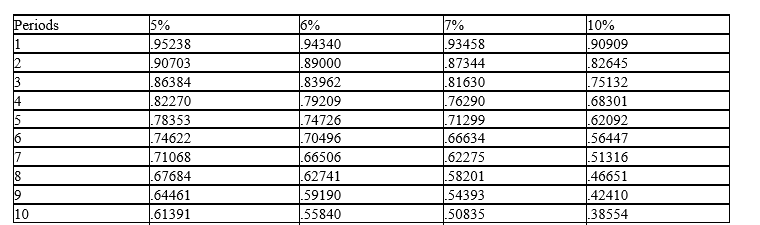
(72) Use the following tables to calculate the present value of a $25,000 7%, 5 year bond that pays $1,750 ($25,000 ´ 7%) interest annually, if the market rate of interest is 7%
Present Value of $1 at Compound Interest
 Present Value of Annuity of $1 at Compound Interest
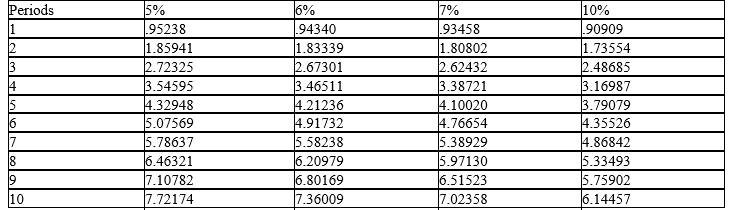
Present Value of Annuity of $1 at Compound Interest
(Essay)
4.9/5 (93)
(93) 
Filters
- Essay(0)
- Multiple Choice(0)
- Short Answer(0)
- True False(0)
- Matching(0)