



 Chat with AI
Exam 17: Job Order Costing

Exam 1: Introduction to Accounting and Business188 Questions
Exam 2: Analyzing Transactions216 Questions
Exam 3: The Adjusting Process179 Questions
Exam 4: Completing the Accounting Cycle198 Questions
Exam 5: Accounting for Merchandising Businesses220 Questions
Exam 6: Inventories170 Questions
Exam 7: Sarbanes-Oxley, Internal Control, and Cash178 Questions
Exam 8: Receivables148 Questions
Exam 9: Fixed Assets and Intangible Assets177 Questions
Exam 10: Current Liabilities and Payroll174 Questions
Exam 11: Corporations: Organization, Stock Transactions, and Dividends172 Questions
Exam 12: Long-Term Liabilities: Bonds and Notes186 Questions
Exam 13: Investments and Fair Value Accounting133 Questions
Exam 14: Statement of Cash Flows161 Questions
Exam 15: Financial Statement Analysis184 Questions
Exam 16: Managerial Accounting Concepts and Principles175 Questions
Exam 17: Job Order Costing176 Questions
Exam 18: Process Cost Systems177 Questions
Exam 19: Cost Behavior and Cost-Volume-Profit Analysis215 Questions
Exam 20: Variable Costing for Management Analysis154 Questions
Exam 21: Budgeting185 Questions
Exam 22: Performance Evaluation Using Variances From Standard Costs160 Questions
Exam 23: Performance Evaluation for Decentralized Operations198 Questions
Exam 24: Differential Analysis and Product Pricing161 Questions
Exam 25: Capital Investment Analysis179 Questions
Exam 26: Cost Allocation and Activity-Based Costing111 Questions
Exam 27: Cost Management for Just-In-Time Environments122 Questions
Select questions type


At the end of the fiscal year, the balance in Factory Overhead is small. This balance would normally be:
(Multiple Choice)
4.8/5  (75)
(75) When the goods are sold, their costs are transferred from Work in Process to Finished Goods.
(True/False)
4.9/5 (75)
(75) If the underapplied factory overhead amount is immaterial, it is transferred to Cost of Goods Sold at the end of the fiscal year.
(True/False)
4.8/5 (85)
(85) A manufacturing company applies factory overhead based on direct labor hours. At the beginning of the year, it estimated that factory overhead costs would be $360,000 and direct labor hours would be 30,000. Actual manufacturing overhead costs incurred were $377,200, and actual direct labor hours were 36,000. What is the predetermined overhead rate per direct labor hour?
(Multiple Choice)
4.9/5 (78)
(78) Factory overhead is applied to production using a predetermined overhead rate.
(True/False)
4.8/5 (76)
(76) The basis for recording direct and indirect labor costs incurred is a summary of the period's:
(Multiple Choice)
4.7/5 (67)
(67) A manufacturing company applies factory overhead based on direct labor hours. At the beginning of the year, it estimated that factory overhead costs would be $360,000 and direct labor hours would be 30,000. Actual factory overhead costs incurred were $377,200, and actual direct labor hours were 36,000. What is the amount of overapplied or underapplied manufacturing overhead at the end of the year?
(Multiple Choice)
4.7/5 (81)
(81) Perpetual inventory controlling accounts and subsidiary ledgers are maintained for materials, work in process, and finished goods in cost accounting systems.
(True/False)
4.9/5 (85)
(85) The document that serves as the basis for recording direct labor on a job cost sheet is the time card.
(True/False)
5.0/5 (87)
(87) During the month of April, Cavy Company incurred factory overhead as follows:
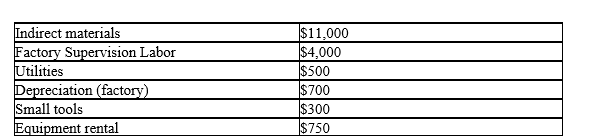 Journalize the entry to record the factory overhead incurred during April.
 (Essay)
4.9/5 (80)
(80) All of the following are examples of activity bases except:
(Multiple Choice)
4.9/5 (84)
(84) During the period, labor costs incurred on account amounted to $275,000 including $200,000 for production orders and $75,000 for general factory use. In addition, factory overhead applied to production was $32,000. From the following, select the entry to record the actual factory overhead costs incurred.
(Multiple Choice)
4.8/5 (89)
(89) Cavy Company estimates that total factory overhead costs will be $660,000 for the year. Direct labor hours are estimated to be 100,000. Determine (a) the predetermined factory overhead rate, (b) the amount of factory overhead applied to Job 345 if the amount of direct labor hours is 560 and Job 777 if the amount of direct labor hours is 800, and (c) prepare the journal entry to apply factory overhead in April according to the predetermined overhead rate.
(Essay)
4.7/5 (82)
(82) The Stamping Department accepted Job 051507A on May 15th to make 1,000 funnels.
To complete the job they requisitioned 1,100 sheets at $1.20 per sheet and 1,150 grommets at $0.15 per set.
The cost driver that the Stamping Department uses is drop-forge strokes which are counted on a machine mounted counter. $2.25 is applied as overhead for each drop-forge stroke. Additionally $375.00 of overhead is applied to each job due to setup and teardown.
Direct labor is applied at $22.50 per hour for the machine operator and $11.10 for the machine loader. The job required 6 1/2 hours of labor by the team.
When the job was complete Job 051507A was transferred to Semi-finished Goods Inventory (SFGI). When the job was transferred, 20 sheets were returned unused to raw material inventory, 75 grommet sets were returned, and there were 1,115 strokes on the counter.
Journalize all events depicted as of May 15th.
(Essay)
4.7/5 (85)
(85) Bar code scanners are now being used to track incoming materials and to electronically transmit this data. Scanners have replaced which of the following:
(Multiple Choice)
4.9/5 (88)
(88) Depreciation expense on factory equipment is part of factory overhead cost.
(True/False)
4.9/5 (79)
(79) Job cost sheets can provide information to managers on unit cost trends, the cost impact of continuous improvement in the manufacturing process, the cost impact of materials changes, and the cost impact of direct materials price or direct labor rate changes over time.
(True/False)
4.8/5 (82)
(82) The following account appears in the ledger after only part of the postings have been completed for July, the first month of the current fiscal year:
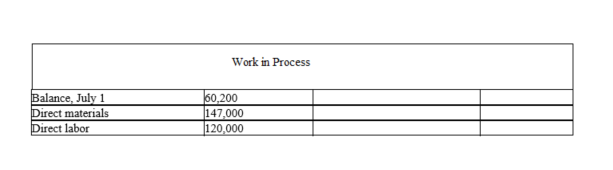 Factory overhead is applied to jobs at the rate of 60% of direct labor cost. The actual factory overhead incurred for July was $75,000. Jobs completed during the month totaled $301,200.

Factory overhead is applied to jobs at the rate of 60% of direct labor cost. The actual factory overhead incurred for July was $75,000. Jobs completed during the month totaled $301,200.
(Not Answered)
This question doesn't have any answer yet
Period costs are costs that are incurred for the production requirements of a certain period.
(True/False)
4.9/5 (80)
(80) 
Filters
- Essay(0)
- Multiple Choice(0)
- Short Answer(0)
- True False(0)
- Matching(0)