



 Chat with AI
Exam 24: Differential Analysis and Product Pricing

Exam 1: Introduction to Accounting and Business188 Questions
Exam 2: Analyzing Transactions216 Questions
Exam 3: The Adjusting Process179 Questions
Exam 4: Completing the Accounting Cycle198 Questions
Exam 5: Accounting for Merchandising Businesses220 Questions
Exam 6: Inventories170 Questions
Exam 7: Sarbanes-Oxley, Internal Control, and Cash178 Questions
Exam 8: Receivables148 Questions
Exam 9: Fixed Assets and Intangible Assets177 Questions
Exam 10: Current Liabilities and Payroll174 Questions
Exam 11: Corporations: Organization, Stock Transactions, and Dividends172 Questions
Exam 12: Long-Term Liabilities: Bonds and Notes186 Questions
Exam 13: Investments and Fair Value Accounting133 Questions
Exam 14: Statement of Cash Flows161 Questions
Exam 15: Financial Statement Analysis184 Questions
Exam 16: Managerial Accounting Concepts and Principles175 Questions
Exam 17: Job Order Costing176 Questions
Exam 18: Process Cost Systems177 Questions
Exam 19: Cost Behavior and Cost-Volume-Profit Analysis215 Questions
Exam 20: Variable Costing for Management Analysis154 Questions
Exam 21: Budgeting185 Questions
Exam 22: Performance Evaluation Using Variances From Standard Costs160 Questions
Exam 23: Performance Evaluation for Decentralized Operations198 Questions
Exam 24: Differential Analysis and Product Pricing161 Questions
Exam 25: Capital Investment Analysis179 Questions
Exam 26: Cost Allocation and Activity-Based Costing111 Questions
Exam 27: Cost Management for Just-In-Time Environments122 Questions
Select questions type


Crane Company Division B recorded sales of $360,000, variable cost of goods sold of $315,000, variable selling expenses of $13,000, and fixed costs of $61,000, creating a loss from operations of $29,000. Determine the differential income or loss from the sales of Division
B. Should this division be discontinued?
(Essay)
4.8/5  (99)
(99) Partridge Co. can further process Product J to produce Product D. Product J is currently selling for $21 per pound and costs $15.75 per pound to produce. Product D would sell for $38 per pound and would require an additional cost of $9.25 per pound to produce.
What is the differential cost of producing Product D?
(Multiple Choice)
5.0/5 (70)
(70) Falcon Co. produces a single product. Its normal selling price is $30.00 per unit. The variable costs are $19.00 per unit. Fixed costs are $25,000 for a normal production run of 5,000 units per month. Falcon received a request for a special order that would not interfere with normal sales. The order was for 1,500 units and a special price of $20.00 per unit. Falcon Co. has the capacity to handle the special order and, for this order, a variable selling cost of $1.00 per unit would be eliminated. If the order is accepted, what would be the impact on net income?
(Multiple Choice)
4.8/5 (84)
(84) In addition to the differential costs in an equipment replacement decision, the remaining useful life of the old equipment and the estimated life of the new equipment are important considerations.
(True/False)
4.9/5 (77)
(77) When using the product cost concept of applying the cost-plus approach to product pricing, what is included in the markup?
(Multiple Choice)
4.8/5 (86)
(86) Widgeon Co. manufactures three products: Bales; Tales; and Wales. The selling prices are: $55; $78; and $32, respectively. The variable costs for each product are: $20; $50; and $15, respectively. Each product must go through the same processing in a machine that is limited to 2,000 hours per month. Bales take 5 hours to process, Tales take 7 hours, and Wales take 1 hour. What is the contribution per machine hour for Wales?
(Multiple Choice)
4.8/5 (83)
(83) The Owl Company produces and sells Product X at a total cost of $35 per unit, of which $28 is product cost and $7 is selling and administrative expenses. In addition, the total cost of $35 is made up of $24 variable cost and $11 fixed cost. The desired profit is $6 per unit. Determine the mark up percentage on product cost.
(Essay)
4.7/5 (84)
(84) Mighty Safe Fire Alarm is currently buying 50,000 motherboard from MotherBoard, Inc. at a price of $65 per board. Mighty Safe is considering making its own boards. The costs to make the board are as follows: Direct Materials $32 per unit, Direct labor $10 per unit, Variable Factory Overhead $16.00, Fixed Costs for the plant would increase by $75,000. Which option should be selected and why?
(Multiple Choice)
5.0/5 (74)
(74) Flyer Company sells a product in a competitive marketplace. Market analysis indicates that their product would probably sell at $48 per unit. Flyer management desires a 12.5% profit margin on sales. Their current full cost per unit for the product is $44 per unit. What is the desired profit per unit?
(Multiple Choice)
4.9/5 (83)
(83) If the company can not cut costs any lower than they already are what would the profit margin on sales be if they meet the market selling price?
(Multiple Choice)
4.9/5 (85)
(85) Magpie Corporation uses the total cost concept of product pricing. Below is cost information for the production and sale of 60,000 units of its sole product. Magpie desires a profit equal to a 25% rate of return on invested assets of $700,000. 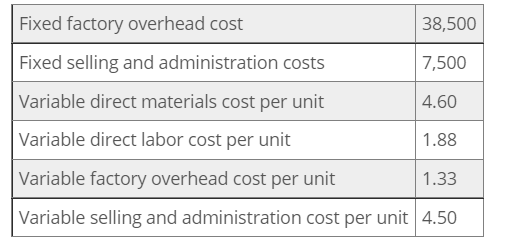 The cost per unit for the production and sale of the company's product is:
 (Multiple Choice)
4.8/5 (76)
(76) Olsen Company produces two products. Product A has a contribution margin of $30 and requires 10 machine hours. Product B has a contribution margin of $24 and requires 4 machine hours. Determine the most profitable product assuming the machine hours are the constraint.
(Essay)
4.8/5 (78)
(78) The theory of constraints is a manufacturing strategy that focuses on reducing the influence of bottlenecks on a process.
(True/False)
4.9/5 (87)
(87) Widgeon Co. manufactures three products: Bales; Tales; and Wales. The selling prices are: $55; $78; and $32, respectively. The variable costs for each product are: $20; $50; and $15, respectively. Each product must go through the same processing in a machine that is limited to 2,000 hours per month. Bales take 5 hours to process, Tales take 7 hours, and Wales take 1 hour. What is the contribution margin per machine hour for Tales?
(Multiple Choice)
4.8/5 (64)
(64) Assume that Penguin Co. is considering disposing of equipment that cost $50,000 and has $40,000 of accumulated depreciation to date. Penguin Co. can sell the equipment through a broker for $25,000 less 5% commission. Alternatively, Teal Co. has offered to lease the equipment for five years for a total of $48,750. Penguin will incur repair, insurance, and property tax expenses estimated at $10,000. At lease-end, the equipment is expected to have no residual value. The net differential income from the lease alternative is:
(Multiple Choice)
4.9/5 (69)
(69) Which of the following is NOT a cost concept commonly used in applying the cost-plus approach to product pricing?
(Multiple Choice)
4.8/5 (72)
(72) A business received an offer from an exporter for 10,000 units of product at $17.50 per unit. The acceptance of the offer will not affect normal production or domestic sales prices. The following data is available:  What is the differential revenue from the acceptance of the offer?
 (Multiple Choice)
5.0/5 (86)
(86) A business received an offer from an exporter for 30,000 units of product at $16 per unit. The acceptance of the offer will not affect normal production or domestic sales prices. The following data are available:  What is the differential cost from the acceptance of the offer?
 (Multiple Choice)
4.8/5 (75)
(75) Falcon Co. produces a single product. Its normal selling price is $30.00 per unit. The variable costs are $19.00 per unit. Fixed costs are $25,000 for a normal production run of 5,000 units per month. Falcon received a request for a special order that would not interfere with normal sales. The order was for 1,500 units and a special price of $20.00 per unit. Falcon Co. has the capacity to handle the special order and, for this order, a variable selling cost of $1.00 per unit would be eliminated. Should the special order be accepted?
(Multiple Choice)
4.8/5 (72)
(72) All of the following should be considered in a make or buy decision except
(Multiple Choice)
4.9/5 (82)
(82) 
Filters
- Essay(0)
- Multiple Choice(0)
- Short Answer(0)
- True False(0)
- Matching(0)