



 Chat with AI
Exam 11: Air Masses and Fronts

Exam 1: Earth and Its Atmosphere95 Questions
Exam 2: Energy: Warming Earth and the Atmosphere110 Questions
Exam 3: Seasonal and Daily Temperatures116 Questions
Exam 4: Atmospheric Humidity78 Questions
Exam 5: Condensation: Dew, Fog, and Clouds119 Questions
Exam 6: Stability and Cloud Development82 Questions
Exam 7: Precipitation78 Questions
Exam 8: Air Pressure and Winds121 Questions
Exam 9: Wind: Small-Scale and Local Systems104 Questions
Exam 10: Wind: Global Systems75 Questions
Exam 11: Air Masses and Fronts99 Questions
Exam 12: Middle-Latitude Cyclones63 Questions
Exam 13: Weather Forecasting131 Questions
Exam 14: Thunderstorms79 Questions
Exam 15: Tornadoes48 Questions
Exam 16: Hurricanes76 Questions
Exam 17: Earths Changing Climate69 Questions
Exam 18: Global Climate77 Questions
Exam 19: Air Pollution84 Questions
Select questions type


The greatest contrast in both temperature and moisture occurs along the boundary between which of the following air masses?
(Multiple Choice)
4.9/5  (88)
(88) Referring to a weather map, which of the following statements defines "frontogenesis"?
(Multiple Choice)
4.9/5 (79)
(79) Which of the following statements best compares an mT air mass with an mP air mass?
(Multiple Choice)
4.8/5 (75)
(75) Which of the following expressions is the designation for a cool, moist air mass?
(Multiple Choice)
4.9/5 (84)
(84)
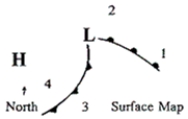
Refer to the above surface weather map.
-At which of the following positions is heavy snow most likely falling?
Refer to the above surface weather map.
-At which of the following positions is heavy snow most likely falling? (Multiple Choice)
4.8/5 (76)
(76) Which of the following areas provides a good regional source for an air mass?
(Multiple Choice)
4.8/5 (74)
(74) Describe some of the changes in weather conditions (winds, temperature, clouds, precipitation, pressure changes) you can observe as a cold front approaches and passes through your location.
(Essay)
4.8/5 (70)
(70) Draw side views of a typical warm and cold front. Clearly indicate the temperatures of the separate air masses and show their directions of motion. What types of clouds would likely occur and where? Where would precipitation occur?
(Essay)
4.7/5 (85)
(85) Clear, sunny days with very cold nights are associated with which of the following types of air masses?
(Multiple Choice)
4.9/5 (92)
(92) Which of the following statements accurately compares an average cold front to an average warm front?
(Multiple Choice)
4.9/5 (77)
(77) Which of the following statements describes weather fronts in the southern hemisphere?
(Multiple Choice)
4.7/5 (77)
(77) Which of the following situations provides an example of a "back door" cold front?
(Multiple Choice)
4.8/5 (92)
(92) Which of the following terms refers to a cold front that moves into the Maritimes from the east or northeast?
(Multiple Choice)
4.7/5 (90)
(90)  -Which of the following options gives the names of the types of air masses that the upper air flow brings into southern Ontario?
 (Multiple Choice)
4.7/5 (89)
(89) Which of the following statements explains why a cP air mass becomes warmer at the surface after it moves from the east into British Columbia?
(Multiple Choice)
4.8/5 (101)
(101) Which of the following types of air masses is mainly responsible for snow showers on the western slopes of the Rockies?
(Multiple Choice)
4.8/5 (66)
(66)

Refer to the above surface weather map.
-Which of the following would you expect to see as a cold front approaches?
Refer to the above surface weather map.
-Which of the following would you expect to see as a cold front approaches? (Multiple Choice)
4.9/5 (74)
(74)  Refer to the above surface weather map.
-Between which of the following points is a cold front positioned?
Refer to the above surface weather map.
-Between which of the following points is a cold front positioned? (Multiple Choice)
4.9/5 (72)
(72)  -Which of the following options gives the names of the types of air masses that the upper air flow brings into Atlantic Canada?
 (Multiple Choice)
4.7/5 (80)
(80) On a weather map, which of the following types of weather fronts are drawn to indicate where cold air is replacing cool air?
(Multiple Choice)
4.9/5 (59)
(59) 
Filters
- Essay(0)
- Multiple Choice(0)
- Short Answer(0)
- True False(0)
- Matching(0)