



 Chat with AI
Exam 4: Atmospheric Humidity


Describe the differences in the molecular structure of the water molecules in the gas, liquid, and ice phases of water.

 (74)
 Answered by Examlex AI Copilot
In the gas phase, water molecules are spread out and have high kinetic energy, allowing them to move freely and independently of each other. In this phase, the water molecules are not strongly attracted to each other, resulting in a low density of water vapor.
In the liquid phase, water molecules are closely packed together but still have enough kinetic energy to move around and slide past each other. The molecules are attracted to each other through hydrogen bonding, which gives liquid water its unique properties such as high surface tension and cohesion.
In the ice phase, water molecules form a rigid, hexagonal lattice structure due to the strong hydrogen bonding between the molecules. The molecules are held in fixed positions and have very little kinetic energy, resulting in a solid and stable arrangement with a lower density than liquid water.
Overall, the differences in molecular structure of water molecules in the gas, liquid, and ice phases are primarily due to variations in the strength of hydrogen bonding and the amount of kinetic energy present.
Which of the following terms refers to the density of water vapour in a given parcel of air?
(79)  Verified
C
When the air is saturated, which of the following conditions occurs?
(98) VerifiedA
 -Which of the following describes what a high water vapour pressure indicates?
 (78) Explain why the temperature overnight seldom drops below the afternoon dew point.
(70) Which of the following is the name for the maximum pressure that water vapour molecules exert when the air is saturated?
(70)
For the following questions refer to the temperature and dew point data in the following cities:  -How much water would cover the globe if all the water vapour in the atmosphere condensed and fell to the ground?
 (80) Which of the following factors will decrease in a rising parcel of air?
(89) Explain why the dew point temperature provides a better indication of the air's actual water vapour content rather than its relative humidity.
(83) In which of the following conditions does wet laundry hanging outdoors on a clothesline dry most quickly? 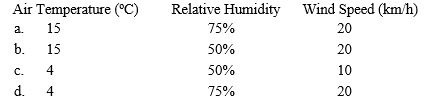
(65) Which of the following is the main reason why vegetables take longer to cook in boiling water at high altitudes?
(66)
-To which of the following percentages is relative humidity often nearest in the polar regions?
-To which of the following percentages is relative humidity often nearest in the polar regions? (81) Describe how a sling psychrometer is used to determine the relative humidity or dew point.
(84)
For the following questions refer to the temperature and dew point data in the following cities:  -Which city has the greatest amount of water vapour in the air?
 (84)
For the following questions refer to the temperature and dew point data in the following cities:  -Which of the following terms refers to the ratio of the mass of water vapour in a given volume (parcel) of air to the mass of the remaining dry air?
 (78)
For the following questions refer to the temperature and dew point data in the following cities: 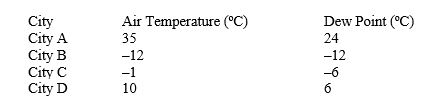 -In which of the following summer climates are evaporative coolers primarily used?
 (78)
For the following questions refer to the temperature and dew point data in the following cities: 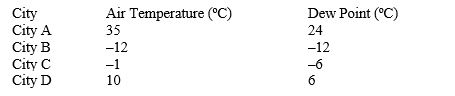 -Which city has the highest saturation vapour pressure?
 (68)
For the following questions refer to the temperature and dew point data in the following cities:
-Which of the following will happen to the relative humidity as the air temperature increases, and with no addition of water vapour to the air?
-Which of the following will happen to the relative humidity as the air temperature increases, and with no addition of water vapour to the air? (67)
For the following questions refer to the temperature and dew point data in the following cities:  -Suppose it is snowing outside and the air is saturated. The air temperature and dew point are both -9ºC, and the actual vapour pressure is 3 hPa. If this air is brought indoors and warmed to 24ºC, what would be the relative humidity of this air, assuming that its moisture content does not change? (The saturation vapour pressure at 24ºC is 30 hPa.)
 (83) 
Filters
- Essay(0)
- Multiple Choice(0)
- Short Answer(0)
- True False(0)
- Matching(0)