



 Chat with AI
Exam 15: Tornadoes


What local signs predict the approach of a low-pressure centre or a weather front?

 (71)
 Answered by Examlex AI Copilot
The approach of a low-pressure center or a weather front is often indicated by a series of local signs that can be observed in the environment. These signs are a result of the changes in atmospheric conditions that fronts and low-pressure systems bring. Here are some of the local signs that can predict their approach:
1. **Cloud Patterns**: As a low-pressure system or front approaches, clouds often increase in coverage and altitude. You may first notice high, wispy cirrus clouds that thicken and lower into cirrostratus and then altostratus clouds. Eventually, nimbostratus clouds may form, bringing steady precipitation.
2. **Wind Changes**: Winds typically shift direction as a front approaches. For example, winds may shift from a southerly to an easterly direction as a warm front approaches, and from southerly to westerly or northwesterly with the passage of a cold front. Wind speed may also increase ahead of the front.
3. **Temperature Changes**: A drop in temperature can indicate the approach of a cold front, while a rise in temperature may signal an approaching warm front. The temperature changes can be sudden or gradual, depending on the nature of the front.
4. **Barometric Pressure**: A falling barometer is a classic sign of an approaching low-pressure system or front. Low pressure is associated with unsettled weather conditions, including storms and precipitation.
5. **Humidity Changes**: An increase in humidity or a feeling of "mugginess" in the air can precede the arrival of a weather front, particularly a warm front.
6. **Precipitation**: The onset of precipitation, often starting as light drizzle and intensifying, can indicate the imminent arrival of a weather front. The type of precipitation can vary, including rain, sleet, or snow, depending on the temperature and the nature of the front.
7. **Animal Behavior**: Some animals are sensitive to changes in atmospheric pressure and may behave unusually before a change in the weather. Birds, for instance, may fly lower to the ground, and pets may become restless.
8. **Sky Color**: A change in the color of the sky, especially a greenish tint in the sky, can sometimes indicate severe weather, such as thunderstorms, which are often associated with low-pressure systems.
9. **Visibility**: Changes in visibility can occur with the approach of a front. For example, haze or fog may develop with a warm front, while visibility may improve rapidly after the passage of a cold front.
10. **Rainbows or Halos**: The presence of a halo around the sun or moon, or the sighting of a rainbow in the western sky, can indicate that precipitation is not far behind, as these phenomena are caused by the refraction and reflection of light by ice crystals or water droplets in the advancing clouds.
It's important to note that these signs can vary depending on the specific characteristics of the weather system and the geographic location. Meteorologists use a combination of ground observations, satellite imagery, and radar data to more accurately predict the movement and impact of low-pressure centers and weather fronts.
Which of the following terms refers to a weather forecast that predicts that future weather will be the same as the present weather?
(74)  Verified
D
In which of the following conditions can a persistence forecast be quite accurate?
(91) VerifiedD
Which of the following forecasting methods assumes that weather systems will continue to move in the same direction and at the same speed as they have been moving?
(74) At which location represented by the four positions on the map would you expect to hear the following 12-hour forecast: "Cloudy with possible showers today, turning colder by tonight"?
(92) 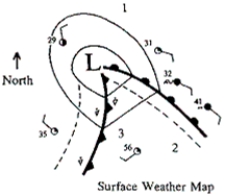
-At which location represented by the four positions on the map would you expect to hear the following 12-hour forecast: "Cloudy and cold this morning with snow this afternoon and tonight"?
-At which location represented by the four positions on the map would you expect to hear the following 12-hour forecast: "Cloudy and cold this morning with snow this afternoon and tonight"? (73) Explain how observed teleconnection patterns can help in the preparation of a seasonal weather forecast.
List some of the factors that affect the accuracy of atmospheric models.
Which of the following terms refers to a wind that changes direction in a counterclockwise sense with increasing height?
(73) Which of the following statements explains the meaning of a probability forecast that calls for a "40 percent chance of rain"?
(95) Explain the process of ensemble forecasting and how it is useful to meteorologists.
(81) 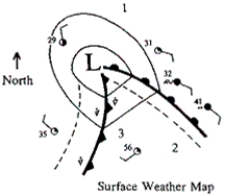 -Which of the following descriptions is associated with an omega high?
 (72) In terms of weather forecasting methods, which of the following defines an analysis?
(84) Which of the following describes where the greatest improvement in forecasting skill has occurred during the past 30 years?
(77) Discuss the strengths and weaknesses of four different types of weather forecasting methods.
(81) 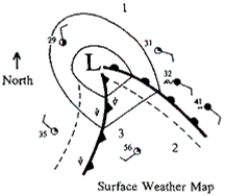 -Which of the following terms refers to the lines that connect points of equal pressure change?
 (73) Assuming you know last night's minimum temperature, what weather information can be used to predict tonight's minimum temperature?
(90) 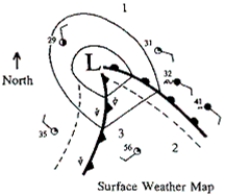 -At which location represented by the four positions on the map would you expect to hear the following 12-hour forecast: "Partly cloudy and continued warm through this afternoon and evening"?
 (73) 
Filters
- Essay(0)
- Multiple Choice(0)
- Short Answer(0)
- True False(0)
- Matching(0)