



 Chat with AI
Exam 4: Atmospheric Humidity

Exam 1: Earth and Its Atmosphere95 Questions
Exam 2: Energy: Warming Earth and the Atmosphere110 Questions
Exam 3: Seasonal and Daily Temperatures116 Questions
Exam 4: Atmospheric Humidity78 Questions
Exam 5: Condensation: Dew, Fog, and Clouds119 Questions
Exam 6: Stability and Cloud Development82 Questions
Exam 7: Precipitation78 Questions
Exam 8: Air Pressure and Winds121 Questions
Exam 9: Wind: Small-Scale and Local Systems104 Questions
Exam 10: Wind: Global Systems75 Questions
Exam 11: Air Masses and Fronts99 Questions
Exam 12: Middle-Latitude Cyclones63 Questions
Exam 13: Weather Forecasting131 Questions
Exam 14: Thunderstorms79 Questions
Exam 15: Tornadoes48 Questions
Exam 16: Hurricanes76 Questions
Exam 17: Earths Changing Climate69 Questions
Exam 18: Global Climate77 Questions
Exam 19: Air Pollution84 Questions
Select questions type


Which of the following factors mainly determines the temperature at which water boils?
(Multiple Choice)
4.8/5  (81)
(81) Which of the following statements explains why night-time temperatures rarely drop below the dew-point temperature?
(Multiple Choice)
4.8/5 (84)
(84) Explain why the statement "warm air can hold more water vapour molecules" is misleading and commonly misinterpreted. Suggest a better way to explain this concept.
(Essay)
4.8/5 (74)
(74) When air temperature increases, which of the following happens to the saturation vapour pressure?
(Multiple Choice)
4.8/5 (79)
(79)
For the following questions refer to the temperature and dew point data in the following cities:  -Which of the following statements about water vapour is correct?
 (Multiple Choice)
4.9/5 (68)
(68) Which of the following is the BEST indicator of the actual amount of water vapour in the air?
(Multiple Choice)
4.8/5 (70)
(70)
For the following questions refer to the temperature and dew point data in the following cities: 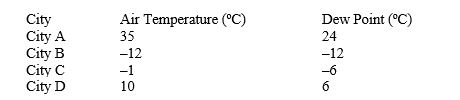 -Which of the following procedures will increase the relative humidity in a home during the winter?
 (Multiple Choice)
4.8/5 (82)
(82)
For the following questions refer to the temperature and dew point data in the following cities:  -Suppose saturated polar air has an air temperature and dew point of -10ºC, and unsaturated desert air has an air temperature of 35ºC and a dew point of 10ºC. Which of the following describes the water vapour and relative humidity of desert air compared to polar air?
 (Multiple Choice)
4.7/5 (82)
(82)
For the following questions refer to the temperature and dew point data in the following cities: 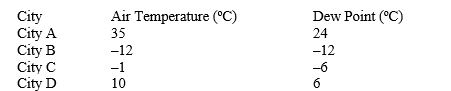 -In which part of Canada are average summer dew point temperatures highest?
 (Multiple Choice)
4.9/5 (82)
(82) As the air temperature increases, with no addition of water vapour to the air, which of the following will happen to the dew point?
(Multiple Choice)
5.0/5 (68)
(68) Explain why condensation is more likely to occur on a glass of water sitting on a table outdoors on a warm day as opposed to a cold day.
(Short Answer)
4.9/5 (80)
(80) When comparing the water budgets from each of the following locations, on average which would have the lowest amount of runoff?
(Multiple Choice)
4.9/5 (85)
(85) Even if the relative humidity of polar air is often close to 100 percent, explain why polar air is often described as dry.
(Short Answer)
4.9/5 (73)
(73) Which of the following terms refers to the percentage of water vapour present in the air compared to that required for saturation?
(Multiple Choice)
4.9/5 (79)
(79) When calculating a water budget for a Canadian location, in which of the following seasons does the actual evapotranspiration typically NOT keep pace with the potential evapotranspiration?
(Multiple Choice)
4.8/5 (78)
(78) At 4ºC, the atmosphere is saturated with water vapour. If the air temperature increases to 15ºC, with no addition or removal of water vapour, what is the dew point?
(Multiple Choice)
4.8/5 (63)
(63) Which of the following amounts is the water vapour pressure that occurs when water vapour comprises 3.5 percent of an air parcel whose total pressure is 100 kPa?
(Multiple Choice)
4.9/5 (75)
(75)
For the following questions refer to the temperature and dew point data in the following cities: 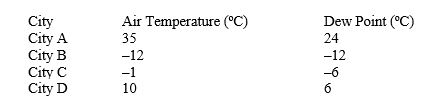 -If very cold air is brought indoors and warmed with no change in its moisture content, which of the following will happen to the saturation vapour pressure of this air?
 (Multiple Choice)
4.8/5 (77)
(77) 
Filters
- Essay(0)
- Multiple Choice(0)
- Short Answer(0)
- True False(0)
- Matching(0)