



 Chat with AI
Exam 19: Air Pollution

Exam 1: Earth and Its Atmosphere95 Questions
Exam 2: Energy: Warming Earth and the Atmosphere110 Questions
Exam 3: Seasonal and Daily Temperatures116 Questions
Exam 4: Atmospheric Humidity78 Questions
Exam 5: Condensation: Dew, Fog, and Clouds119 Questions
Exam 6: Stability and Cloud Development82 Questions
Exam 7: Precipitation78 Questions
Exam 8: Air Pressure and Winds121 Questions
Exam 9: Wind: Small-Scale and Local Systems104 Questions
Exam 10: Wind: Global Systems75 Questions
Exam 11: Air Masses and Fronts99 Questions
Exam 12: Middle-Latitude Cyclones63 Questions
Exam 13: Weather Forecasting131 Questions
Exam 14: Thunderstorms79 Questions
Exam 15: Tornadoes48 Questions
Exam 16: Hurricanes76 Questions
Exam 17: Earths Changing Climate69 Questions
Exam 18: Global Climate77 Questions
Exam 19: Air Pollution84 Questions
Select questions type


Which of the following is the name for beams of light that shine downward through breaks or holes in clouds?
(Multiple Choice)
4.9/5  (79)
(79) The figure below represents the scattering of sunlight by an air molecule. The group of rays labelled B is scattered light. Which of the following groups of rays is the most intense beam of light? 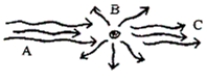
(Multiple Choice)
4.7/5 (71)
(71) Do you expect to see a halo during clear or cloudy conditions? What does a halo tell you about upper atmospheric conditions?
(Short Answer)
4.9/5 (81)
(81) Which of the following phenomena can be seen only when the sun is behind you and it is raining in front of you?
(Multiple Choice)
4.9/5 (75)
(75) Which of the following terms refers to the bending of light that occurs when it enters and passes through a substance of different density?
(Multiple Choice)
4.9/5 (73)
(73) What produces a sundog? Where and at what time of day might you try to see a sundog?
(Short Answer)
4.7/5 (86)
(86) Which of the following cloud types is most associated with halos and sundogs?
(Multiple Choice)
4.8/5 (87)
(87) Suppose you take a colour photograph of clouds at night, with your camera adjusted so that the shutter stays open long enough for the same amount of light to enter the camera as during a daytime photograph. Which of the following describes the appearance of the clouds on the resulting photograph?
(Multiple Choice)
4.7/5 (90)
(90) Suppose the temperature is constant in the lowest 1000 metres of the atmosphere. How good would the conditions be for viewing a mirage?
(Multiple Choice)
4.8/5 (86)
(86) Which of the following processes is exemplified by the green flash?
(Multiple Choice)
4.8/5 (84)
(84) Which of the following terms refers to the nerve endings in the human eye that are responsible for the perception of colour?
(Multiple Choice)
4.8/5 (68)
(68) Which of the following explains the blue colour of the sky?
(Multiple Choice)
4.8/5 (84)
(84) Which of the following phenomena can sometimes be seen near the upper rim of a setting or rising sun?
(Multiple Choice)
4.8/5 (80)
(80) Which of the diagrams below correctly depicts the bending of light in an inferior mirage? 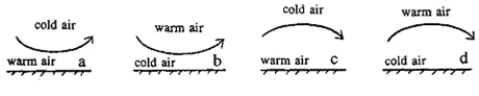
(Multiple Choice)
4.8/5 (79)
(79) In which of the following directions could you see a sundog at sunrise?
(Multiple Choice)
4.9/5 (85)
(85) In which of the following conditions are sun pillars most commonly seen?
(Multiple Choice)
4.7/5 (85)
(85) How can you demonstrate the phenomenon of light scattering using a glass tank filled with water, a flashlight, and some milk?
(Short Answer)
4.9/5 (86)
(86) Why does adding particles to the atmosphere affect visibility?
(Not Answered)
This question doesn't have any answer yet
In which of the following directions does a rainbow appear at sunset in the middle latitudes?
(Multiple Choice)
4.9/5 (81)
(81) With which of the following is it very easy to produce an artificial rainbow?
(Multiple Choice)
4.7/5 (74)
(74) 
Filters
- Essay(0)
- Multiple Choice(0)
- Short Answer(0)
- True False(0)
- Matching(0)